Juan 8
The Orthodox Jewish Bible · Toca un versículo para ver sus referencias cruzadas.
The Woman Caught in Adultery
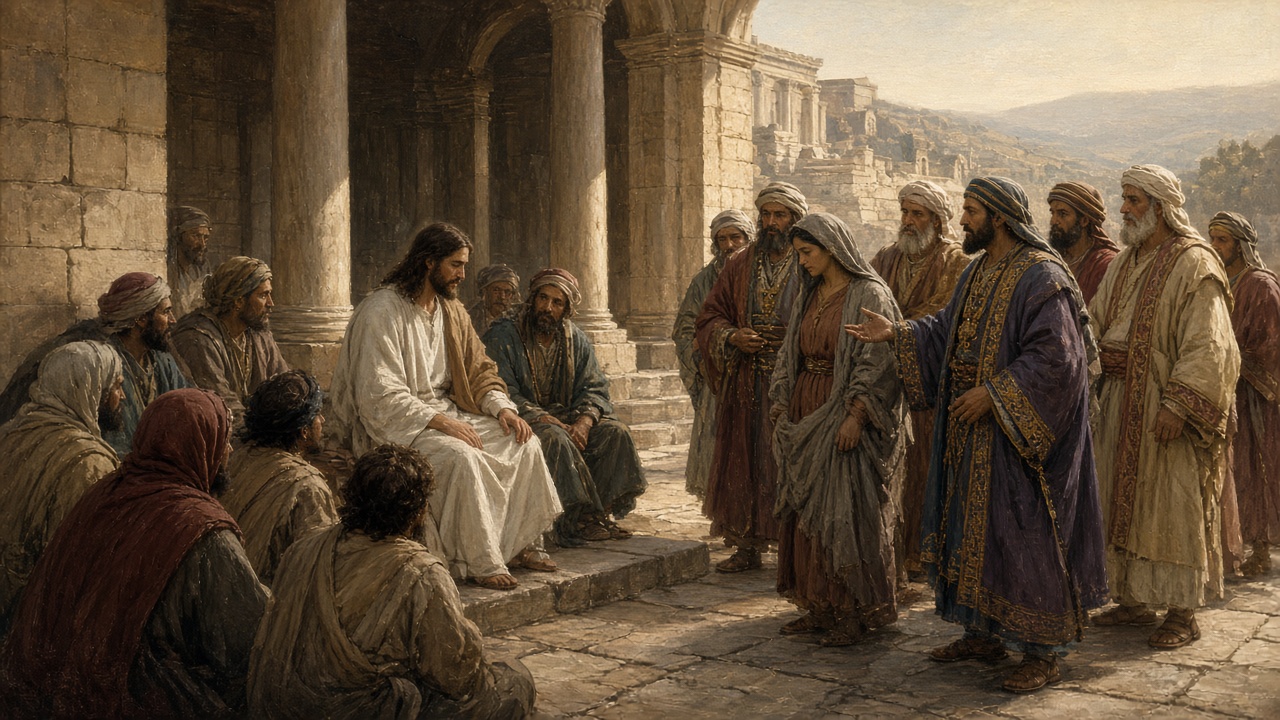
1But Rebbe, Melech HaMoshiach went to the Har HaZeytim (Mount of Olives). 2And at the beginning of Shacharis, Rebbe, Melech HaMoshiach came again into the Beis Hamikdash and kol haAm (all the people) were coming to Rebbe, Melech HaMoshiach, and having sat, for them he was saying a shiur. 3And the Sofrim and the Perushim led an isha (woman) having been caught in ni'uf (adultery) and, having stood her in the midst, 4They say to Rebbe, Melech HaMoshiach, Rabbi, this isha (woman) has been caught in the act of committing ni'uf (adultery). 5Now in our Torah Moshe Rabbeinu gave us a mitzvah to stone such nashim. You, therefore, what do you say? 6But this they were saying to put a nissayon before Rebbe, Melech HaMoshiach that they might have something about which to accuse him, but he, having stooped down with his finger, was writing on the ground. 7But as they were remaining, questioning him, he stood up and said to them, The one without chet (sin) among you, at her let him be first to throw a stone. 8And again, having stooped down, he was writing on the ground. 9And the ones having heard were departing, one by one, beginning with the zekenim, and he was left alone with the isha standing before him. 10And having stood up, he said to her, Isha, where are they? Does no one condemn you? 11And she said, No one, Adoni. And Rebbe, Melech HaMoshiach said, Neither do I condemn you. Go and practice chet no more.
Jesus the Light of the World
12Then again he spoke to them, saying, Ani Hu HaOhr HaOlam Hazeh. The one following me will never walk in choshech, but will have the Ohr HaChayyim. 13Therefore, the Perushim said to him, You give solemn edut (testimony) about yourself. But your edut is not ne'emanah. 14In reply, he said to them, Even if I give solemn edut about myself, my edut is ne'emanah, because I have da'as of where I came from and where I go, but you have no da'as of where I come from or where I go. 15You judge according to the basar; I do not judge anyone. 16But even if I judge, my psak din, my mishpat, is emes, because it is not I alone but the One having sent me, HaAv. 17And it has been written even in your Torah, that the edut (testimony) of two is ne'emanah. 18Ani Hu the one giving solemn edut (testimony) about myself and the One having sent me, HaAv, gives solemn edut about me. 19Therefore, they were saying to Rebbe, Melech HaMoshiach, Where is HaAv of you? In reply, he said, You have da'as of neither me nor HaAv of me. If you had had da'as of me, you would have had da'as of HaAv of me. 20These devarim, Rebbe, Melech HaMoshiach spoke in the Beis HaOtzar while saying shiurim in the Beis Hamikdash, and no one arrested him, because his sha'ah had not yet come.
21Rebbe, Melech HaMoshiach said, therefore, again to them, I go away (Rebbe's Histalkus) and you will seek me, and in your chet you will go to your mavet. Where I go you are not able to come. 22Therefore, those of Yehudah were saying, Does he mean he will commit suicide, because he says, Where I go you are not able to come? 23And Rebbe, Melech HaMoshiach was saying to them, You are from mattah (below); Ani Hu from ma'lah (above). You are of the Olam Hazeh; I am not of the Olam Hazeh. 24I said, therefore, to you that you will go to your mavet in your averos (sins), for if you do not have emunah (faith) that Ani Hu, you will die in your chatta'im. 25They were saying, therefore, to him, Who are you? Rebbe, Melech HaMoshiach said to them, What I have told you from the beginning. 26I have much to speak regarding you, much about you worthy of harsha'ah (condemnation), but the One having sent me is ne'eman and what I heard from Him these things I speak in the Olam Hazeh. 27They did not have da'as that Rebbe, Melech HaMoshiach was speaking to them about Elohim HaAv. 28Therefore, Rebbe, Melech HaMoshiach said to them, When you perform the hagbah (lifting up) of the Bar Enosh, you will have da'as that Ani Hu, and from myself I do nothing, but as HaAv of me taught me, these things I speak. 29And the One having sent me is with me. He did not leave me alone, because I always do the things that please Him.
The Truth Will Set You Free
30As Rebbe, Melech HaMoshiach was saying these things, many put their emunah in him.
31Therefore, Rebbe, Melech HaMoshiach was saying to the Yehudim who had emunah in him, If you remain in the dvar of me, then you are my talmidim indeed. 32And you will have da'as of HaEmes (the Truth) and HaEmes will give you cherut (freedom). 33They answered Rebbe, Melech HaMoshiach, We are of the zera Avraham and to no one have we ever been enslaved. How do you say, You will become Bnei Chorin (freedmen)?
34In reply, Rebbe, Melech HaMoshiach said to them, Omein, omein, I say to you that everyone practicing Chet is an eved HaChet. 35But the eved does not remain in the Bais ad Olam. HaBen remains ad Olam. 36If therefore HaBen makes you Bnei Chorin, you shall be Bnei Chorin indeed. 37I have da'as that you are zera Avraham, but you seek to kill me, because my dvar has no place in you. 38What I have seen in the presence of HaAv of me, of that, I make solemn declaration. Therefore, the things you have heard from your father you do.
39They answered and said unto him, Avinu hu Avraham. Rebbe, Melech HaMoshiach says to them, If you were yeladim of Avraham, you would have been doing the ma'asei Avraham. 40But now you are seeking to kill me, a man who has told you HaEmes, which I heard from Hashem; this was not a ma'aseh that Avraham did. 41You are doing the ma'asim of your Av. They said, therefore, to Rebbe, Melech HaMoshiach, We are not mamzerim who have been born of zenunim (fornication). We have Av Echad, Hashem. 42He said to them, If Hashem were the Av of you, you would have had ahavah for me, for I came forth from Hashem, and now I am present here, for I have not come on my own, but HaAv sent me. 43Why do you not understand my devarim? Because you are not able to give obedient shemah (hearing) to my dvar. 44You are from the Av of you, HaSatan, and the ta'avot of your Av you want to do, for that one was a rotze'ach from Bereshis, and he has not taken a stand in HaEmes, because HaEmes is not in him. When he speaks the sheker, he speaks naturally, because he is a shakran (liar) and the av of it. 45But because I speak HaEmes, you do not have bitachon (trust) in me. 46Who among you convicts me of chet (sin)? If I speak HaEmes, why do you not have emunah in me? 47The one who is of Hashem hears the divrei Hashem. Therefore, you do not hear because you are not of Hashem.
Before Abraham Was Born, I Am
48In reply, those of Yehudah said to Rebbe, Melech HaMoshiach, Did we not rightly say that you are a Shomroni (Samaritan) and that you have a shed (demon)? 49In reply, Rebbe, Melech HaMoshiach said, I do not have a shed (demon). But I honor HaAv of me and you dishonor me. 50But I do not seek my own kavod; there is One seeking and judging. 51Omein, omein, I say to you, regarding the dvar of me, if anyone is shomer, he will never see mavet. 52Therefore, those of Yehudah said to Rebbe, Melech HaMoshiach, Now we have da'as that you have a shed, Avraham died and the Nevi'im; yet you say if anyone keeps the dvar of me he will never taste mavet (death). 53Surely you are not greater than Avraham Avinu, who died? And the Nevi'im died. Whom do you make yourself to be? 54In reply, Rebbe, Melech HaMoshiach said, If I give myself kavod, the kavod of me is nothing. It is HaAv of me Who is giving me kavod, Whom you say, He is Eloheinu. 55And you have not had da'as of Him. But I have had da'as of Him. If I would say that I do not have da'as of Him, I will be like you, a shakran (liar); but I do have da'as of Him, and I keep His dvar. 56Avraham your Av had lev same'ach to see the Yom of me, and he saw it and had simcha. 57Therefore those of Yehudah said to him, You do not yet possess fifty years and yet you have seen Avraham Avinu? 58Rebbe, Melech HaMoshiach said to them, Omein, omein, I say to you, before Avraham came into being, Ani Hu. 59Then they took up stones that they might stone him, but Rebbe, Melech HaMoshiach was hidden and departed out of the Beis Hamikdash.
¿Sabías que…?
Luz, ley y Abraham
- Juan 8 comienza cuando Jesús va al monte de los Olivos y regresa temprano por la mañana a los atrios del templo, donde se sienta y enseña a la gente que se reúne. El monte de los Olivos es una sierra al este de Jerusalén, separada de la ciudad por el valle del Cedrón, y debe su nombre a los olivos que cubren sus laderas.Fuentes: el propio texto bíblico · Mount of Olives
- Los escribas y fariseos traen a una mujer sorprendida en adulterio y preguntan a Jesús qué dice sobre el mandato de Moisés, en la Ley, de apedrear a tal mujer, buscando ponerlo a prueba y tener base para acusarlo. Todavía en los atrios del templo, cerca del tesoro, Jesús dice más tarde: "Yo soy la luz del mundo". Una lista fechada de eventos sitúa ambos episodios en el año 29 d. C., y cada uno dura un día.Fuentes: el propio texto bíblico · Woman Caught in Adultery · Light of the World/I am discourse
- Cuando Jesús dice que la verdad los hará libres, sus oyentes responden que son descendientes de Abraham y que nunca han sido esclavos de nadie. A Abraham se le llama "padre de una multitud"; era hijo de Taré y heredero de las promesas. Después de que Jesús declara "antes de que Abraham naciera, yo soy", recogen piedras para arrojarlas contra él.Fuentes: el propio texto bíblico · Abraham
Notas escritas con ayuda de IA a partir de fuentes abiertas (Theographic Bible Metadata, CC BY-SA 4.0; Easton’s Bible Dictionary, dominio público) y revisadas antes de publicarse.
Lugares de este capítulo
- Mount of Olives · 31.778, 35.246 · versículo 1
Solo aparecen lugares identificados con alta confianza (90 % o más según las fuentes académicas reunidas por OpenBible). Mapa de la época: DARE (Digital Atlas of the Roman Empire), CC BY 4.0; mapa actual: © colaboradores de OpenStreetMap; lugares: OpenBible.info (CC BY 4.0).
Créditos y licencia de esta traducción
The Orthodox Jewish Bible
The Orthodox Jewish Bible - Tanakh and Orthodox Jewish Brit Chadasha - The Holy Bible
copyright © 2002-2011, 2021, 2024 Artists for Israel International
Language: English
Contributor: Artists for Israel International
THE ORTHODOX JEWISH TANAKH
Artists For Israel Intl Inc.
This version also appears with the Orthodox Yiddish Triglot which presents the Hebrew Yiddish script in Latin script and an English word for word translation, available at afii.org/Torah
To donate PayPal.Me
This translation is made available to you under the terms of the
Creative Commons Attribution license 4.0.
You may share and redistribute this Bible translation or extracts from it in any format, provided that:
You include the above copyright and source information.
If you make any changes to the text, you must indicate that you did so in a way that makes it clear that the original licensor is not necessarily endorsing your changes.
Pictures included with Scriptures and other documents on this site are licensed just for use with those Scriptures and documents.
For other uses, please contact the respective copyright owners.
Note that in addition to the rules above, revising and adapting God's Word involves a great responsibility to be true to God's Word. See Revelation 22:18-19.
2026-01-06
Títulos de sección adaptados de la Berean Standard Bible (dominio público); no forman parte del texto bíblico de esta traducción.
Fuente: http://ebible.org/engojb/ · eBible.org