Jeremías 8
The Orthodox Jewish Bible · Toca un versículo para ver sus referencias cruzadas.
Judah’s Sin and Punishment
1At that time, saith Hashem, they shall remove the atzmot of the melachim of Yehudah, and the atzmot of his sarim, and the atzmot of the kohanim, and the atzmot of the nevi'im, and the atzmot of the inhabitants of Yerushalayim, out of their keverim; 2And they shall spread them out before the shemesh, and the yarei'ach, and all the tz'va haShomayim, whom they have loved, and whom they have served, and after whom they have walked, and whom they have consulted, and whom they have worshiped; they shall not be gathered up, nor be buried in a kever; they shall be like domen upon the surface of ha'adamah. 3And mavet shall be chosen rather than chayyim by all the She'erit of them that remain of this mishpakhah hara'ah, which remain in all the places where I have banished them, saith Hashem Tzva'os.
4Moreover thou shalt say unto them, Thus saith Hashem:
Shall they fall, and not get up?
Shall one turn away, and not turn back?
5Why then does HaAm Hazeh turn away
in perpetual meshuvah (backsliding)?
They hold fast to deceit,
refusing to make teshuvah.
6I paid heed and heard,
but they spoke not aright;
no ish made teshuvah from his wickedness,
saying: What have I done?
Every one pursues his own course,
like the sus (horse) charging into milchamah.
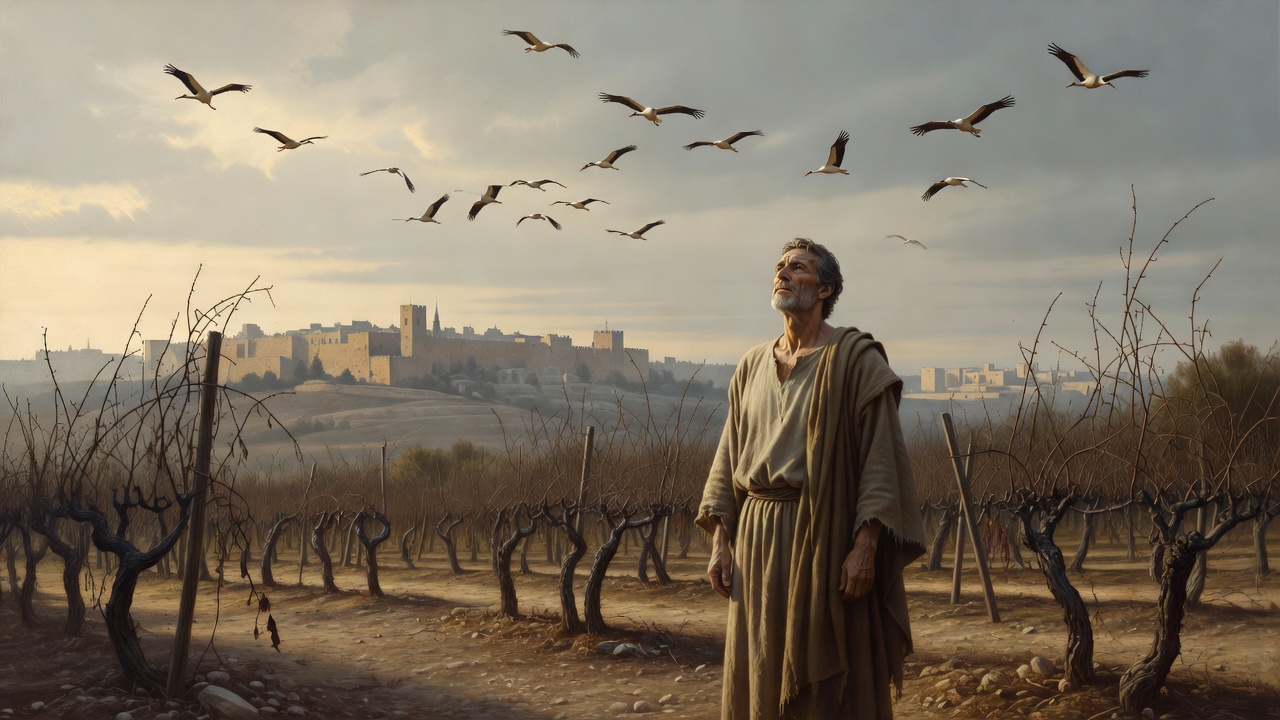
7Yea, the stork in the Shomayim knoweth her mo'adim (appointed times);
and the turtledove and the swift and the crane
are shomer over their time for migration;
but Ami (My People) have no da'as (knowledge)
of the Mishpat Hashem (rule, ordinance, regulation, law of Hashem ).
8How can ye say, We are chachamim (wise ones),
and the torat Hashem is with us,
when, hinei, the et sheker (deceiving pen) of the sofrim (scribes)
has made it into sheker (a falsehood).
9The chachamim (wise men) are ashamed,
they are dismayed and trapped;
they have rejected the Devar Hashem;
so what chochmah (wisdom) is in them?
10Therefore will I give their nashim unto others,
and their sadot to them that shall inherit them;
for every one from the katan even unto the gadol
is greedy for unjust gain,
from the navi even unto the kohen every one doeth sheker.
11For they give superficial treatment to the hurt of Bat Ami,
saying: Shalom, shalom; v'ein shalom.
12Were they ashamed
when they did to'evah (abomination)?
No, they were not at all ashamed,
neither could they know to blush;
therefore shall they fall among them that fall;
in the time of their pekuddah (visitation [for punishment], time of reckoning)
they shall be brought down,
saith Hashem.
13I would surely have harvested them,
saith Hashem,
but no grapes are on the gefen,
nor te'enim (figs) on the te'enah (fig tree),
even the leaf shall wither;
and the things that I have given them shall pass away from them.
The People Respond
14Why do we sit still?
Assemble yourselves, and let us enter into the fortified cities,
and let us perish there;
for Hashem Eloheinu hath made us to perish,
and given us mey rosh (poisonous water) to drink,
because we have sinned against Hashem.
15We looked for shalom, but no tov came;
and for et marpeh (a time of healing), and, hinei, terror!
16The snorting of his susim (horses) was heard from Dan;
kol ha'aretz trembled at the sound
of the neighing of his stallions;
for they are come, and have devoured eretz, and all that is in it;
the Ir (city), and those that dwell therein.
17For, hinei, I will send nachashim,
tzifonim (vipers), among you, which will not be charmed,
and they shall bite you,
saith Hashem.
Jeremiah Weeps for His People
18When I would comfort myself against sorrow,
my lev is faint within me.
19Hinei, the sound of the cry of the Bat Ami
from eretz markhakim (a land of places far away):
is Hashem not in Tziyon? Is her Melech not in her?
Why have they provoked Me to anger with their pesilim (idols),
and with alien vanities (futile foreign g-ds)?
20The katzir (harvest) is past, kayitz (summer) is ended,
and loh noshanu (we are not saved).
21For the hurt of the Bat Ami am I hurt;
I mourn; desolation hath taken hold on me.
22Is there no tzori (medicinal balsam or balm) in Gil'ad;
is there no rofeh (physician) there?
Why then is the health
of the Bat Ami not recovered?
23Oh that my rosh (head) were mayim,
and mine eyes a makor dimah (a fountain of tears),
that I might weep yomam valailah
for the slain of the Bat Ami!
¿Sabías que…?
Juicio, engaño y el bálsamo de Galaad
- Jeremías contrasta el instinto natural de las aves migratorias, como la cigüeña, la tórtola, el vencejo y el tordo, con la conducta del pueblo de Jerusalén. Mientras las aves reconocen por instinto sus épocas fijadas y sus tiempos de migración, el pueblo se niega con terquedad a volverse a Dios.Fuentes: el propio texto bíblico · Jerusalem
- La advertencia de que el resoplido de los caballos de guerra enemigos se escucha desde Dan señala una invasión que entra por el extremo norte. Dan se situaba en el límite septentrional del país, indicando que el destructor ejército invasor ya avanzaba sobre el territorio.Fuentes: el propio texto bíblico · Dan
- El clamor del profeta, '¿No hay bálsamo en Galaad?', evoca a Galaad, una región montañosa situada al este del río Jordán. Jeremías recurre a la figura de médicos y remedios de dicha región para lamentar el colapso moral y físico de su pueblo que sigue sin sanar.Fuentes: el propio texto bíblico · Gilead
Notas escritas con ayuda de IA a partir de fuentes abiertas (Theographic Bible Metadata, CC BY-SA 4.0; Easton’s Bible Dictionary, dominio público) y revisadas antes de publicarse.
Lugares de este capítulo
- Jerusalem · 31.777, 35.234 · versículos 1, 5
- Dan · Hoy: Tel Dan · 33.249, 35.652 · versículo 16
- Zion · Hoy: Jerusalem · 31.777, 35.234 · versículo 19
- Gilead · Hoy: Gilead 1 · 32.187, 35.692 · versículo 22
Solo aparecen lugares identificados con alta confianza (90 % o más según las fuentes académicas reunidas por OpenBible). Mapa de la época: DARE (Digital Atlas of the Roman Empire), CC BY 4.0; mapa actual: © colaboradores de OpenStreetMap; lugares: OpenBible.info (CC BY 4.0).
Créditos y licencia de esta traducción
The Orthodox Jewish Bible
The Orthodox Jewish Bible - Tanakh and Orthodox Jewish Brit Chadasha - The Holy Bible
copyright © 2002-2011, 2021, 2024 Artists for Israel International
Language: English
Contributor: Artists for Israel International
THE ORTHODOX JEWISH TANAKH
Artists For Israel Intl Inc.
This version also appears with the Orthodox Yiddish Triglot which presents the Hebrew Yiddish script in Latin script and an English word for word translation, available at afii.org/Torah
To donate PayPal.Me
This translation is made available to you under the terms of the
Creative Commons Attribution license 4.0.
You may share and redistribute this Bible translation or extracts from it in any format, provided that:
You include the above copyright and source information.
If you make any changes to the text, you must indicate that you did so in a way that makes it clear that the original licensor is not necessarily endorsing your changes.
Pictures included with Scriptures and other documents on this site are licensed just for use with those Scriptures and documents.
For other uses, please contact the respective copyright owners.
Note that in addition to the rules above, revising and adapting God's Word involves a great responsibility to be true to God's Word. See Revelation 22:18-19.
2026-01-06
Títulos de sección adaptados de la Berean Standard Bible (dominio público); no forman parte del texto bíblico de esta traducción.
Fuente: http://ebible.org/engojb/ · eBible.org