Jeremías 2
The Orthodox Jewish Bible · Toca un versículo para ver sus referencias cruzadas.
Israel Has Forsaken God
1Moreover the Devar Hashem came to me, saying,
2Go and cry, shouting in the ears of Yerushalayim, saying, Thus saith Hashem;
I remember thee, the chesed of thy ne'urim,
the ahavas of thy days as a kallah,
when thou wentest after Me in midbar,
in an eretz that was not sown.
3Yisroel was Kodesh unto Hashem,
and the reshit (firstfruit) of his tevu'ah (crop):
all that devour him are held guilty;
ra'ah shall overtake them,
saith Hashem.
4Hear ye the Devar Hashem, O Beis Ya'akov, and all the mishpekhot of Bais Yisroel: 5Thus saith Hashem:
What avel (wrong, fault) have avoteichem found in Me,
that they are strayed far from Me,
and have walked after hevel (vain, empty delusion), and are become deluded?
6Neither did they ask: Where is Hashem
that brought us up out of Eretz Mitzrayim,
that led us through the midbar,
through an eretz of deserts and pits,
through an eretz tziyyah (land of drought) and tzalmavet,
through eretz that no ish passed through,
where no adam dwelt?
7And I brought you into an eretz hacarmel,
to eat the pri thereof and the tovah thereof;
but when ye entered, ye made My land tameh,
and made My nachalah a to'evah.
8The Kohanim asked not: Where is Hashem?
And they that handle the Torah had no da'as of Me;
the ro'im also rebelled against Me,
and the nevi'im prophesied by Ba'al,
and walked after worthless things.
9Therefore I will yet bring lawsuit against you,
saith Hashem,
and against bnei beneichem will I bring lawsuit.
10For pass over to the isles of Kittim, and look;
and send unto Kedar, and consider diligently,
and see if there has ever been anything like this.
11Hath ever a nation changed elohim,
and these no elohim at all?
But My people have exchanged their kavod
for that which is worthless.
12Be appalled, O ye Shomayim, at this,
and be horribly afraid, be ye very desolate,
saith Hashem.
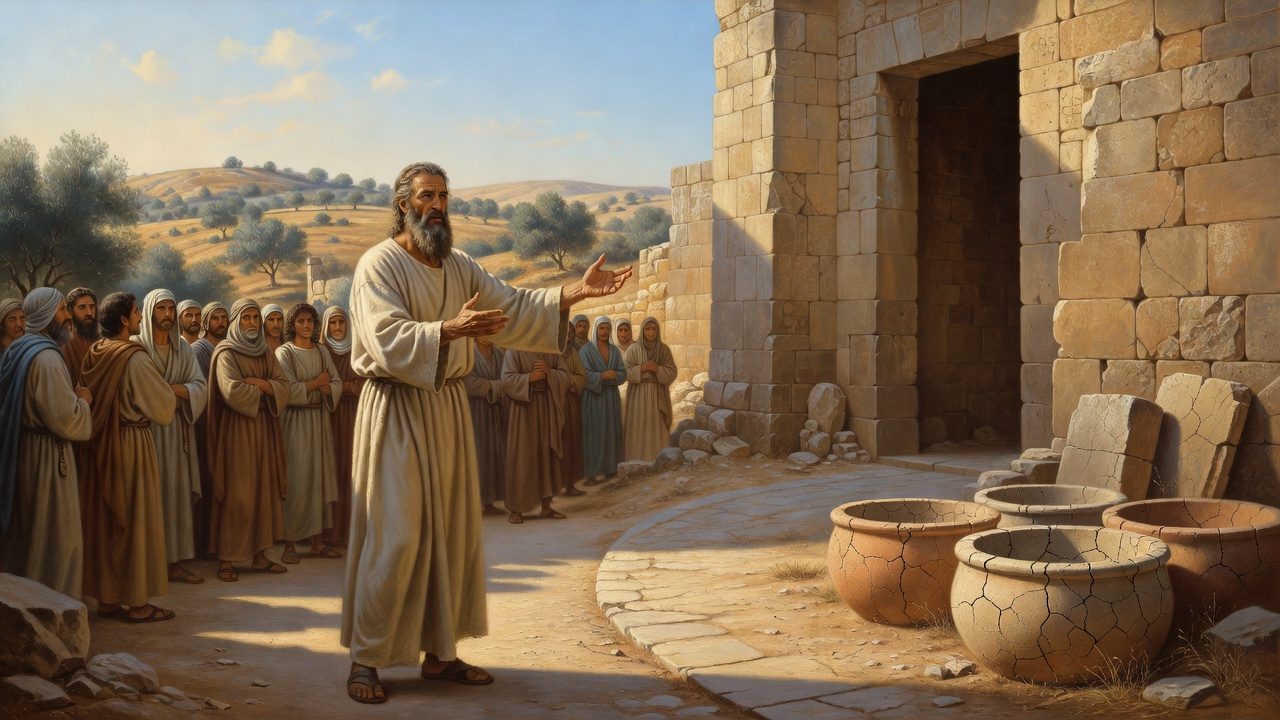
13For Ami have committed shtayim ra'ot (two evils):
they have forsaken Me, the fountain of Mayim Chayim,
and hewed them out cisterns, broken cisterns,
that can hold no mayim.
The Consequence of Israel’s Sin
14Is Yisroel an eved?
Is he a homeborn slave?
Why has he become plunder?
15The young lions roared upon him, and growled,
and they made his Eretz waste;
his towns are burned without inhabitant.
16Also the Bnei Noph and Tachpanches
have broken the crown of thy head.
17Hast thou not procured this unto thyself,
in that thou hast forsaken Hashem Eloheicha,
when He led thee by the derech?
18And now what hast thou to do in the derech Mitzrayim,
to drink the waters of the Shichor ([Nile] River)?
Or what hast thou to do in the derech Ashur (Assyria),
to drink the waters of the Euphrates [River]?
19Thine own ra'ah shall correct thee,
and thy meshuvot (backslidings) shall reprove thee:
know therefore and see that it is an evil thing and mar (bitter),
that thou hast forsaken Hashem Eloheicha,
and that My pachad is not in thee,
saith Adonoi Hashem Tzva'os.
20For long ago I have broken thy ol (yoke),
and tore off thy bonds;
and thou saidst: I will not serve;
when upon every high hill
and under every green tree
thou hast sprawled, playing the zonah.
21Yet I had planted thee a choice vine,
wholly a zera emes.
How then art thou turned into the degenerate plant
of a gefen nochriyah unto Me?
22For though thou wash thee with lye,
and take thee much soap,
yet thine avon (iniquity) is marked before Me,
saith Adonoi Hashem.
Israel’s Unfaithfulness
23How canst thou say: I am not tameh,
I have not gone after Ba'alim?
See thy derech in the valley,
know what thou hast done:
thou art a swift camel traversing her ways;
24A pereh used to the midbar,
that sniffs up the ruach in the craving of her nefesh;
in her occasion [of heat] who can turn her away?
All they that seek her will not weary themselves;
in her month they shall find her.
25Withhold thy regel from being unshod,
and thy throat from thirst;
but thou saidst, There is no hope:
no; for I have loved zarim,
and after them will I go.
26As the ganav is ashamed when he is caught,
so is the Bais Yisroel ashamed;
they, their melachim, their sarim,
and their kohanim, and their nevi'im.
27Saying to Etz (wood): Thou art Avi;
and to Even (stone): Thou hast brought me forth;
for they have turned their back unto Me,
and not their face;
but in the time of their trouble they will say:
Arise, and hoshi'einu (save us).
28But where are thy elohim
that thou hast made for thee?
Let them arise, if they can save thee
in the time of thy trouble;
for as many as are the mispar (number)
of thy towns are thy elohim, O Yehudah.
29Why will ye bring lawsuit against Me?
Ye all have rebelled against Me,
saith Hashem.
30In vain have I struck your banim;
they received no musar;
your own cherev hath devoured your nevi'im,
like a destroying lion.
31O HaDor (Generation), heed ye the Devar Hashem.
Have I been a midbar unto Yisroel?
An eretz of great darkness?
Madu'a (why) say Ami: We are free;
we will come no more unto Thee?
32Can a betulah forget her jewelry,
or a kallah her adornments?
Yet My people have forgotten Me
yamim ein mispar (days without number).
33How well thou direct thy derech to seek ahavah?
Therefore hast thou also taught hara'ot (the worst women)
the darkhei (ways) of thee.
34Also in thy skirts is found the dahm
of the nefashot of the innocent poor;
although you never caught them breaking in.
Yet concerning all these
35Thou sayest: Because I am innocent,
surely His anger shall turn from me.
Hineni, I will plead My case with thee,
because thou sayest: Loh chatati (I have not sinned).
36Why doest thou gad about so much
to change the course of thy derech?
Thou also shalt be ashamed of Mitzrayim,
as thou wast ashamed of Assyria.
37Yea, thou shalt go forth from this,
and thine hands upon thine head;
for Hashem hath rejected thy confidences,
and thou shalt not prosper in them.
¿Sabías que…?
La devoción olvidada de Israel
- En Jeremías 2:10, el profeta contrasta a Chipre (Quitim), en el mar Mediterráneo hacia el oeste, con Cedar, que representaba a las tribus árabes nómadas hacia el este en el desierto de Arabia. Al citar estos horizontes opuestos, el texto subraya que ni siquiera las naciones vecinas cambiaban a sus dioses tradicionales.Fuentes: el propio texto bíblico · Cyprus · Kedar
- Las referencias a Menfis (Nof) y al beber de las aguas del Nilo y del Éufrates destacan la inestable dependencia política de Judá respecto a Egipto y Asiria. Jeremías compara el confiar en estas potencias extranjeras con abandonar un manantial de agua viva para cavar cisternas agrietadas.Fuentes: el propio texto bíblico · Memphis · Egypt · Assyria
- La reprensión por seguir a los 'baales' utiliza el término en plural para los cultos locales de Baal, la principal deidad masculina de los fenicios. La adoración a Baal se había infiltrado repetidamente en Israel y Judá, practicándose con frecuencia en colinas altas y bajo árboles frondosos.Fuentes: el propio texto bíblico · Baal
Notas escritas con ayuda de IA a partir de fuentes abiertas (Theographic Bible Metadata, CC BY-SA 4.0; Easton’s Bible Dictionary, dominio público) y revisadas antes de publicarse.
Lugares de este capítulo
- Jerusalem · 31.777, 35.234 · versículo 2
- Egypt · 30.129, 31.308 · versículos 6, 18, 36, 37
- Cyprus · 35.000, 33.000 · versículo 10
- Kedar · 29.811, 39.868 · versículo 10
- Memphis · 29.849, 31.253 · versículo 16
- Tahpanhes · Hoy: Tell Defenneh · 30.861, 32.171 · versículo 16
- Assyria · 36.359, 43.153 · versículos 18, 36
- Euphrates · Hoy: Euphrates River · 31.004, 47.442 · versículo 18
- Nile · Hoy: Nile River · 31.465, 30.367 · versículo 18
- Valley of Hinnom · Hoy: Hinnom Valley · 31.769, 35.228 · versículo 23
Solo aparecen lugares identificados con alta confianza (90 % o más según las fuentes académicas reunidas por OpenBible). Mapa de la época: DARE (Digital Atlas of the Roman Empire), CC BY 4.0; mapa actual: © colaboradores de OpenStreetMap; lugares: OpenBible.info (CC BY 4.0).
Créditos y licencia de esta traducción
The Orthodox Jewish Bible
The Orthodox Jewish Bible - Tanakh and Orthodox Jewish Brit Chadasha - The Holy Bible
copyright © 2002-2011, 2021, 2024 Artists for Israel International
Language: English
Contributor: Artists for Israel International
THE ORTHODOX JEWISH TANAKH
Artists For Israel Intl Inc.
This version also appears with the Orthodox Yiddish Triglot which presents the Hebrew Yiddish script in Latin script and an English word for word translation, available at afii.org/Torah
To donate PayPal.Me
This translation is made available to you under the terms of the
Creative Commons Attribution license 4.0.
You may share and redistribute this Bible translation or extracts from it in any format, provided that:
You include the above copyright and source information.
If you make any changes to the text, you must indicate that you did so in a way that makes it clear that the original licensor is not necessarily endorsing your changes.
Pictures included with Scriptures and other documents on this site are licensed just for use with those Scriptures and documents.
For other uses, please contact the respective copyright owners.
Note that in addition to the rules above, revising and adapting God's Word involves a great responsibility to be true to God's Word. See Revelation 22:18-19.
2026-01-06
Títulos de sección adaptados de la Berean Standard Bible (dominio público); no forman parte del texto bíblico de esta traducción.
Fuente: http://ebible.org/engojb/ · eBible.org