Jeremías 17
The Orthodox Jewish Bible · Toca un versículo para ver sus referencias cruzadas.
The Sin and Punishment of Judah
1The chattat Yehudah is written with an et barzel (iron pen), and with the tzipporen shamir (point of a diamond); it is engraved upon the luach (tablet) of their lev, and upon the karenot (horns) of your mizbechot (altars); 2Whilst their banim remember their mizbechot and their asherim by the leafy trees upon the high hills. 3O My mountain in the sadeh, I will give over thy wealth and all thy otzerot (treasures) as plunder, and thy high places for sin, throughout all thy territories. 4And thou, even thyself, shalt let go of thine nachalah that I gave thee; and I will cause thee to serve thine oyevim in ha'aretz which thou knowest not; for ye have kindled an eish in Mine anger, which shall burn ad-olam (forever).
5Thus saith Hashem:
Arur (cursed) be the gever that trusteth in adam,
and maketh basar his zero'a,
and whose lev turneth away from Hashem.
6For he shall be like the shrub in the aravah (desert),
and shall not see when tov cometh;
but shall inhabit the parched places in the midbar,
in an eretz melechah (salt land) and not inhabited.
7Baruch hagever asher yivtach ba Hashem (Blessed is the man that trusteth in Hashem ),
and whose mivtach (confidence) Hashem is.
8For he shall be as an etz planted by the mayim,
and that spreadeth out her shorashim (roots) by the brook,
and shall not fear when chom (heat) cometh,
but its leaf shall be green;
and shall not be anxious in the shenat batzoret (year of drought),
neither shall cease from yielding p'ri (fruit).
9The lev (heart, mind) akov (is deceitful) above all things,
and anush (incurable); who can know it?
10I, Hashem, search the lev,
I test the kelayot (kidneys),
requiting to every ish according to his drakhim,
and according to the p'ri of his deeds.
11As the partridge sitteth on eggs, and hatcheth them not;
so he that getteth osher (riches), and not by mishpat,
shall leave them in the midst of his days,
and at his end shall be a naval (fool).
Jeremiah’s Prayer for Deliverance
12A glorious high kisse from the beginning
is the place of Mikdasheinu (our Beis HaMikdash).
13Hashem, the Mikveh Yisroel,
all that forsake Thee shall be put to shame,
and they that turn away from Me
shall be written down in ha'aretz,
because they have forsaken Hashem,
the Makor Mayim Chayyim (Fountain of Living Waters).
14Heal me, Hashem, and I shall be healed;
hoshi'eini (save me), and I shall be saved;
for Thou art my tehillah (praise).
15Hinei, they say unto me:
Where is the Devar Hashem?
Let it come now.
16As for me, I have not hastened away
from being a ro'eh (shepherd) to follow Thee;
neither did I lust for the woeful day;
Thou knowest;
that which came out of my lips was before Thee.
17Be not a mechittah (terror) unto me;
Thou art my refuge in the Yom Ra'ah (Day of Evil, Day of Disaster, Day of Doom).
18Let them be ashamed that persecute me,
but let not me be put to shame;
let them be dismayed,
but let not me be dismayed;
bring upon them the Yom Ra'ah,
and destroy them with mishneh (double) destruction.
Restoring the Sabbath
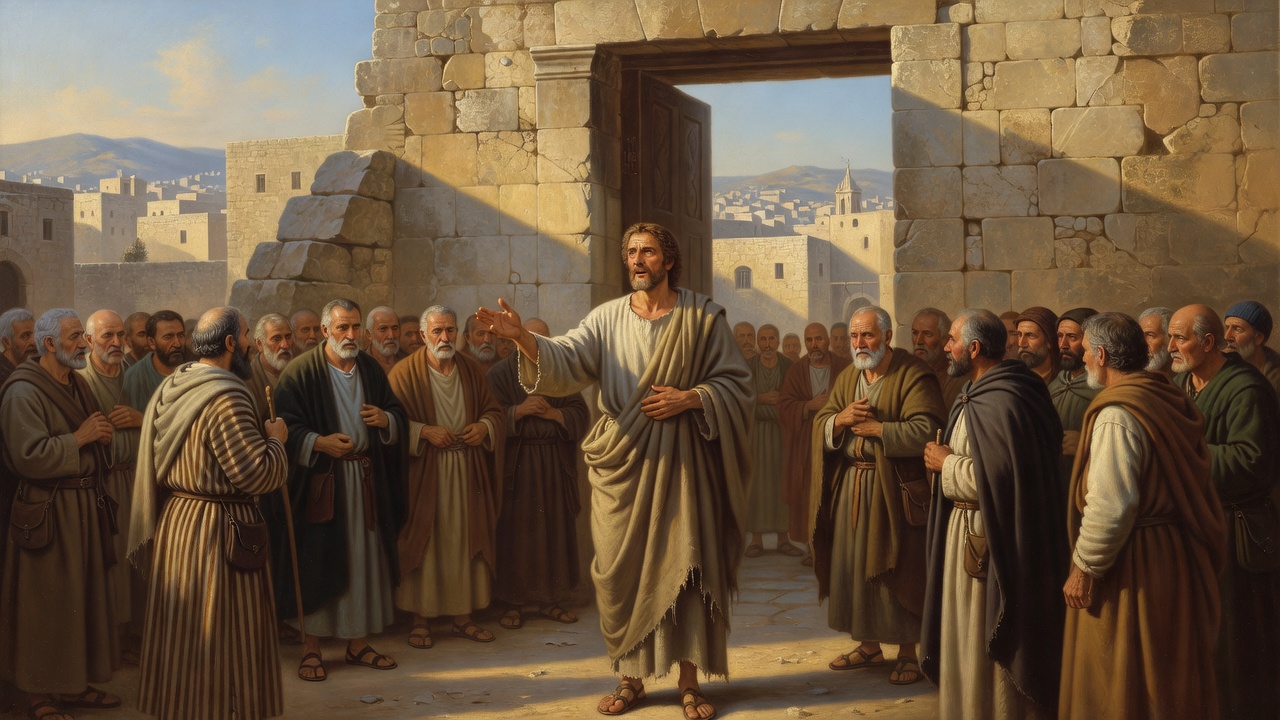
19Thus said Hashem unto me; Go and stand in the Sha'ar Bnei HaAm, whereby the melachim of Yehudah come in, and by the which they go out, and in all the Sha'arei Yerushalayim; 20And say unto them, Hear ye the Devar Hashem, ye melachim of Yehudah, and all Yehudah, and all the inhabitants of Yerushalayim, that enter in by these she'arim (gates); 21Thus saith Hashem: Be shomer over your nefashot, and bear no massa (burden) on Shabbos, nor bring through the Sha'arei Yerushalayim; 22Neither carry forth a massa (burden) out of your batim (houses) on Shabbos, neither do ye any melachah (work), but keep Shabbos set apart as kodesh, just as I commanded Avoteichem. 23But they obeyed not, neither inclined their ozen (ear), but made their stubborn neck stiff, that they might not hear, nor receive musar (discipline).
24And it shall come to pass, if ye diligently pay heed unto Me, saith Hashem, to bring in no massa (burden) through the she'arim (gates) of this city on the day of Shabbos, but keep the day of Shabbos holy, to do no melachah (work) therein; 25Then shall there enter into the she'arim (gates) of this city melachim and sarim sitting upon the kisse Dovid, riding in chariots and on susim, they, and their sarim, the Ish Yehudah, and the inhabitants of Yerushalayim; and this city shall be inhabited l'olam (forever). 26And they shall come from the towns of Yehudah, and from the places around Yerushalayim, and from Eretz Binyamin, and from the Shephalah (Lowlands), and from the har (hill country), and from the Negev bringing olah (burnt offering), and zevach (sacrifice), and minchah (grain offering), and levonah (frankincense), and bringing todah (thank offering), unto the Bais Hashem. 27But if ye will not pay heed unto Me to keep the day of Shabbos holy, and not to bear a massa (burden), when entering in at the She'arim of Yerushalayim on the day of Shabbos; then will I kindle an eish in the she'arim thereof, and it shall devour the fortresses of Yerushalayim, and it shall not be quenched.
¿Sabías que…?
La confianza, el corazón y el día de reposo
- El estilo de hierro y la punta de diamante eran herramientas antiguas utilizadas para grabar inscripciones profundas y permanentes en piedra o metal. Jeremías emplea esta imagen para resaltar que la idolatría de Judá no era superficial, sino que estaba profundamente grabada en sus corazones y en los cuernos de sus altares.Fuentes: el propio texto bíblico
- Jeremías contrasta un arbusto solitario en el desierto árido y salitroso con un árbol frondoso plantado junto a una corriente de agua. Un árbol cuyas raíces alcanzan el agua se mantiene verde y produce fruto incluso en años de sequía, representando a quienes confían en Dios en lugar de las fuerzas humanas.Fuentes: el propio texto bíblico
- Jeremías recibió la instrucción de proclamar el mensaje divino en las puertas de Jerusalén, prohibiendo el traslado de cargas en el día de reposo. Guardar este día aseguraba la continuidad de los reyes en el trono de David y la llegada de adoradores de la tierra de Benjamín, de Judá y del Neguev.Fuentes: el propio texto bíblico · David · Benjamin (patriarch) · Jerusalem
Notas escritas con ayuda de IA a partir de fuentes abiertas (Theographic Bible Metadata, CC BY-SA 4.0; Easton’s Bible Dictionary, dominio público) y revisadas antes de publicarse.
Lugares de este capítulo
- Arabah · 30.417, 35.151 · versículo 6
- Jerusalem · 31.777, 35.234 · versículos 19, 20, 21, 25, 26, 27
- People’s Gate · Hoy: in Jerusalem · 31.777, 35.234 · versículo 19
- Negeb · 31.245, 34.841 · versículo 26
- Shephelah · 31.692, 34.875 · versículo 26
Solo aparecen lugares identificados con alta confianza (90 % o más según las fuentes académicas reunidas por OpenBible). Mapa de la época: DARE (Digital Atlas of the Roman Empire), CC BY 4.0; mapa actual: © colaboradores de OpenStreetMap; lugares: OpenBible.info (CC BY 4.0).
Créditos y licencia de esta traducción
The Orthodox Jewish Bible
The Orthodox Jewish Bible - Tanakh and Orthodox Jewish Brit Chadasha - The Holy Bible
copyright © 2002-2011, 2021, 2024 Artists for Israel International
Language: English
Contributor: Artists for Israel International
THE ORTHODOX JEWISH TANAKH
Artists For Israel Intl Inc.
This version also appears with the Orthodox Yiddish Triglot which presents the Hebrew Yiddish script in Latin script and an English word for word translation, available at afii.org/Torah
To donate PayPal.Me
This translation is made available to you under the terms of the
Creative Commons Attribution license 4.0.
You may share and redistribute this Bible translation or extracts from it in any format, provided that:
You include the above copyright and source information.
If you make any changes to the text, you must indicate that you did so in a way that makes it clear that the original licensor is not necessarily endorsing your changes.
Pictures included with Scriptures and other documents on this site are licensed just for use with those Scriptures and documents.
For other uses, please contact the respective copyright owners.
Note that in addition to the rules above, revising and adapting God's Word involves a great responsibility to be true to God's Word. See Revelation 22:18-19.
2026-01-06
Títulos de sección adaptados de la Berean Standard Bible (dominio público); no forman parte del texto bíblico de esta traducción.
Fuente: http://ebible.org/engojb/ · eBible.org