Isaías 64
The Orthodox Jewish Bible · Toca un versículo para ver sus referencias cruzadas.
A Prayer for God’s Power
1As eish burneth brushwood,
eish causeth the mayim to boil,
[O, that Thou wouldst come down] to make Thy Shem known to Thine adversaries,
that the Goyim might tremble at Thy presence!
2When Thou didst terrible things
which we looked not for,
Thou camest down,
the harim shook at Thy presence.
3For me'olam (since ancient times) no one hath heard,
nor perceived by the ozen,
neither hath the ayin seen any Elohim besides Thee,
Who acts on behalf of him that waiteth for Him.
4Thou meetest with him that rejoiceth to work tzedek,
those that remember Thee in Thy drakhim;
see, Thou art in wrath; for we have been in sins;
in them a long time, and shall we be saved?
5But we are all as the tameh (unclean thing),
and kol tzidkoteinu (all our righteousness, our righteous deeds, works) are like beged iddim (filthy rags, a garment of menstruation);
and we all do fade like the aleh (leaf);
and avoneinu (our iniquities), like the ruach, have taken us away.
6And there is none that calleth upon Thy Shem,
that stirreth up himself to take hold of Thee;
for Thou hast hid Thy face from us,
and hast consumed us, because of avoneinu.
7But now, Hashem, Thou art Avinu (Our Father);
we are the chomer (clay), and Thou, Yotzreinu (our Potter, Maker, Creator);
and we all are the ma'aseh (work) of Thy yad.
8Be not in wrath ad me'od, Hashem,
neither remember avon forever;
behold, see, we beseech thee, we are all Thy people.
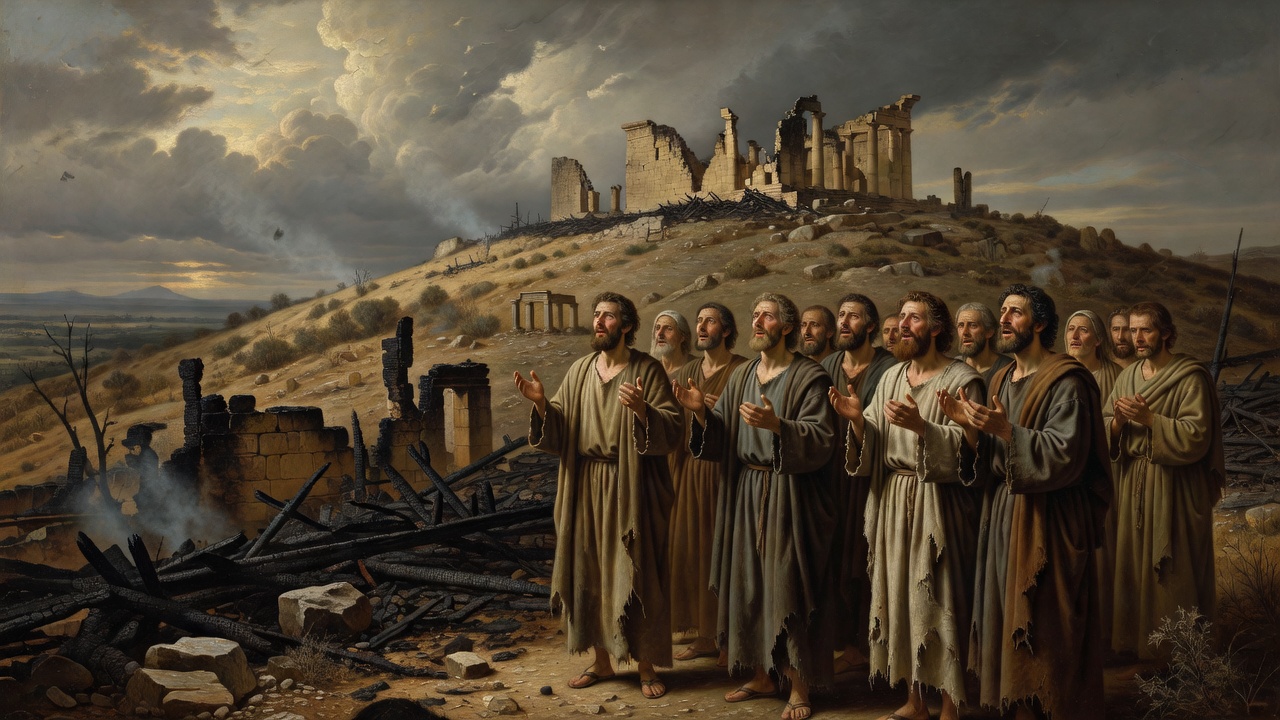
9Arei Kadsheicha (Thy holy cities) are a midbar,
Tziyon is a midbar,
Yerushalayim, a desolation.
10Beis Kadsheinu v'Tifarteinu,
where Avoteinu praised Thee,
is burned up with eish;
and kol machamadeinu (all our desiring) is in ruins.
11Wilt Thou refrain Thyself after these things, Hashem?
Wilt Thou hold Thy peace, and afflict us ad me'od?
¿Sabías que…?
Una Oración por Misericordia en Medio de la Ruina
- El pasaje comienza con una súplica para que Dios rasgue los cielos y descienda con poder sobrecogedor, como fuego que enciende la leña. Sin embargo, contrasta este deseo de la presencia divina con una confesión de la indignidad humana, comparando a las personas con hojas secas arrastradas por sus propias iniquidades.Fuentes: el propio texto bíblico
- En Isaías 64, la comunidad apela a Dios como Padre y artesano, declarando: "nosotros somos el barro, y tú nuestro alfarero". Esta metáfora subraya la fragilidad humana y la total dependencia de Dios, suplicando misericordia divina a pesar del reconocimiento de sus culpas.Fuentes: el propio texto bíblico
- El capítulo lamenta la destrucción de los lugares sagrados, describiendo a Sion y Jerusalén como desolaciones y desiertos. El texto lamenta específicamente el incendio y la ruina del templo sagrado donde las generaciones pasadas habían ofrecido alabanzas.Fuentes: el propio texto bíblico · Zion · Jerusalem
Notas escritas con ayuda de IA a partir de fuentes abiertas (Theographic Bible Metadata, CC BY-SA 4.0; Easton’s Bible Dictionary, dominio público) y revisadas antes de publicarse.
Lugares de este capítulo
Solo aparecen lugares identificados con alta confianza (90 % o más según las fuentes académicas reunidas por OpenBible). Mapa de la época: DARE (Digital Atlas of the Roman Empire), CC BY 4.0; mapa actual: © colaboradores de OpenStreetMap; lugares: OpenBible.info (CC BY 4.0).
Créditos y licencia de esta traducción
The Orthodox Jewish Bible
The Orthodox Jewish Bible - Tanakh and Orthodox Jewish Brit Chadasha - The Holy Bible
copyright © 2002-2011, 2021, 2024 Artists for Israel International
Language: English
Contributor: Artists for Israel International
THE ORTHODOX JEWISH TANAKH
Artists For Israel Intl Inc.
This version also appears with the Orthodox Yiddish Triglot which presents the Hebrew Yiddish script in Latin script and an English word for word translation, available at afii.org/Torah
To donate PayPal.Me
This translation is made available to you under the terms of the
Creative Commons Attribution license 4.0.
You may share and redistribute this Bible translation or extracts from it in any format, provided that:
You include the above copyright and source information.
If you make any changes to the text, you must indicate that you did so in a way that makes it clear that the original licensor is not necessarily endorsing your changes.
Pictures included with Scriptures and other documents on this site are licensed just for use with those Scriptures and documents.
For other uses, please contact the respective copyright owners.
Note that in addition to the rules above, revising and adapting God's Word involves a great responsibility to be true to God's Word. See Revelation 22:18-19.
2026-01-06
Títulos de sección adaptados de la Berean Standard Bible (dominio público); no forman parte del texto bíblico de esta traducción.
Fuente: http://ebible.org/engojb/ · eBible.org