Isaías 35
The Orthodox Jewish Bible · Toca un versículo para ver sus referencias cruzadas.
The Glory of Zion
1The Midbar (desert) and the Tziyyah (dry land) shall be glad over them;
and the Aravah shall rejoice,
and blossom like the khavatzelet (lily).
2It shall bloom abundantly,
and rejoice even with gilat (rejoicing) and rannein (joyous singing);
the kavod haLevanon (glory of Lebanon) shall be given unto her (the Aravah),
the hadar (majesty) of Carmel and Sharon;
they shall see the Kavod Hashem (glory of Hashem ),
and the Hadar Eloheinu (majesty of our G-d).
3Make ye the weak hands chazak (strong),
and steady the birkayim (knees) koshlot (feeble ones [knees] that give way, i.e., of those of the Golus returning to G-d in Tziyon).
4Say to them that are of a fearful lev,
Be strong, fear not;
hinei, Eloheichem (your G-d) will come with nakam (vengeance),
with Elohim gemul (divine retribution)
He will come and save you.
5Then the eyes of the ivvrim (blind people) shall be opened,
and the ears of the chereshim (deaf ones) shall be unstopped.
6Then shall the pisei'ach (lame) leap like the deer,
and the leshon (tongue) of the illem (the mute, the people unable to utter speech) sing for joy;
for in the midbar shall mayim break forth,
and streams in the Aravah.
7And the sharav (burning sand) shall become an agam (pool, lake, pond)
and the thirsty land, springs of mayim;
in the habitation of jackals, where each [jackal] lay, shall be khatzir (grassland)
as well as reeds and gomeh (papyrus, bulrushes).
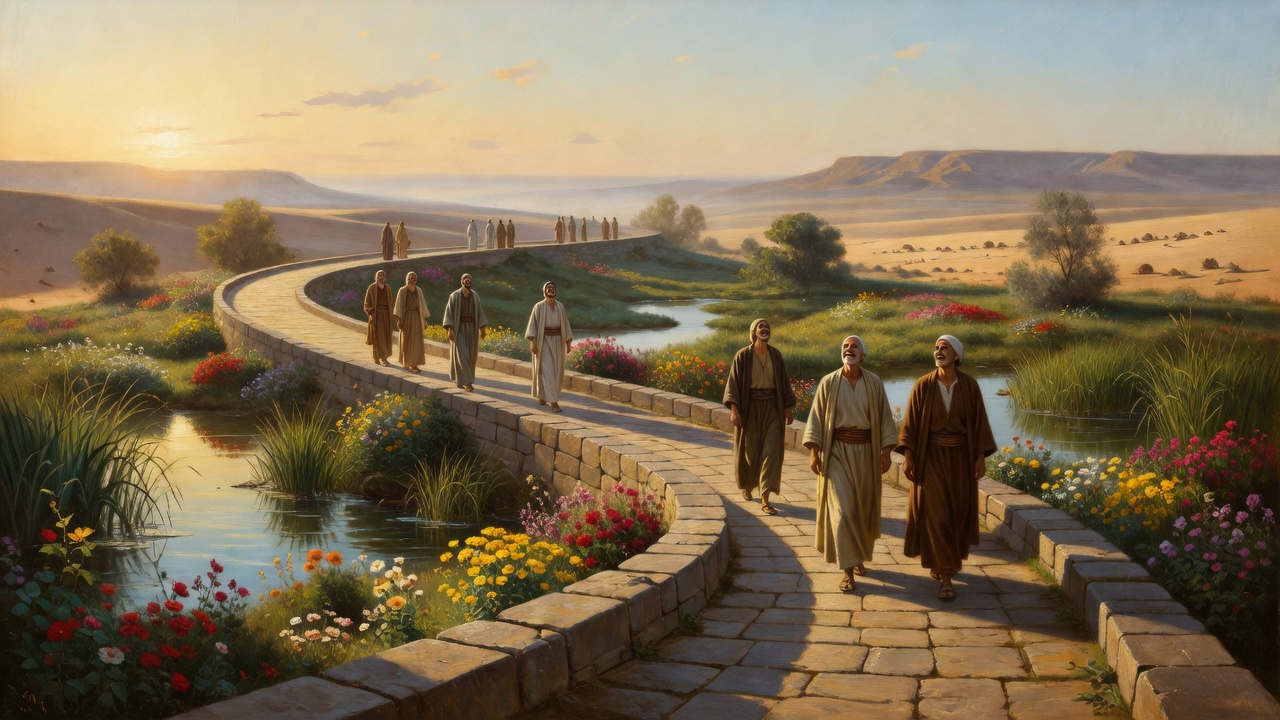
8And a maslul (highway) shall be there, and a derech (road),
and it shall be called The Derech HaKodesh (The Holy Road);
the tameh (unclean, impure person [see Isa 26:7]) shall not pass along it,
inasmuch as it shall be for them,
that is, the Holech Derech (Walker of the Road, i.e., whoever is the [Redeemed] Wayfarer on the Derech HaKodesh),
even evilim (morally bad foolish people) shall not go astray thereon.
9No aryeh (lion) shall be there,
nor any peritz chayyot (ravenous, dangerous, ferocious of [wild] beasts) shall go up thereon,
it shall not be found there;
but the Ge'ulim (redeemed people) shall walk there;
10And the Peduyei Hashem (ransomed ones of Hashem ) shall return,
and come to Tziyon with songs
and simchat olam (everlasting joy) upon their heads;
they shall obtain sasson (joy) and simchah (gladness),
and sorrow and sighing shall flee away.
¿Sabías que…?
La transformación del desierto y el Camino de Santidad
- La poesía profética de este capítulo contrasta el desierto árido con regiones célebres en el antiguo Levante por su exuberante vegetación y grandeza: las altas y boscosas montañas del Líbano y la fértil llanura costera de Sarón. La profecía contempla al desierto floreciendo con el esplendor y la fertilidad tradicionalmente asociados a estos paisajes prósperos.Fuentes: Lebanon · Saron · el propio texto bíblico
- El capítulo culmina con la imagen de los redimidos avanzando por una calzada llamada el Camino de Santidad hacia el monte Sion, la colina fortificada del sureste de Jerusalén donde el rey David estableció su ciudadela. Este camino se presenta libre de fieras peligrosas, permitiendo a los viajeros regresar con cánticos y gozo.Fuentes: Zion · el propio texto bíblico
Notas escritas con ayuda de IA a partir de fuentes abiertas (Theographic Bible Metadata, CC BY-SA 4.0; Easton’s Bible Dictionary, dominio público) y revisadas antes de publicarse.
Lugares de este capítulo
- Lebanon · 33.540, 35.584 · versículo 2
- Mount Carmel · 32.672, 35.023 · versículo 2
- Sharon · Hoy: Sharon Plain · 32.400, 34.883 · versículo 2
- Way of Holiness · Hoy: within 10 km of Jerusalem · 31.777, 35.234 · versículo 8
- Zion · Hoy: Jerusalem · 31.777, 35.234 · versículo 10
Solo aparecen lugares identificados con alta confianza (90 % o más según las fuentes académicas reunidas por OpenBible). Mapa de la época: DARE (Digital Atlas of the Roman Empire), CC BY 4.0; mapa actual: © colaboradores de OpenStreetMap; lugares: OpenBible.info (CC BY 4.0).
Créditos y licencia de esta traducción
The Orthodox Jewish Bible
The Orthodox Jewish Bible - Tanakh and Orthodox Jewish Brit Chadasha - The Holy Bible
copyright © 2002-2011, 2021, 2024 Artists for Israel International
Language: English
Contributor: Artists for Israel International
THE ORTHODOX JEWISH TANAKH
Artists For Israel Intl Inc.
This version also appears with the Orthodox Yiddish Triglot which presents the Hebrew Yiddish script in Latin script and an English word for word translation, available at afii.org/Torah
To donate PayPal.Me
This translation is made available to you under the terms of the
Creative Commons Attribution license 4.0.
You may share and redistribute this Bible translation or extracts from it in any format, provided that:
You include the above copyright and source information.
If you make any changes to the text, you must indicate that you did so in a way that makes it clear that the original licensor is not necessarily endorsing your changes.
Pictures included with Scriptures and other documents on this site are licensed just for use with those Scriptures and documents.
For other uses, please contact the respective copyright owners.
Note that in addition to the rules above, revising and adapting God's Word involves a great responsibility to be true to God's Word. See Revelation 22:18-19.
2026-01-06
Títulos de sección adaptados de la Berean Standard Bible (dominio público); no forman parte del texto bíblico de esta traducción.
Fuente: http://ebible.org/engojb/ · eBible.org