Isaías 23
The Orthodox Jewish Bible · Toca un versículo para ver sus referencias cruzadas.
The Burden against Tyre
1The massa (burden) of Tzor:
Howl, ye oniyyot (ships) of Tarshish;
for it is destroyed, so that there is no bais, no entering in;
from the Eretz Kittim (Land of Cyprus)
niglah (it is revealed) to them.
2Be still, ye inhabitants of the ee (isle, island);
thou whom the sokher (merchant) of Tzidon,
that pass over the yam, have enriched.
3And by mayim rabbim, the zera (grain) of Shikhor,
the katzir (harvest) of the Shikhor, is her tevuah (produce, income);
and she is a Sakhar Goyim (market bazaar of nations).
4Be thou ashamed, O Tzidon; for the yam hath spoken,
even the ma'oz (fortress) of the yam, saying,
I travail not, nor give birth,
neither do I rear bochurim,
nor bring up betulot.
5As at the report concerning Mitzrayim,
so shall they be sorely pained at the report of Tzor.
6Cross ye over to Tarshish;
howl, ye inhabitants of the ee (isle, island).
7Is this your joyous city,
whose antiquity is of ancient days?
Her own raglayim shall carry her afar off to sojourn.
8Who hath devised this against Tzor, the crowning city,
whose sokharim (merchants) are sarim (princes),
whose traders are the nikhbadei Eretz (honored of the Earth).
9Hashem Tzva'os hath devised it,
to demean the ga'on (pride) of every beauty,
and to humble all the nikhbadei Eretz.
10Pass through thy land like the Nile, O Bat Tarshish;
there is no more restraint.
11He stretched out His Yad over the yam,
He shook the mamlakhot (kingdoms);
Hashem hath given a commandment against Kena'an,
to destroy her ma'a'uzim (fortresses).
12And He said, Thou shalt no more exult,
O thou oppressed Betulah, Bat Tzidon;
arise, pass over to Kittim (Cyprus);
there also shalt thou have no rest.
13Behold, Eretz Kasdim (land of Chaldeans); this people was not, till the Assyrian made it for wild creatures; they raise up the siege towers thereof, they destroyed the palaces thereof; and turned her to ruin.
14Howl, ye oniyyot Tarshish;
for your stronghold is destroyed.
15And it shall come to pass in that day, that Tzor shall be forgotten shiv'im shanah, according to the yamim of melech echad; after the end of shiv'im shanah shall Tzor sing as a zonah.
16Take a kinnor,
go about the Ir,
thou zonah that hast been forgotten;
make sweet melody,
sing many shir,
that thou mayest be remembered.
17And it shall come to pass at the end of shiv'im shanah, that Hashem will visit Tzor, and she shall return to her hire, and shall commit fornication with all the mamlakhot HaAretz upon the face of ha'adamah. 18And her gain and her hire shall be kodesh to Hashem; it shall not be treasured nor laid up; for her earnings shall be for them that live before Hashem, to eat sufficiently, and for choice clothing.
¿Sabías que…?
El Oráculo Sobre Tiro y Sidón
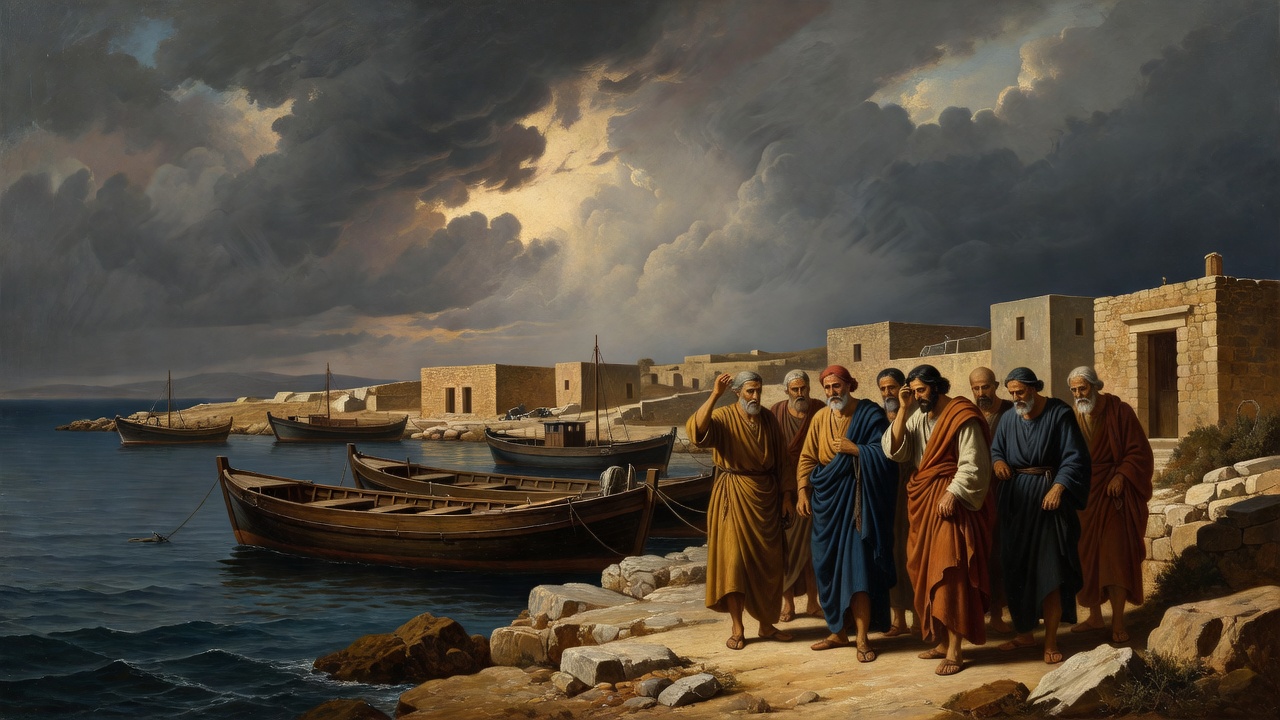
- Tiro y su vecina más antigua, Sidón, eran prominentes ciudades portuarias fenicias en la costa del Mediterráneo. Célebres por su vasta red comercial, los mercaderes fenicios navegaban por el mar y fundaban colonias por toda la cuenca mediterránea, llegando hasta Tarsis, en España.Fuentes: Tyre · Sidon · Tarshish · el propio texto bíblico
- En el vocabulario geográfico del Antiguo Testamento, la isla de Chipre era llamada Quitim. Situada a unas sesenta millas de la costa siria, constituía un enclave comercial fenicio y un punto de escala clave donde los marineros recibían noticias antes de alcanzar tierra firme.Fuentes: Cyprus · el propio texto bíblico
- El nombre Sijor en este capítulo se refiere al río Nilo. Los comerciantes fenicios transportaban la cosecha agrícola de Egipto por vía marítima, convirtiendo el grano egipcio en una fuente primordial de riqueza para los almacenes de Tiro.Fuentes: Nile · Shihor · Tyre · el propio texto bíblico
Notas escritas con ayuda de IA a partir de fuentes abiertas (Theographic Bible Metadata, CC BY-SA 4.0; Easton’s Bible Dictionary, dominio público) y revisadas antes de publicarse.
Lugares de este capítulo
- Cyprus · 35.000, 33.000 · versículos 1, 12
- Tyre · 33.271, 35.196 · versículos 1, 3, 4, 5, 8, 10, 15, 17
- Sidon · Hoy: Sandikli archaeological site in Sidon · 33.561, 35.372 · versículos 2, 4, 12
- Nile · Hoy: Nile River · 31.465, 30.367 · versículos 3, 10
- Egypt · 30.129, 31.308 · versículo 5
- Canaan · 32.767, 35.333 · versículo 11
- Assyria · 36.359, 43.153 · versículo 13
- Babylon · 32.543, 44.422 · versículo 13
- Chaldea · 30.962, 46.104 · versículo 13
Solo aparecen lugares identificados con alta confianza (90 % o más según las fuentes académicas reunidas por OpenBible). Mapa de la época: DARE (Digital Atlas of the Roman Empire), CC BY 4.0; mapa actual: © colaboradores de OpenStreetMap; lugares: OpenBible.info (CC BY 4.0).
Créditos y licencia de esta traducción
The Orthodox Jewish Bible
The Orthodox Jewish Bible - Tanakh and Orthodox Jewish Brit Chadasha - The Holy Bible
copyright © 2002-2011, 2021, 2024 Artists for Israel International
Language: English
Contributor: Artists for Israel International
THE ORTHODOX JEWISH TANAKH
Artists For Israel Intl Inc.
This version also appears with the Orthodox Yiddish Triglot which presents the Hebrew Yiddish script in Latin script and an English word for word translation, available at afii.org/Torah
To donate PayPal.Me
This translation is made available to you under the terms of the
Creative Commons Attribution license 4.0.
You may share and redistribute this Bible translation or extracts from it in any format, provided that:
You include the above copyright and source information.
If you make any changes to the text, you must indicate that you did so in a way that makes it clear that the original licensor is not necessarily endorsing your changes.
Pictures included with Scriptures and other documents on this site are licensed just for use with those Scriptures and documents.
For other uses, please contact the respective copyright owners.
Note that in addition to the rules above, revising and adapting God's Word involves a great responsibility to be true to God's Word. See Revelation 22:18-19.
2026-01-06
Títulos de sección adaptados de la Berean Standard Bible (dominio público); no forman parte del texto bíblico de esta traducción.
Fuente: http://ebible.org/engojb/ · eBible.org