Oseas 13
The Orthodox Jewish Bible · Toca un versículo para ver sus referencias cruzadas.
God’s Anger against Israel
1When Ephrayim spoke there was trembling;
he was exalted in Yisroel;
but when he became guilty in Ba'al, he died.
2And now they sin more and more,
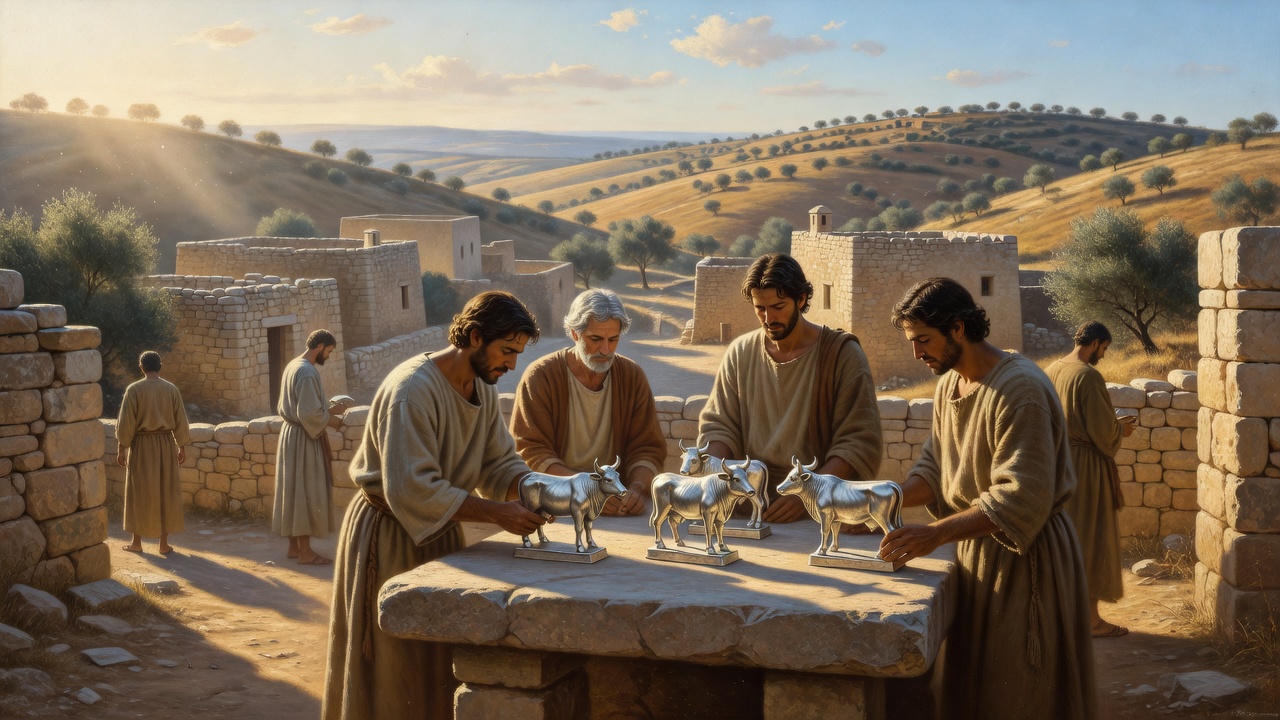
and have made for themselves massekhah (idol) of their kesef,
and atzabim according to their faculty of binah (understanding),
all of it the work of the craftsmen;
they say of them:
Let adam that sacrifice kiss calf-idols.
3Therefore they shall be like the anan boker (morning cloud)
and as the early dew that disappears,
like the motz (chaff) that is driven with the whirlwind out of the threshing floor,
and as the smoke out of the window.
4Yet I am Hashem Eloheicha from Eretz Mitzrayim,
and thou shalt know no Elohim but Me;
for there is no Moshia besides Me.
5I did know thee in the midbar,
in the eretz taluvot (land of burning heat).
6According to their pasture, so were they filled;
they were filled, and their lev became proud;
therefore have they forgotten Me.
7Therefore I will be unto them as a lion;
as a leopard by the derech will I lie in wait;
8I will meet them as a dov (bear) that is bereaved of her cubs,
and will rip open the covering of their lev,
and there will I devour them like a lion;
as the wild beast of the sadeh would tear them.
Death and Resurrection
9O Yisroel, thou art destroyed;
because thou art against Me, thine Ezer (Help).
10Where now is thy melech
that he may save thee?
Where in all thy cities are thy shofetim of whom thou saidst:
Give me a melech and sarim?
11I gave thee a melech in Mine anger,
and took him away in My wrath.
12The avon (iniquity) of Ephrayim is bound up;
his chattat is lurking.
13The chevlei yoledah (birth pangs of a woman in childbirth) shall come upon him;
he is a ben lo chacham;
for when it is time he does not come
to the opening of the womb.
14Should I ransom them from the power of Sheol?
Should I redeem them from mavet?
O Mavet, where are the dever (pestilence, plague) of thee?
O Sheol, where is thy destruction?
Nocham (sorrow, compassion, pity) shall be hidden from Mine eyes.
Judgment on Samaria
15Even though he thrives among his achim,
an east wind shall come,
the Ruach Hashem shall come up from the midbar (desert),
and his makor (spring, fountain) shall become dry,
and his well shall be dried up;
it shall plunder the otzar of every keli chemdah (precious vessel).
¿Sabías que…?
La caída de Efraín y Samaria
- Oseas 13 comienza recordando que Efraín, antes exaltado en Israel, provocó su propia ruina mediante la adoración a Baal. Baal era la principal divinidad masculina de los fenicios, y su culto influyó profundamente en las tribus del norte.Fuentes: el propio texto bíblico · Baal
- El capítulo recuerda que Dios había sido el Dios de Israel desde la tierra de Egipto y lo había cuidado en el desierto árido. Sin embargo, cuando el pueblo tuvo pastos y quedó saciado, su corazón se llenó de orgullo y olvidó a su protector.Fuentes: el propio texto bíblico · Egypt
- La profecía concluye con un anuncio de juicio contra Samaria, la ciudad capital establecida por el rey Omri en la colina de Somerón. Oseas declara que Samaria cargará con su culpa y sufrirá una violenta destrucción por haberse rebelado contra Dios.Fuentes: el propio texto bíblico · Samaria
Notas escritas con ayuda de IA a partir de fuentes abiertas (Theographic Bible Metadata, CC BY-SA 4.0; Easton’s Bible Dictionary, dominio público) y revisadas antes de publicarse.
Lugares de este capítulo
Solo aparecen lugares identificados con alta confianza (90 % o más según las fuentes académicas reunidas por OpenBible). Mapa de la época: DARE (Digital Atlas of the Roman Empire), CC BY 4.0; mapa actual: © colaboradores de OpenStreetMap; lugares: OpenBible.info (CC BY 4.0).
Créditos y licencia de esta traducción
The Orthodox Jewish Bible
The Orthodox Jewish Bible - Tanakh and Orthodox Jewish Brit Chadasha - The Holy Bible
copyright © 2002-2011, 2021, 2024 Artists for Israel International
Language: English
Contributor: Artists for Israel International
THE ORTHODOX JEWISH TANAKH
Artists For Israel Intl Inc.
This version also appears with the Orthodox Yiddish Triglot which presents the Hebrew Yiddish script in Latin script and an English word for word translation, available at afii.org/Torah
To donate PayPal.Me
This translation is made available to you under the terms of the
Creative Commons Attribution license 4.0.
You may share and redistribute this Bible translation or extracts from it in any format, provided that:
You include the above copyright and source information.
If you make any changes to the text, you must indicate that you did so in a way that makes it clear that the original licensor is not necessarily endorsing your changes.
Pictures included with Scriptures and other documents on this site are licensed just for use with those Scriptures and documents.
For other uses, please contact the respective copyright owners.
Note that in addition to the rules above, revising and adapting God's Word involves a great responsibility to be true to God's Word. See Revelation 22:18-19.
2026-01-06
Títulos de sección adaptados de la Berean Standard Bible (dominio público); no forman parte del texto bíblico de esta traducción.
Fuente: http://ebible.org/engojb/ · eBible.org