Habacuc 3
The Orthodox Jewish Bible · Toca un versículo para ver sus referencias cruzadas.
Habakkuk’s Prayer
1A tefillah of Chabakuk HaNavi. On Shigionoth.
2Hashem, I have heard Thy speech, and was afraid;
Hashem, revive Thy work in the midst of the shanim, i
n the midst of the shanim make known;
in wrath remember mercy.
3G-d came from Teman,
and HaKadosh from Mt Paran.
Selah.
His hod (glory) covered HaShomayim,
and ha'aretz was full of His tehillah (praise).
4And His brightness was like the ohr;
He had rays of light flashing from His yad;
and there was His power hidden.
5Before Him went the dever (plague),
and pestilence went forth at His feet.
6He stood, and measured ha'aretz;
He beheld, and made the Goyim tremble;
and the everlasting mountains were scattered,
the perpetual hills did bow;
His ways are olam (everlasting).
7I saw the tents of Kushan in affliction;
and the dwellings of Eretz Midyan did tremble.
8Was Hashem displeased against the rivers?
Was Thine anger against the rivers?
Was Thy wrath against the yam,
that Thou didst ride upon Thine susim
and Thy merkavot of yeshu'ah (salvation)?
9Thy keshet (bow) was made bare.
Oathes were sworn over mattot (rods, arrows).
Selah.
Thou didst cleave the earth with rivers.
10The harim (mountains) saw Thee, and they trembled;
the overflowing of the water passed by;
the tehom (deep) uttered its voice,
and lifted up its hands on high.
11The shemesh and yarei'ach stood still in their habitation;
at the ohr of Thine arrows they went,
and at the lightning of Thy glittering spear.
12Thou didst march through the land in indignation,
Thou didst thresh the Goyim in anger.
13Thou wentest forth for the salvation of Thy people,
even for deliverance of Thy Moshiach;
Thou crushed the rosh of the bais of the wicked,
Thou stripped him thigh to neck.
Selah.
14Thou didst pierce with his spears the head of his horde;
they came out like a whirlwind to scatter me;
their rejoicing was like unto devouring the aniyim (the poor) in secret.
15Thou didst walk through the yam with Thine susim,
through the heap of mayim rabbim.
16When I heard, my heart trembled;
my lips quivered at the voice;
rottenness entered into my bones,
and I trembled in myself,
that I might wait patiently for the Yom Tzarah
to come on the nation invading us.
Habakkuk Rejoices
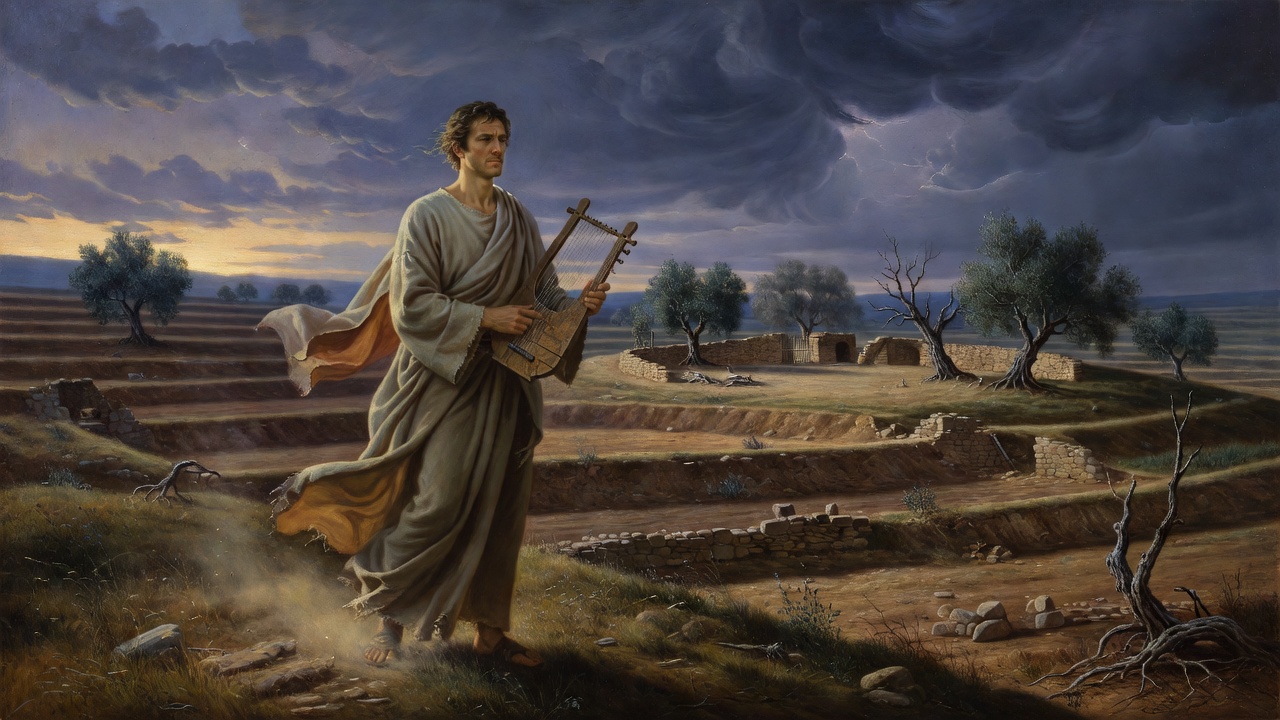
17Although the etz te'enah shall not blossom,
neither shall grape be on the gefen;
the labor of the olive shall fail,
and the fields shall yield no okhel;
the tzon shall be cut off from the fold,
and there shall be no herd in the stalls;
18Yet I will rejoice in Hashem,
I will joy in the G-d of my salvation.
19Hashem Adonoi is my strength,
and He will make my feet like the feet of a deer,
and He will make me to walk upon mine high places.
To the chief singer on my stringed instruments.
¿Sabías que…?
La oración de Habacuc y el cántico de fe
- El poema describe a Dios manifestándose desde el desierto meridional, mencionando a Temán en el sur de Idumea y al monte Parán en el límite desértico de la Tierra Prometida. Estas referencias geográficas evocan descripciones poéticas antiguas del Señor marchando en majestad desde el sur.Fuentes: Teman · Mount Paran · el propio texto bíblico
- Cusán y Madián son representadas temblando ante el avance divino. Los madianitas eran tribus árabes nómadas que habitaban en tiendas a través de los desiertos y pastizales del Sinaí y el norte de Arabia.Fuentes: Cushan · Midian · el propio texto bíblico
- El capítulo está estructurado como un salmo litúrgico, con términos musicales como 'Sigionot', 'Selah' y una dedicatoria final al director del coro para ser interpretado con instrumentos de cuerda.Fuentes: el propio texto bíblico
Notas escritas con ayuda de IA a partir de fuentes abiertas (Theographic Bible Metadata, CC BY-SA 4.0; Easton’s Bible Dictionary, dominio público) y revisadas antes de publicarse.
Lugares de este capítulo
- Midian · 28.495, 35.012 · versículo 7
Solo aparecen lugares identificados con alta confianza (90 % o más según las fuentes académicas reunidas por OpenBible). Mapa de la época: DARE (Digital Atlas of the Roman Empire), CC BY 4.0; mapa actual: © colaboradores de OpenStreetMap; lugares: OpenBible.info (CC BY 4.0).
Créditos y licencia de esta traducción
The Orthodox Jewish Bible
The Orthodox Jewish Bible - Tanakh and Orthodox Jewish Brit Chadasha - The Holy Bible
copyright © 2002-2011, 2021, 2024 Artists for Israel International
Language: English
Contributor: Artists for Israel International
THE ORTHODOX JEWISH TANAKH
Artists For Israel Intl Inc.
This version also appears with the Orthodox Yiddish Triglot which presents the Hebrew Yiddish script in Latin script and an English word for word translation, available at afii.org/Torah
To donate PayPal.Me
This translation is made available to you under the terms of the
Creative Commons Attribution license 4.0.
You may share and redistribute this Bible translation or extracts from it in any format, provided that:
You include the above copyright and source information.
If you make any changes to the text, you must indicate that you did so in a way that makes it clear that the original licensor is not necessarily endorsing your changes.
Pictures included with Scriptures and other documents on this site are licensed just for use with those Scriptures and documents.
For other uses, please contact the respective copyright owners.
Note that in addition to the rules above, revising and adapting God's Word involves a great responsibility to be true to God's Word. See Revelation 22:18-19.
2026-01-06
Títulos de sección adaptados de la Berean Standard Bible (dominio público); no forman parte del texto bíblico de esta traducción.
Fuente: http://ebible.org/engojb/ · eBible.org