Esdras 10
The Orthodox Jewish Bible · Toca un versículo para ver sus referencias cruzadas.
Shecaniah’s Encouragement
1Now while Ezra was davening and making vidduy, weeping and prostrating himself before the Beis HaElohim, a Kahal rav me'od, anashim, nashim, and yeladim, gathered to him from Yisroel, for the people wept bitterly. 2And Shechanyah ben Yechiel, of the Bnei Eilam, answered and said to Ezra, We have been unfaithful to Eloheinu, have married foreign am ha'aretz women; yet now there is mikveh for Yisroel in spite of this. 3So now let us make a Brit with Eloheinu to put away all nashim and that born of them, according to the counsel of Adonoi and the charedim at the mitzvot of Eloheinu; and let it be done according to the Torah. 4Arise! For this matter is your responsibility; but we will be with you; chazak and act.
5Then Ezra rose and made the leading Kohanim, the Levi'im, and kol Yisroel take an oath that they would do according to this proposal; so they took the oath.
The People’s Confession of Sin
6Then Ezra arose from before the Beis HaElohim and went into the chamber of Yehochanan ben Elyashiv. Although he went there, he did not eat lechem, nor drink water, for he was mourning over the unfaithfulness of those of the Golus.
7And they issued a proclamation throughout Yehudah and Yerushalayim to all the Banim of the Golus, that they should assemble at Yerushalayim, 8And that whoever would not come within three days, according to the counsel of the sarim and the zekenim, all his possessions should be forfeited and he himself excluded from the Kahal of those of the Golus.
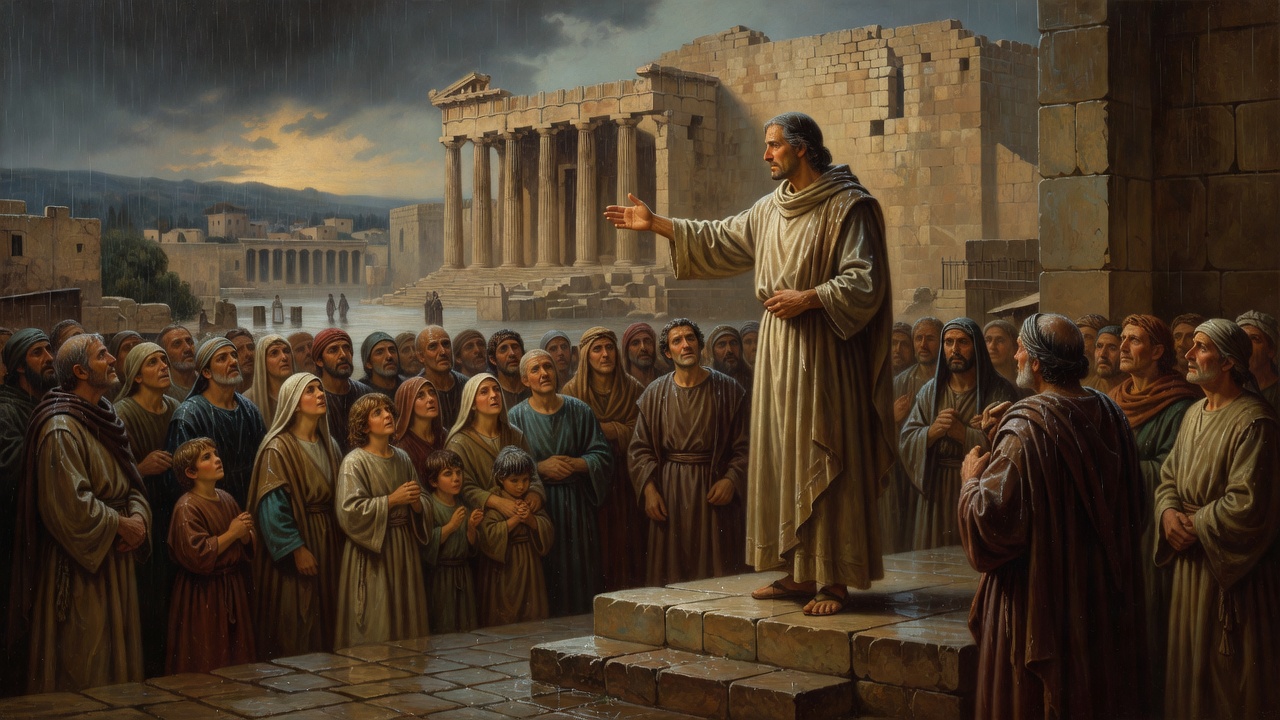
9So all the men of Yehudah and Binyamin assembled at Yerushalayim within the three days. It was the ninth month on the twentieth of the month, and kol HaAm sat in the rechov before the Beis HaElohim, distressed by the occasion and the heavy rain. 10Then Ezra HaKohen stood up and said to them, You have been unfaithful and have married foreign women adding to Ashmat Yisroel. 11Now, therefore, make confession to Hashem Elohei Avoteichem and do His will; separate yourselves from the am ha'aretz and from the foreign women. 12Then Kol HaKahal answered and said with a kol gadol, Ken! As you have said, so it is our duty to do. 13But there are Am rav, it is the rainy season, and we are not able to stand bachotz (outside). Nor can the matter be done in one or two days, for we have transgressed greatly in this matter. 14Let our leaders represent the Kol HaKahal and let all those in our towns who have married foreign women come at appointed times, together with the ziknei ir and shofetim of each town until the charon af Eloheinu on account of this matter is turned away from us. 15Only Yonatan ben Asahel and Yachzeyah ben Tikvah supported by Meshullam and Shabetai the Levi stood opposed. 16But the Banim of the Golus did so. And Ezra HaKohen selected anashim who were Rashei HaAvot for each of their fatherʼs households, all of them by shemot. So they convened on the first day of the tenth month to investigate the matter. 17And they finished investigating all men who had married foreign women by the 1 st day of the 1 st month.
Those Guilty of Intermarriage
18And among the Bnei HaKohanim who had married foreign women were found of the Bnei Yeshua ben Yotzadak, and his brothers; Ma'aseiyah, Eli'ezer, Yariv, and Gedalyah. 19And they pledged to put away their women, and being guilty, they offered a ram of the flock for their asham. 20And of the Bnei Immer there were Chanani and Zevadyah; 21and of the Bnei of Charim; Ma'aseiyah, Eliyah, Shema'yah, Yechiel, and Uziyah; 22and of the Bnei of Pashchur; Elyo'einai, Ma'aseiyah, Yishmael, Netanel, Yozavad, and El'asah.
23And of Levi'im there were Yozavad, Shime'i, Kelayah (that is, Kelita), Petachyah, Yehudah, and Eli'ezer.
24And of the singers there was Elyashiv; and of the gatekeepers; Shallum, Telem, and Uri.
25And of Yisroel, of the Bnei of Parosh there were Remiyah, Yizziyah, Malchiyah, Miyamin, El'azar, Malkiyah, and Benayah; 26And of the Bnei Eilam; Matanyah, Zecharyah, Yechiel, Avdi, Yeremot, and Eliyah; 27And of the Bnei Zattu; Elyo'einai, Elyashiv, Matanyah, Yeremot, Zavad, and Aziza; 28And of the Bnei Bevai; Yehochanan, Chananyah, Zabbai, and Atlai; 29And of the Bnei Bani; Meshullam, Malluch, and Adayah, Yashuv, Sheal, and Ramot; 30And of the Bnei Pachat-Moav; Adna, Kelal, Benayah, Ma'aseiyah, Matanyah, Betzalel, Binnui, and Menasheh; 31And of the Bnei Charim; Eli'ezer; Yishiyah, Malkiyah, Shema'yah, Shim'on, 32Binyamin, Malluch, and Shemaryah; 33Of the Bnei of Chashum; Matnai, Mattattah, Zavad, Eliphelet, Yeremai, Menasheh, and Shime'i; 34Of the Bnei Bani; Ma'adai, Amram, U'el, 35Benayah, Bedyah, Keluhi, 36Vanyah, Meremot, Elyashiv, 37Matanyah, Matnai, Ya'asai, 38Bani, Binnui, Shime'i, 39Shelemyah, Natan, Adayah, 40Machnavdai, Shashai, Sharai, 41Azare'el, Shelemyah, Shemaryah, 42Shallum, Amaryah, and Yosef. 43Of the Bnei Nevo there were Ye'iel, Mattityah, Zavad, Zevina, Yaddai, Yoel, and Benayah.
44All these had taken foreign women, and some of them wives by whom they had banim.
¿Sabías que…?
La asamblea y el juramento de separación
- Para tratar el asunto de los matrimonios mixtos, los líderes emitieron una proclamación que ordenaba a todos los exiliados en Judá y Benjamín reunirse en Jerusalén en un plazo de tres días, bajo pena de confiscación de bienes y expulsión de la comunidad. Al congregarse en la plaza frente a la casa de Dios, el pueblo temblaba tanto por la gravedad del asunto como por la intensa lluvia.Fuentes: el propio texto bíblico · Jerusalem
- Debido a que la gran multitud no podía permanecer a la intemperie durante la temporada invernal de lluvias, la comunidad organizó una investigación formal. Esdras y los jefes de familia designados examinaron los casos pueblo por pueblo durante tres meses completos, desde el primer día del décimo mes hasta el primer día del primer mes.Fuentes: el propio texto bíblico · Ezra
- El capítulo y el libro concluyen con un registro detallado de más de cien hombres que habían tomado mujeres extranjeras. La lista demuestra que los matrimonios mixtos habían afectado a todos los estratos de la sociedad posterior al exilio, incluidos descendientes del linaje sacerdotal, levitas, cantores del templo, porteros y laicos comunes.Fuentes: el propio texto bíblico
Notas escritas con ayuda de IA a partir de fuentes abiertas (Theographic Bible Metadata, CC BY-SA 4.0; Easton’s Bible Dictionary, dominio público) y revisadas antes de publicarse.
Lugares de este capítulo
Solo aparecen lugares identificados con alta confianza (90 % o más según las fuentes académicas reunidas por OpenBible). Mapa de la época: DARE (Digital Atlas of the Roman Empire), CC BY 4.0; mapa actual: © colaboradores de OpenStreetMap; lugares: OpenBible.info (CC BY 4.0).
Créditos y licencia de esta traducción
The Orthodox Jewish Bible
The Orthodox Jewish Bible - Tanakh and Orthodox Jewish Brit Chadasha - The Holy Bible
copyright © 2002-2011, 2021, 2024 Artists for Israel International
Language: English
Contributor: Artists for Israel International
THE ORTHODOX JEWISH TANAKH
Artists For Israel Intl Inc.
This version also appears with the Orthodox Yiddish Triglot which presents the Hebrew Yiddish script in Latin script and an English word for word translation, available at afii.org/Torah
To donate PayPal.Me
This translation is made available to you under the terms of the
Creative Commons Attribution license 4.0.
You may share and redistribute this Bible translation or extracts from it in any format, provided that:
You include the above copyright and source information.
If you make any changes to the text, you must indicate that you did so in a way that makes it clear that the original licensor is not necessarily endorsing your changes.
Pictures included with Scriptures and other documents on this site are licensed just for use with those Scriptures and documents.
For other uses, please contact the respective copyright owners.
Note that in addition to the rules above, revising and adapting God's Word involves a great responsibility to be true to God's Word. See Revelation 22:18-19.
2026-01-06
Títulos de sección adaptados de la Berean Standard Bible (dominio público); no forman parte del texto bíblico de esta traducción.
Fuente: http://ebible.org/engojb/ · eBible.org