Ester 2
The Orthodox Jewish Bible · Toca un versículo para ver sus referencias cruzadas.
Seeking Vashti’s Successor
1After these things, when the wrath of HaMelech Achashverosh was appeased, he remembered Vashti, and what she had done, and what was decreed against her. 2Then said the attendants of HaMelech that ministered unto him, Let there be beautiful ne'arot betulot (young virgins) sought for HaMelech; 3And let HaMelech appoint pekidim (overseers) in all the provinces of his malkhut (kingdom, realm), that they may gather together all the beautiful na'arah betulah (young virgins) unto Shushan the capital, to the Bais HaNashim (House of the Women, Harem), unto the custody of Hegai the Saris HaMelech (the Eunuch of the King), the Shomer HaNashim (Custodian of the Women); and let their (bodily) rubbings be given them. 4And let the na'arah which pleaseth HaMelech be Malkah (Queen) instead of Vashti. And the thing pleased HaMelech; and he did so.
Esther Finds Favor
5Now in Shushan the capital there was an ish Yehudi, shmo Mordechai ben Yair ben Shime'i ben Kish, a Binyamini, 6which (ones) had been carried away from Yerushalayim in the Golus among those taken captive with Yechanyah Melech Yehudah, whom Nevukhadnetzar Melech Bavel had carried away. 7And he brought up Hadassah, that is, Ester, the bat of his dod (uncle); for she had neither av nor em, and the na'arah was lovely in form and beautiful in appearance, whom Mordechai, when her av and em were dead, took for the bat of his own.
8So it came to pass, when the commandment of HaMelech and his dat (decree, law) was heard, and when ne'arot rabbot (many maidens) were gathered together unto Shushan the capital, to the custody of Hegai, that Ester was brought also unto the Beis HaMelech, to the custody of Hegai, Shomer HaNashim. 9And the na'arah pleased him, and she took up chesed before him; and he speedily had her be given her (bodily) rubbings, with her portion of special food; and also he selected sheva hane'arot (seven maids) for her from the Beis HaMelech; and he transferred her and her ne'arot to the preferred quarters in the Bais HaNashim.
10Ester had not revealed her Am (People), nor her moledet, for Mordechai had charged her she should not show it. 11And Mordechai walked kol yom vayom before the khatzer Bais HaNashim (courtyard of the House of the Women, Harem) to have da'as of the shalom Ester (welfare of Ester), and what would become of her.
12Now before the turn of every na'arah came to go in to HaMelech Achashverosh, she had to complete the yemei merukeihen (the days of her [bodily] rubbings) which were prescribed for the nashim and which involved shneym asar chodesh (twelve months), shisha chodashim (six months) of shemen (oil) of myrrh and shisha chodashim (six months) of perfumes and beauty treatments for nashim. 13Then thus came every na'arah unto HaMelech; whatsoever she desired was given her to go with her out of the Bais HaNashim unto the Beis HaMelech. 14Ba'erev (in the evening) she went, and ba'boker (in the morning) she returned to a Bais HaNashim Sheni (a second House of the Women, Harem) to the custody of Sha'ashgaz, Saris HaMelech, Shomer HaPilagshim (Eunuch of the King, Custodian of the Concubines). She came in unto HaMelech no more, except HaMelech delighted in her, and she were summoned b'shem (by name).
15Now when the turn of Ester bat Avichayil, dod Mordechai, who had adopted her as his bat, was come to go in unto HaMelech, she required nothing but what Hegai, Saris HaMelech, the Shomer HaNashim, suggested. And Ester took up chen (favor, grace) in the sight of all them that looked upon her.
16So Ester was taken unto HaMelech Achashverosh into his Bais Malkhut (royal residence) in the chodesh ha'asiri (tenth month), which is the month Tevet, in the shnat sheva (seventh year) of his reign.
Esther Becomes Queen
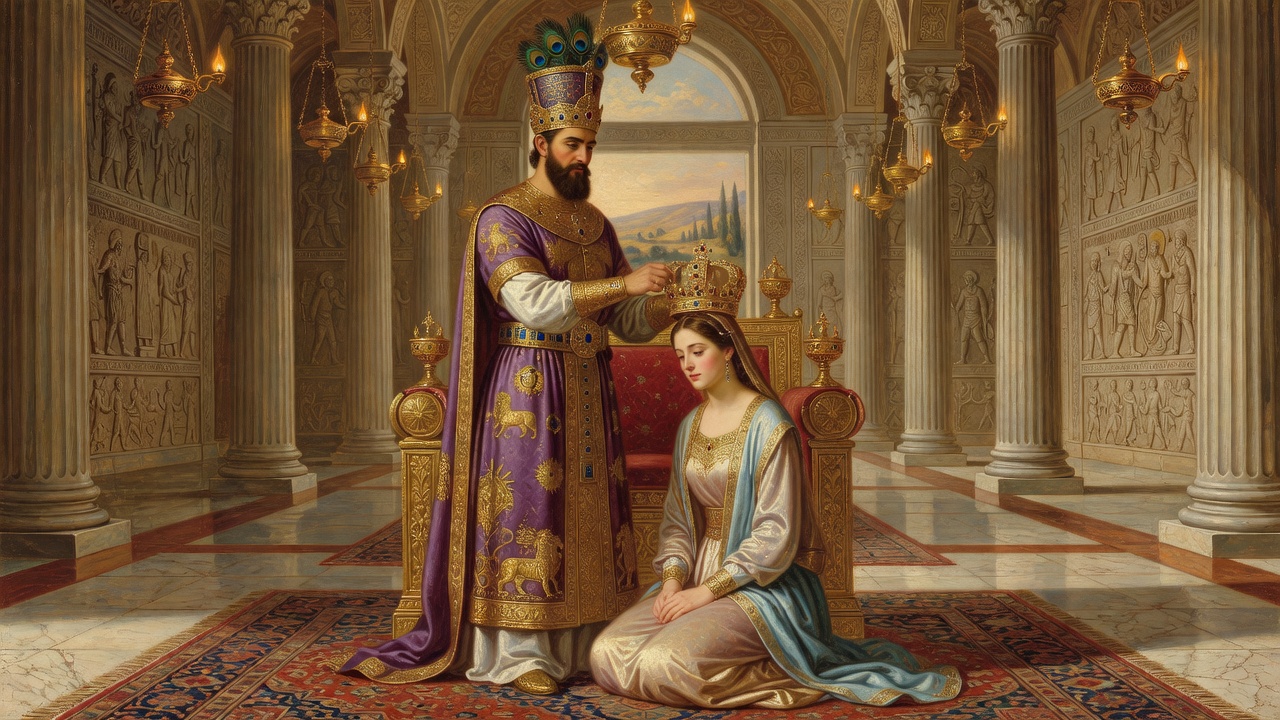
17And HaMelech loved Ester mikol hanashim (more than all the women), and she took up chen vachesed (favor and grace) in his sight more than kol habetulot (all the virgins), so that he set the keter malkhut (royal crown) upon her head, and made her Malkah instead of Vashti. 18Then HaMelech gave a mishteh gadol (great feast) unto all his sarim (nobles) and his avadim (servants, officials), even Mishteh Ester; and he decreed a holiday throughout the provinces and distributed gifts according to the [bountiful] yad HaMelech.
19And when the betulot (virgins) were gathered together again, then Mordechai yoshev b'Sha'ar HaMelech (sat in the Kingʼs Gate). 20Ester had not yet revealed her moledet (kindred) nor her Am (people), as Mordechai had charged her; for Ester did the commandment of Mordechai, like as when she was brought up with him.
Mordecai Uncovers a Conspiracy
21In those yamim, while Mordechai yoshev b'Sha'ar HaMelech, two of the Sarisim of HaMelech, Bigtan and Teresh, of the Mishomrei HaSaf (Keepers of the Door, Doorkeepers), were angry, and conspired to assassinate HaMelech Achashverosh. 22And Mordechai came to da'as of the plot, and told it unto Ester HaMalkah; and Ester informed HaMelech thereof b'shem Mordechai. 23And when inquiry was made of the matter, it was found true; therefore the two of them were made talui al etz (hanged on a tree), and it was written in the sefer of the divrei hayamim before HaMelech.
¿Sabías que…?
El ascenso de Ester como reina
- Ester tenía originalmente el nombre hebreo Hadasa, que significa "mirto", pero pasó a llamarse Ester (derivado del vocablo persa para "estrella") en la corte persa. Huérfana de la tribu de Benjamín, fue criada por su primo Mardoqueo, quien le indicó guardar en secreto su origen judío.Fuentes: Esther · el propio texto bíblico
- Las jóvenes llevadas a la ciudadela de Susa pasaban por una rigurosa preparación de doce meses bajo el cuidado del funcionario Hegai. El tratamiento requería seis meses con aceite de mirra y otros seis meses con perfumes y cosméticos antes de presentarse ante el rey.Fuentes: Hegai · el propio texto bíblico
- Estando sentado a la puerta del palacio, Mardoqueo descubrió una conspiración de dos guardias, Bigtán y Teres, para asesinar al rey Asuero. La reina Ester informó sobre la traición en nombre de Mardoqueo, y el suceso quedó formalmente registrado en las crónicas reales.Fuentes: el propio texto bíblico
Notas escritas con ayuda de IA a partir de fuentes abiertas (Theographic Bible Metadata, CC BY-SA 4.0; Easton’s Bible Dictionary, dominio público) y revisadas antes de publicarse.
Lugares de este capítulo
- Susa · Hoy: Shush · 32.189, 48.258 · versículos 3, 5, 8
- Babylon · 32.543, 44.422 · versículo 6
- Jerusalem · 31.777, 35.234 · versículo 6
Solo aparecen lugares identificados con alta confianza (90 % o más según las fuentes académicas reunidas por OpenBible). Mapa de la época: DARE (Digital Atlas of the Roman Empire), CC BY 4.0; mapa actual: © colaboradores de OpenStreetMap; lugares: OpenBible.info (CC BY 4.0).
Créditos y licencia de esta traducción
The Orthodox Jewish Bible
The Orthodox Jewish Bible - Tanakh and Orthodox Jewish Brit Chadasha - The Holy Bible
copyright © 2002-2011, 2021, 2024 Artists for Israel International
Language: English
Contributor: Artists for Israel International
THE ORTHODOX JEWISH TANAKH
Artists For Israel Intl Inc.
This version also appears with the Orthodox Yiddish Triglot which presents the Hebrew Yiddish script in Latin script and an English word for word translation, available at afii.org/Torah
To donate PayPal.Me
This translation is made available to you under the terms of the
Creative Commons Attribution license 4.0.
You may share and redistribute this Bible translation or extracts from it in any format, provided that:
You include the above copyright and source information.
If you make any changes to the text, you must indicate that you did so in a way that makes it clear that the original licensor is not necessarily endorsing your changes.
Pictures included with Scriptures and other documents on this site are licensed just for use with those Scriptures and documents.
For other uses, please contact the respective copyright owners.
Note that in addition to the rules above, revising and adapting God's Word involves a great responsibility to be true to God's Word. See Revelation 22:18-19.
2026-01-06
Títulos de sección adaptados de la Berean Standard Bible (dominio público); no forman parte del texto bíblico de esta traducción.
Fuente: http://ebible.org/engojb/ · eBible.org