Eclesiastés 3
The Orthodox Jewish Bible · Toca un versículo para ver sus referencias cruzadas.
To Everything There Is a Season
1To every thing there is a zeman (time), and an et (season) for every matter under Shomayim:
2An et (season) to be born,
and an et (season) to die;
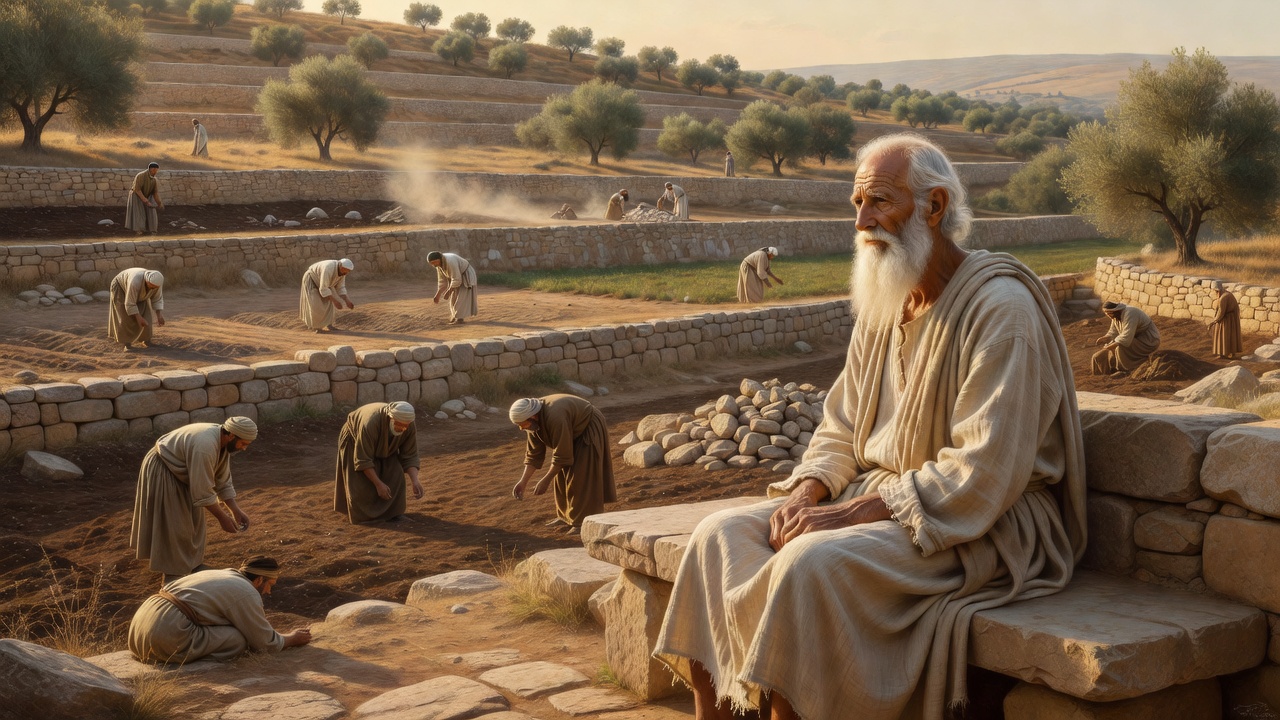
an et (season) to plant,
and an et (season) to uproot that which is planted;
3An et (season) to kill,
and an et (season) to heal;
an et (season) to tear down,
and an et (season) to build up;
4An et (season) to weep,
and an et (season) to laugh;
an et (season) to mourn,
and an et (season) to dance;
5An et (season) to throw stones away,
and an et (season) to gather stones together;
an et (season) to embrace,
and an et (season) to refrain from embracing;
6An et (season) to look for,
and an et (season) to lose;
an et (season) to keep,
and an et (season) to throw away;
7An et (season) to tear,
and an et (season) to mend;
an et (season) to keep silent,
and an et (season) to speak;
8An et (season) to love,
and an et (season) to hate;
an et (season) of milchamah,
and an et (season) of shalom.
God’s Works Remain Forever
9What profit hath the worker from his amal (labor)? 10I have seen the occupation, which Elohim hath given to the bnei HaAdam to keep them occupied. 11Hashem hath made every thing yafeh in its et (season); also He hath set HaOlam in their lev, yet so that no adam can find out the ma'aseh that HaElohim hath done from the beginning to the end. 12I have da'as that there is nothing better for adam, than that they have simchah and do tov while they live. 13And also that kol haAdam should eat and drink, and enjoy the good of all his amal. This is a gift of Elohim.
14I have da'as that, all that HaElohim doeth will endure l'olam; nothing can be added to it, nor any thing taken from it; HaElohim doeth it, that men should fear before Him. 15That which is hath been already; and that which is to be hath already been; and HaElohim will call that which is past to account.
From Dust to Dust
16And moreover I saw under the shemesh that in the Mekom Mishpat (place of judgment) resha (wickedness) was there; and in the Mekom Tzedek, resha (wickedness) was there. 17I said in mine lev, HaElohim shall judge the tzaddik and the resha (wicked); for an et (season) for every matter and for every ma'aseh is there. 18I said in mine lev, As for bnei haAdam, HaElohim tests them, that they might see that they themselves are like beheimah. 19For bnei haAdam and beheimah share one and same mikreh (fortune); as the one dieth, so dieth the other; yea, they have all one breath; so that the adam hath no advantage above the beheimah; for all is hevel. 20All go unto mekom echad; all are of the afahr (dust), and all return to the afahr again. 21Who hath da'as of the ruach bnei haAdam that goeth upward, and the ruach habeheimah that goeth downward to ha'aretz? 22Wherefore I perceive that there is nothing better than that the adam find simchah in his ma'asim; for that is his chelek; for who shall bring him to see what shall be after him?
¿Sabías que…?
Un tiempo para cada ocasión
- El capítulo comienza con un célebre poema de catorce pares de opuestos, que abarcan desde nacer y morir, plantar y arrancar, hasta llorar y bailar, la guerra y la paz. Esta estructura literaria ilustra la totalidad de las experiencias humanas debajo del cielo.Fuentes: el propio texto bíblico
- El autor observa que Dios ha puesto la eternidad en el corazón humano, aunque los mortales no pueden comprender plenamente la obra que Dios hace de principio a fin.Fuentes: el propio texto bíblico
- Al reflexionar sobre la mortalidad, el texto señala que tanto las personas como los animales vuelven al polvo. Ante este destino físico compartido, el Maestro concluye que disfrutar del trabajo cotidiano, de la comida y de la bebida es un don de Dios.Fuentes: el propio texto bíblico
Notas escritas con ayuda de IA a partir de fuentes abiertas (Theographic Bible Metadata, CC BY-SA 4.0; Easton’s Bible Dictionary, dominio público) y revisadas antes de publicarse.
Créditos y licencia de esta traducción
The Orthodox Jewish Bible
The Orthodox Jewish Bible - Tanakh and Orthodox Jewish Brit Chadasha - The Holy Bible
copyright © 2002-2011, 2021, 2024 Artists for Israel International
Language: English
Contributor: Artists for Israel International
THE ORTHODOX JEWISH TANAKH
Artists For Israel Intl Inc.
This version also appears with the Orthodox Yiddish Triglot which presents the Hebrew Yiddish script in Latin script and an English word for word translation, available at afii.org/Torah
To donate PayPal.Me
This translation is made available to you under the terms of the
Creative Commons Attribution license 4.0.
You may share and redistribute this Bible translation or extracts from it in any format, provided that:
You include the above copyright and source information.
If you make any changes to the text, you must indicate that you did so in a way that makes it clear that the original licensor is not necessarily endorsing your changes.
Pictures included with Scriptures and other documents on this site are licensed just for use with those Scriptures and documents.
For other uses, please contact the respective copyright owners.
Note that in addition to the rules above, revising and adapting God's Word involves a great responsibility to be true to God's Word. See Revelation 22:18-19.
2026-01-06
Títulos de sección adaptados de la Berean Standard Bible (dominio público); no forman parte del texto bíblico de esta traducción.
Fuente: http://ebible.org/engojb/ · eBible.org