Deuteronomio 5
The Orthodox Jewish Bible · Toca un versículo para ver sus referencias cruzadas.
The Covenant at Horeb
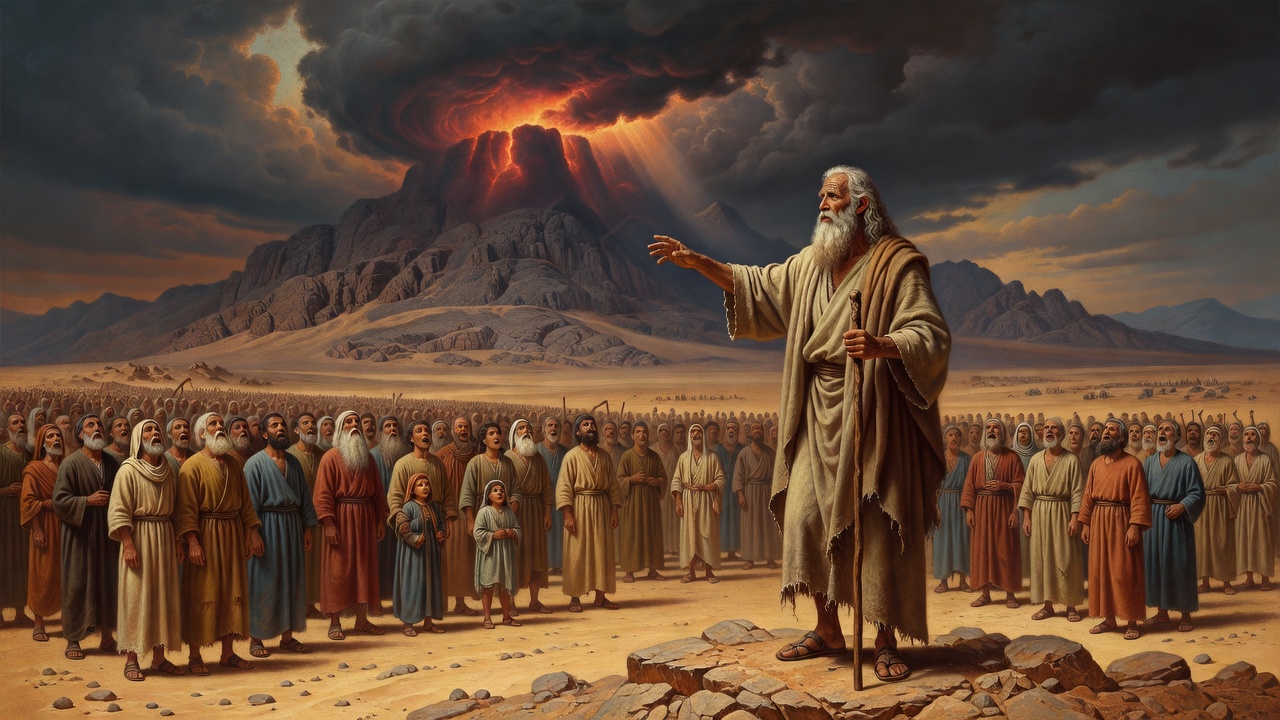
1And Moshe called kol Yisroel, and said unto them, Shema, Yisroel, to the chukkim and mishpatim which I speak in your ears today, that ye may learn them, and be shomer to do them. 2Hashem Eloheinu made a Brit with us in Chorev. 3Hashem made not this Brit with Avoteinu, but with us, even us, who are all of us here alive today. 4Hashem talked with you panim b'panim in the har out of the midst of the eish,
The Ten Commandments
5(I stood between Hashem and you at that time, to show you the Devar Hashem; for ye were afraid by reason of the eish, and went not up into the har) saying:
6[ALEF] I am Hashem Eloheicha, Which brought thee out of Eretz Mitzrayim, from the bais avadim.
7[BET] Thou shalt have no elohim acharim before Me. 8Thou shalt not make thee any pesel, or any temunah of anything that is in Shomayim above, or that is in Ha'Aretz beneath, or that is in the mayim beneath ha'aretz; 9Lo tishtachaveh (thou shalt not bow down thyself) unto them, nor serve them; for I Hashem Eloheicha am an El Kannah, visiting the iniquity of the avot upon the banim unto the third and fourth generation of them that hate Me, 10And showing chesed unto thousands of them that love Me and are shomer over My mitzvot.
11[GIMEL] Thou shalt not take the Shem of Hashem Eloheicha in vain; for Hashem will not hold him guiltless that taketh Shmo in vain.
12[DALET] Keep shomer Shabbos to set Shabbos apart as kodesh as Hashem Eloheicha commanded thee. 13Sheshet yamim thou shalt labor, and do all thy work: 14But the Yom HaShevi'i is the Shabbos of Hashem Eloheicha: in it thou shalt not do any work, thou, nor thy ben, nor thy bat, nor thy eved, nor thy maidservant, nor thine ox, nor thine donkey, nor any of thy cattle, nor thy ger that is within thy she'arim; that thy eved and thy amah may rest as well as thou. 15And remember that thou wast an eved in Eretz Mitzrayim, and that Hashem Eloheicha brought thee out thence through a yad chazakah and by an outstretched zero'a; therefore Hashem Eloheicha commanded thee to be shomer Shabbos on Yom HaShabbat.
16[HEH] Honor thy av and thy em, as Hashem Eloheicha hath commanded thee; that thy yamim may be prolonged, and that it may go well with thee, in ha'adamah which Hashem Eloheicha giveth thee.
17[VAV] Lo tirtzah (thou shalt not murder).
18 [ZAYIN] V'lo tinaf (neither shalt thou commit adultery).
19 [KHET] V'lo tignov (neither shalt thou steal).
20 [TET] V'lo ta'aneh v'reacha ed shav (neither shalt thou bear false witness against thy neighbor).
18[YOD] V'lo tachmod (neither shalt thou covet, desiring) thy neighborʼs wife, neither shalt thou covet thy neighborʼs bais, his sadeh, or his eved, or his amah, his ox, or his donkey, or any thing that is thy neighborʼs.
19These devarim Hashem spoke unto all your Kahal in the mountain out of the midst of the eish, of the anan, and of the thick darkness, with a kol gadol; and He added no more. And He wrote them in two luchot of even (stone), and delivered them unto me. 20And it came to pass, when ye heard the voice out of the midst of the choshech, (for the har did burn with eish,) that ye came near unto me, even all your Rashei Shvatim (Heads of Tribes), and your Zekenim (Elders); 21And ye said, Behold, Hashem Eloheinu hath showed us His kavod and His gadol (greatness), and we have heard His voice out of the midst of the eish; we have seen today that Elohim doth talk with man, and he liveth.
Moses Intercedes for the People
22Now therefore why should we die? For this great eish will consume us; if we hear the voice of Hashem Eloheinu any more, then we shall die. 23For who is there of all basar, that hath heard the voice of the Elohim Chayyim speaking out of the midst of the eish, as we have, and lived?
24Go thou near, and hear all that Hashem Eloheinu shall say; and speak thou unto us all that Hashem Eloheinu shall speak unto thee; and we will hear it, and do it.
25And Hashem heard the voice of your words, when ye spoke unto me; and Hashem said unto me, I have heard the voice of the words of this people, which they have spoken unto thee; they have well said all that they have spoken. 26O that there were such a lev in them, that they would fear Me, and be shomer mitzvot over all My mitzvot always, that it might be well with them, and with their banim l'olam! 27Go say to them, Get you into your oholim again. 28But as for thee, stand thou here by Me, and I will speak unto thee all the mitzvot, and the chukkim, and the mishpatim, which thou shalt teach them, that they may do them in ha'aretz which I give them to possess it. 29Ye shall be shomer to do therefore as Hashem Eloheicha hath commanded you; ye shall not turn aside to the right or to the left. 30Ye shall walk in kol HaDerech which Hashem Eloheicha hath commanded you, that ye may live, and that it may be well with you, and that ye may prolong your yamim in ha'aretz which ye shall possess.
¿Sabías que…?
El pacto y los Diez Mandamientos
- En Deuteronomio, la montaña donde se entregaron el pacto y los mandamientos se denomina Horeb. Horeb se refiere a la cordillera montañosa más amplia de la cual el Sinaí era una cumbre, ubicada junto a una vasta llanura donde los israelitas podían acampar.Fuentes: Horeb · el propio texto bíblico
- En el relato del mandamiento del sábado en Deuteronomio, el mandato de descansar se vincula de manera explícita con la historia de esclavitud de Israel en Egipto. Debido a que los israelitas habían sido liberados del trabajo forzado, sus siervos, extranjeros y animales de trabajo también debían gozar de pleno descanso en el séptimo día.Fuentes: el propio texto bíblico
- Moisés actuó como intermediario entre Dios y el pueblo porque los jefes tribales y los ancianos temían morir si continuaban escuchando la voz divina desde el fuego y la densa oscuridad. Le pidieron a Moisés que se acercara, recibiera los preceptos restantes y los transmitiera a la asamblea.Fuentes: el propio texto bíblico
Notas escritas con ayuda de IA a partir de fuentes abiertas (Theographic Bible Metadata, CC BY-SA 4.0; Easton’s Bible Dictionary, dominio público) y revisadas antes de publicarse.
Lugares de este capítulo
- Mount Horeb · Hoy: Jebel Musa · 28.540, 33.973 · versículo 2
- Egypt · 30.129, 31.308 · versículos 6, 15
Solo aparecen lugares identificados con alta confianza (90 % o más según las fuentes académicas reunidas por OpenBible). Mapa de la época: DARE (Digital Atlas of the Roman Empire), CC BY 4.0; mapa actual: © colaboradores de OpenStreetMap; lugares: OpenBible.info (CC BY 4.0).
Créditos y licencia de esta traducción
The Orthodox Jewish Bible
The Orthodox Jewish Bible - Tanakh and Orthodox Jewish Brit Chadasha - The Holy Bible
copyright © 2002-2011, 2021, 2024 Artists for Israel International
Language: English
Contributor: Artists for Israel International
THE ORTHODOX JEWISH TANAKH
Artists For Israel Intl Inc.
This version also appears with the Orthodox Yiddish Triglot which presents the Hebrew Yiddish script in Latin script and an English word for word translation, available at afii.org/Torah
To donate PayPal.Me
This translation is made available to you under the terms of the
Creative Commons Attribution license 4.0.
You may share and redistribute this Bible translation or extracts from it in any format, provided that:
You include the above copyright and source information.
If you make any changes to the text, you must indicate that you did so in a way that makes it clear that the original licensor is not necessarily endorsing your changes.
Pictures included with Scriptures and other documents on this site are licensed just for use with those Scriptures and documents.
For other uses, please contact the respective copyright owners.
Note that in addition to the rules above, revising and adapting God's Word involves a great responsibility to be true to God's Word. See Revelation 22:18-19.
2026-01-06
Títulos de sección adaptados de la Berean Standard Bible (dominio público); no forman parte del texto bíblico de esta traducción.
Fuente: http://ebible.org/engojb/ · eBible.org