Daniel 8
The Orthodox Jewish Bible · Toca un versículo para ver sus referencias cruzadas.
Daniel’s Vision of the Ram and the Goat
1In the shnat shalosh (third year) of the reign of Belshatzar HaMelech, a chazon (vision) appeared unto me, Daniel, after that which appeared unto me in the beginning. 2And I beheld in a chazon; and it came to pass, while I was seeing, that I was in Shushan (Susa) the fortress, which is in the province of Eilam; and I saw in a chazon, and I was by the stream Ulai. 3Then I lifted up mine eyes, and saw, and, hinei, there stood before the stream a ram which had two karnayim (horns), and the two karnayim were high; but one was higher than the other, and the higher was coming up last. 4I saw the ram pushing westward, and northward, and southward; so that no chayyot (beasts) might stand before him, neither was there any that could deliver out of his hand; but he did according to his will, and made a great display of strength.
5And as I was considering, hinei, a he-goat was coming from the west on the face of kol ha'aretz, and it was not touching the earth; and as to the goat it had a conspicuous keren (horn) between its eyes. 6And he came to the ram that had two karnayim, which I had seen standing before the stream, and he ran against him with the wrath of his koach (strength). 7And I saw him approaching the ram, and he was enraged against him, and he smote the ram, broke his two karnayim, and there was no koach in the ram to stand before him, and he cast him down to the ground, and trampled him; there was none to deliver the ram from him. 8Therefore the he-goat was acting very presumptuously; and when he was powerful, the keren hagedolah (great horn), was broken; and in the place of it came up conspicuously four, toward the arbah ruchot HaShomayim (the four winds of Heaven).
9And out of one of them came forth a little horn, which became exceeding great, toward the south, and toward the east, and toward the [eretz] hatzevi (the glorious [land]). 10And it became great, even unto the tzva HaShomayim; and it caused to fall down to the earth some of the host and some of the kokhavim it trampled. 11Yea, he magnified himself even unto the Sar HaTzava, and the daily sacrifice was taken away from Him, and the place of His Mikdash was cast down. 12And a tzva (army) was given over to oppose the daily sacrifice on account of peysha (transgression, rebellion), and it cast down emes to the ground; and it acted, and prospered. 13Then I heard one kadosh (angel) speaking, and another kadosh said unto that certain kadosh which spoke, How long shall be the chazon concerning the daily sacrifice, and the desolating peysha (transgression), to give both the Kodesh (Sanctuary) and the tzva (host) to be trodden under foot? 14And he said unto me, Unto erev-boker two thousand and three hundred; then shall the Kodesh (Sanctuary) be vindicated.
Gabriel Interprets Daniel’s Vision
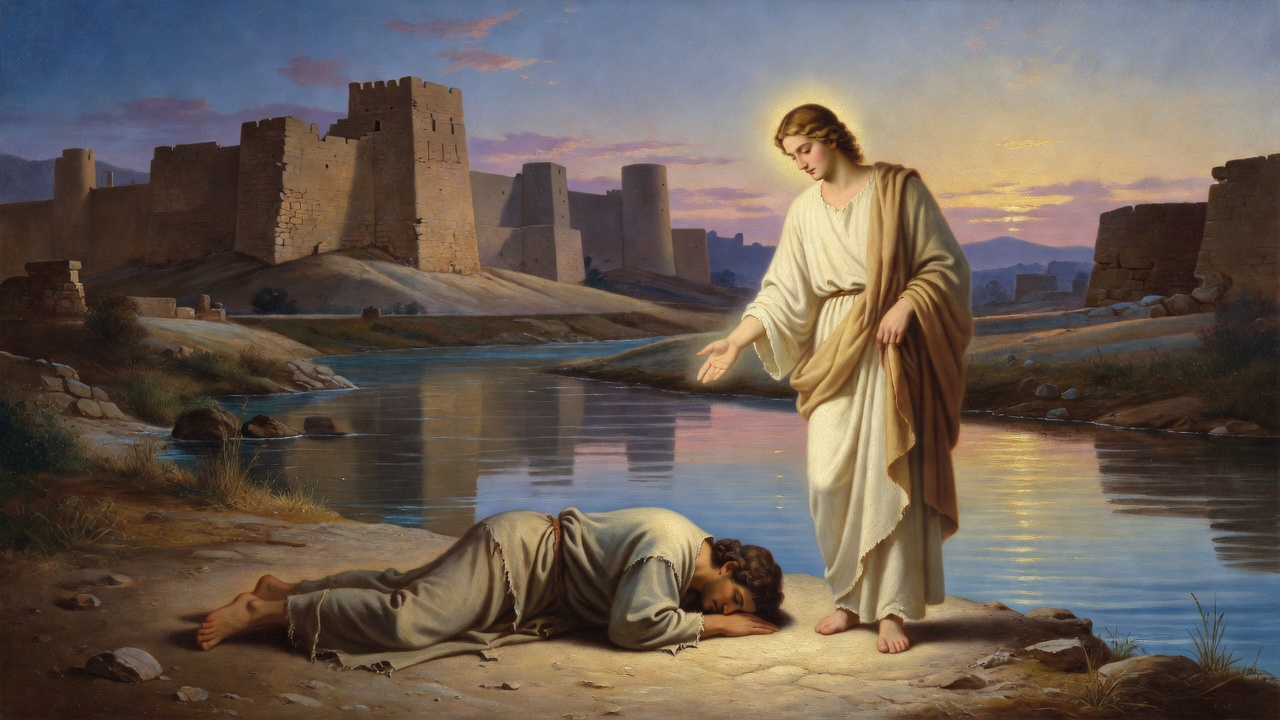
15And it came to pass, when I, even I Daniel, was beholding the chazon, that I sought the meaning; then, hinei, there stood before me as the appearance of a man. 16And I heard a kol adam (manʼs voice) amidst the Ulai, and he called, and said, Gavriel, cause this one to understand the vision. 17So he came near where I stood; and as he came, I was filled with fear, and I fell down upon my face, but he said unto me, Understand, O ben adam, the chazon (vision) points to the time of the ketz (end).
18Now while he was speaking with me, I swooned upon my face toward the ground, but he touched me, and made me stand upright. 19And he said, Hineni, I will cause thee to know that which shall take place in the latter part of HaZa'am (the Wrath period), since at a mo'ed (an appointed time) the Ketz (End) shall be. 20The ram which thou sawest having two karnayim are the melachim of Media and Paras (Persia). 21And the shaggy he-goat is melech Yavan (the king of Greece), and the keren hagedolah (great horn) that is between his eyes is the melech harishon (the first king). 22Now one being broken and four stood up in its place, four kingdoms shall stand up out of the nation, but not in its koach (strength). 23And in the latter time of their kingdom, when haposhe'im (the transgressors, the ones rebelling) are come to the full, a melech of unyielding countenance, and mastering intrigues, shall stand up. 24And his koach shall be mighty, but not by his own koach; and he shall cause astounding destruction, and shall prosper, and accomplish, and shall destroy the mighty and Am Kedoshim (the Holy People). 25And by his cunning also he shall cause mirmah (deceit) to prosper through his hand; and he shall magnify himself in his lev, and by peace shall destroy rabbim (many); he shall also stand up against the Sar Sarim (Prince of Princes); but he shall be broken without [human] hand. 26And the vision of the evening and the morning which was told is emes; and thou! Shut up the chazon; for it shall be for many yamim.
27And I Daniel was faint, and lay ill several yamim; afterward I rose up, and did the kingʼs business; and I was astonished at the vision, but without understanding it.
¿Sabías que…?
La visión del carnero y del macho cabrío
- En su visión, Daniel se ve en la ciudadela de Susa, en la provincia de Elam, junto al canal de Ulai. Susa era la antigua capital de Elam, y el Ulai, llamado por los griegos Eulaus, era un río que se dividía en dos brazos cerca de la ciudad.Fuentes: el propio texto bíblico · Susa · Ulai · Elam
- Este pasaje contiene la primera mención bíblica del ángel Gabriel por su nombre propio. Se le ordena a Gabriel explicar la visión profética a Daniel, quien cae atemorizado antes de que el ángel lo ponga de pie.Fuentes: el propio texto bíblico · Gabriel
- La visión ofrece identificaciones geopolíticas explícitas: el carnero de dos cuernos representa a los reyes de Media y de Persia, mientras que el macho cabrío representa al rey de Grecia.Fuentes: el propio texto bíblico · Media · Persia · Greece
Notas escritas con ayuda de IA a partir de fuentes abiertas (Theographic Bible Metadata, CC BY-SA 4.0; Easton’s Bible Dictionary, dominio público) y revisadas antes de publicarse.
Lugares de este capítulo
- Elam · 32.189, 48.258 · versículo 2
- Susa · Hoy: Shush · 32.189, 48.258 · versículo 2
- Canaan · 32.767, 35.333 · versículo 9
- Media · 34.806, 48.516 · versículo 20
- Persia · 34.806, 48.516 · versículo 20
- Greece · 37.972, 23.727 · versículo 21
Solo aparecen lugares identificados con alta confianza (90 % o más según las fuentes académicas reunidas por OpenBible). Mapa de la época: DARE (Digital Atlas of the Roman Empire), CC BY 4.0; mapa actual: © colaboradores de OpenStreetMap; lugares: OpenBible.info (CC BY 4.0).
Créditos y licencia de esta traducción
The Orthodox Jewish Bible
The Orthodox Jewish Bible - Tanakh and Orthodox Jewish Brit Chadasha - The Holy Bible
copyright © 2002-2011, 2021, 2024 Artists for Israel International
Language: English
Contributor: Artists for Israel International
THE ORTHODOX JEWISH TANAKH
Artists For Israel Intl Inc.
This version also appears with the Orthodox Yiddish Triglot which presents the Hebrew Yiddish script in Latin script and an English word for word translation, available at afii.org/Torah
To donate PayPal.Me
This translation is made available to you under the terms of the
Creative Commons Attribution license 4.0.
You may share and redistribute this Bible translation or extracts from it in any format, provided that:
You include the above copyright and source information.
If you make any changes to the text, you must indicate that you did so in a way that makes it clear that the original licensor is not necessarily endorsing your changes.
Pictures included with Scriptures and other documents on this site are licensed just for use with those Scriptures and documents.
For other uses, please contact the respective copyright owners.
Note that in addition to the rules above, revising and adapting God's Word involves a great responsibility to be true to God's Word. See Revelation 22:18-19.
2026-01-06
Títulos de sección adaptados de la Berean Standard Bible (dominio público); no forman parte del texto bíblico de esta traducción.
Fuente: http://ebible.org/engojb/ · eBible.org