Daniel 3
The Orthodox Jewish Bible · Toca un versículo para ver sus referencias cruzadas.
Nebuchadnezzar’s Golden Statue
1Nevukhadnetzar the king made a tzelem of gold, whose height was threescore cubits, and the breadth thereof six cubits; he set it up in the plain of Dura, in the province of Babylon. 2Then Nevukhadnetzar the king sent to gather together the satraps, the prefects, and the governors, the judges, the treasurers, the counselors, the magistrates, and all the rulers of the provinces, to come to the dedication of the tzelem which Nevukhadnetzar the king had set up. 3Then the satraps, the prefects, and governors, the judges, the treasurers, the counselors, the magistrates, and all the rulers of the provinces, were gathered together unto the dedication of the tzelem that Nevukhadnetzar the king had set up; and they stood before the tzelem that Nevukhadnetzar had set up. 4Then a karoz (herald) cried aloud, To you it is commanded, O people, nations, and languages, 5That at what time ye hear the sound of the horn, flute, harp, lyre, psaltery, pipes, and all kinds of music, ye fall down and worship the golden tzelem that Nevukhadnetzar the king hath set up; 6And whoso falleth not down and worshipeth shall the same hour be cast into the midst of a burning fiery attun (furnace). 7Therefore at that time, when all the people heard the sound of the horn, flute, harp, lyre, psaltery, and all kinds of music, all the people, the nations, and the languages, fell down and worshiped the golden tzelem that Nevukhadnetzar the king had set up.
Shadrach, Meshach, and Abednego Accused
8Wherefore at that time certain Kasdim (Chaldeans) came near, and accused the Yehudim. 9They spoke and said to the king Nevukhadnetzar, O king, live for ever. 10Thou, O king, hast made a decree, that every man that shall hear the sound of the horn, flute, harp, lyre, psaltery, and pipes, and all kinds of music, shall fall down and worship the golden tzelem; 11And whoso falleth not down and worshipeth, that he should be cast into the midst of a burning fiery attun (furnace). 12There are certain Yehudim whom thou hast set over the affairs of the province of Babylon, Shadrach, Meshach, and Abednego; these men, O king, have disregarded thee; they serve not thy g-ds, nor worship the golden tzelem which thou hast set up.
13Then Nevukhadnetzar in his rage and fury commanded to bring Shadrach, Meshach, and Abednego. Then they brought these men before the king. 14Nevukhadnetzar spoke and said unto them, Is it true, O Shadrach, Meshach, and Abednego, do ye not serve my g-ds, nor worship the golden tzelem which I have set up? 15Now if ye be ready that at what time ye hear the sound of the horn, flute, harp, lyre, psaltery, and pipes, and all kinds of music, ye fall down and worship the tzelem which I have made, well; but if ye worship not, ye shall be cast the same hour into the midst of a burning fiery attun; and who is that G-d that shall deliver you out of my hands?
16Shadrach, Meshach, and Abednego, answered and said to the king, O Nevukhadnetzar, we are not needful to answer thee in this matter. 17If it be so, Eloheinu whom we serve is able to deliver us from the burning fiery furnace, and He will deliver us out of thine hand, O king. 18But if not, be it known unto thee, O king, that we will not be the ones serving as deity thy g-ds, nor worship the golden tzelem which thou hast set up.
The Fiery Furnace
19Then was Nevukhadnetzar full of fury, and the expression on his visage was changed against Shadrach, Meshach, and Abednego; therefore he spoke, and commanded that they should heat the attun seven times hotter than usual. 20And he commanded certain gibborim (mighty men) of valor that were in his army to bind Shadrach, Meshach, and Abednego, and to cast them into the burning fiery attun. 21Then these anashim (men) were bound in their mantles, their tunics, and their turbans, and their other garments, and were cast into the midst of the burning fiery furnace. 22Therefore because the kingʼs commandment was severe, and the furnace exceedingly hot, the flames of the eish (fire) violently killed those men that took up Shadrach, Meshach, and Abednego. 23And these three men, Shadrach, Meshach, and Abednego, fell down bound into the midst of the burning fiery furnace.
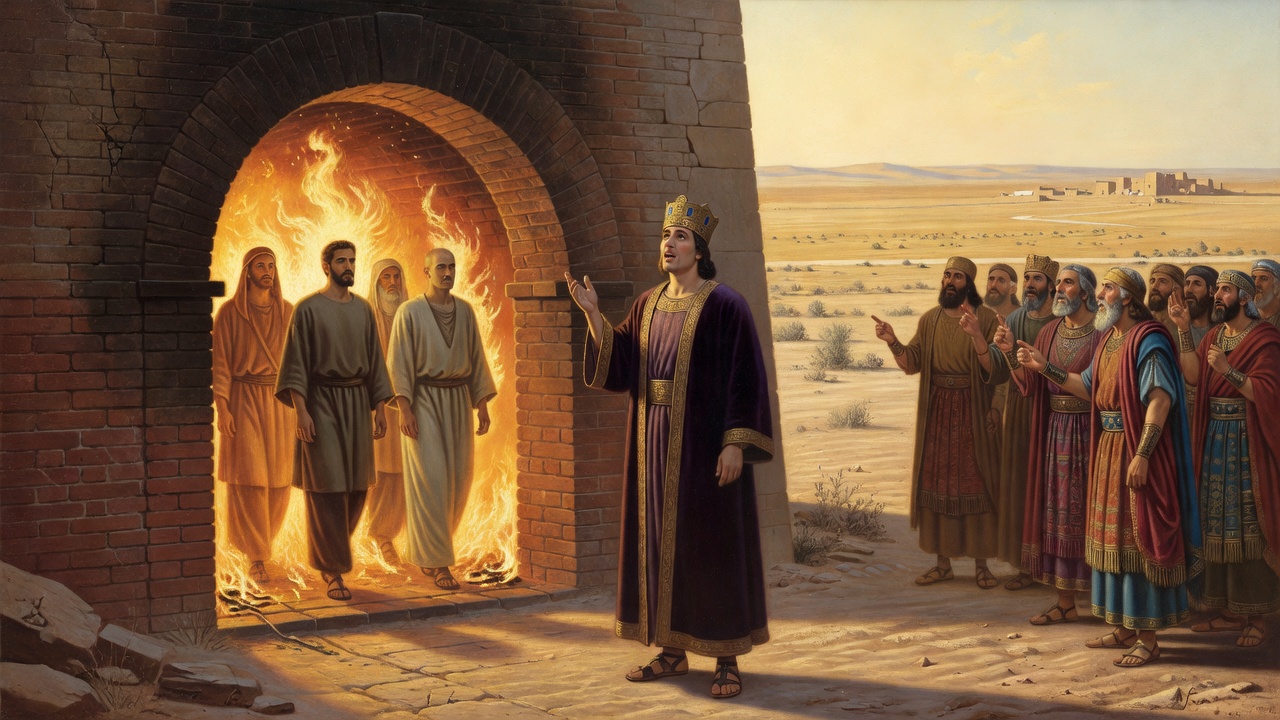
24Then Nevukhadnetzar the king was astonished, and rose up in haste, and spoke, and said unto his counselors, Did not we cast shloshah anashim (three men) bound into the midst of the eish (fire)? They answered and said unto the king, True, O king. 25He answered and said, Lo, I see anashim arba'ah (four men) free (not bound, loose), walking in the midst of the eish (fire), and they have no hurt; and the form of the fourth is like the Bar Elohin (Ben Elohim, Hebrew).
26Then Nevukhadnetzar came near to the door of the burning fiery furnace, and spoke, and said, Shadrach, Meshach, and Abednego, ye servants of El Elyon (G-d Most High), come forth, and come hither. Then Shadrach, Meshach, and Abednego, came forth of the midst of the eish (fire). 27And the satraps, governors, and administrators, and the kingʼs counselors, being gathered together, saw these men, upon whose bodies the eish (fire) had no power, nor was a hair of their head singed, neither were their garments affected, nor the smell of eish (fire) had passed on them. 28Then Nevukhadnetzar spoke, and said, Baruch Elohim shel Shadrach, Meshach, and Abednego, Who hath sent His malach, and delivered His servants that trusted in Him, and frustrated the kingʼs word, and yielded their bodies, that they might not serve, nor worship any g-d, except their own G-d. 29Therefore I make a decree, that every people, nation, and language, which speak any thing amiss against the G-d of Shadrach, Meshach, and Abednego, shall be cut in pieces, and their houses shall be made a pile of rubble, because there is no other g-d that can deliver like this.
30Then the king promoted Shadrach, Meshach, and Abednego, in the province of Babylon.
31Nevukhadnetzar the king, unto all people, nations and languages, that dwell in all the earth; Shalom aleichem l'machbir (Peace be multiplied unto you). 32I thought it good to show the otot (signs) and mofetim (wonders) that El Elyon hath wrought toward me.
33How great are His otot (signs)!
And how mighty are His mofetim (wonders)!
His kingdom is a malchut olam (everlasting kingdom),
and His dominion is from dor v'dor (generation to generation).
¿Sabías que…?
La estatua de oro y el horno ardiente
- La llanura de Dura, cuyo nombre significa "el círculo", se encontraba cerca de Babilonia, donde el rey Nabucodonosor levantó una estatua de oro de sesenta codos de alto y seis de ancho. En uno de los montículos del lugar se halló la base de una estatua colosal, considerada por investigadores como el pedestal de esta imagen de oro.Fuentes: Dura · el propio texto bíblico
- Sadrac y Mesac eran nombres babilónicos dados a los jóvenes hebreos cautivos Ananías y Misael, quienes fueron educados en Babilonia y puestos a cargo de la provincia. A pesar de su posición oficial, ellos y su compañero Abed-nego prefirieron ser arrojados al horno de fuego ardiente antes que adorar la estatua del rey.Fuentes: Shadrach · Meshach · el propio texto bíblico
- El rey Nabucodonosor, cuyo nombre en babilonio significa "¡Nebo, protege la corona!", fue el poderoso soberano que sucedió a su padre Nabopolasar. En inscripciones reales se llamaba a sí mismo "el favorito de Nebo", reflejando el entorno religioso babilónico frente al cual los tres hebreos mantuvieron su lealtad.Fuentes: Nebuchadnezzar · el propio texto bíblico
Notas escritas con ayuda de IA a partir de fuentes abiertas (Theographic Bible Metadata, CC BY-SA 4.0; Easton’s Bible Dictionary, dominio público) y revisadas antes de publicarse.
Lugares de este capítulo
Solo aparecen lugares identificados con alta confianza (90 % o más según las fuentes académicas reunidas por OpenBible). Mapa de la época: DARE (Digital Atlas of the Roman Empire), CC BY 4.0; mapa actual: © colaboradores de OpenStreetMap; lugares: OpenBible.info (CC BY 4.0).
Créditos y licencia de esta traducción
The Orthodox Jewish Bible
The Orthodox Jewish Bible - Tanakh and Orthodox Jewish Brit Chadasha - The Holy Bible
copyright © 2002-2011, 2021, 2024 Artists for Israel International
Language: English
Contributor: Artists for Israel International
THE ORTHODOX JEWISH TANAKH
Artists For Israel Intl Inc.
This version also appears with the Orthodox Yiddish Triglot which presents the Hebrew Yiddish script in Latin script and an English word for word translation, available at afii.org/Torah
To donate PayPal.Me
This translation is made available to you under the terms of the
Creative Commons Attribution license 4.0.
You may share and redistribute this Bible translation or extracts from it in any format, provided that:
You include the above copyright and source information.
If you make any changes to the text, you must indicate that you did so in a way that makes it clear that the original licensor is not necessarily endorsing your changes.
Pictures included with Scriptures and other documents on this site are licensed just for use with those Scriptures and documents.
For other uses, please contact the respective copyright owners.
Note that in addition to the rules above, revising and adapting God's Word involves a great responsibility to be true to God's Word. See Revelation 22:18-19.
2026-01-06
Títulos de sección adaptados de la Berean Standard Bible (dominio público); no forman parte del texto bíblico de esta traducción.
Fuente: http://ebible.org/engojb/ · eBible.org