Hechos 2
The Orthodox Jewish Bible · Toca un versículo para ver sus referencias cruzadas.
The Holy Spirit at Pentecost
1And when the day of Shavuos is fulfilled, they were all together in one place. 2And there was mitamuhl (suddenly) from Shomayim a sound like the rushing of a violent wind, and it filled the whole bais where they were sitting. 3And leshonot appeared to them, being divided as eish resting on each one of them, 4And all were filled with the Ruach Hakodesh, and they began to speak in leshonot acherot as the Ruach Hakodesh was giving the utterance to them.
5Now there were in Yerushalayim frum, charedi (orthodox) Yehudim from all the nations under Shomayim. 6And at this sound, the multitude assembled and was bewildered, because they were hearing, each one in his own native language, the Achim b'Moshiach speaking. 7And they were nispoyel (standing in awe) and marveled, saying, Hinei, are not all of these Galileans speaking? 8And how are we hearing, each in our own language in which we were born? 9We Parthians and Medes and Elamites; the ones living in Mesopotamia, Yehudah, Cappadocia, Pontus, Asia, 10Phrygia, Pamphylia, Mitzrayim (Egypt), and the regions of Libya around Cyrene; and the visiting Romans, 11Both Yehudim and Gerim (Proselytes), Cretan, and Arabic, we hear them speaking in other languages [than their own] of the Gevurot (mighty acts) of Hashem. 12And all had real hispailus (overwhelming awe) and were bewildered saying one to another, What can this mean? 13But others, mocking, were saying, Of sweet wine they have been filled!
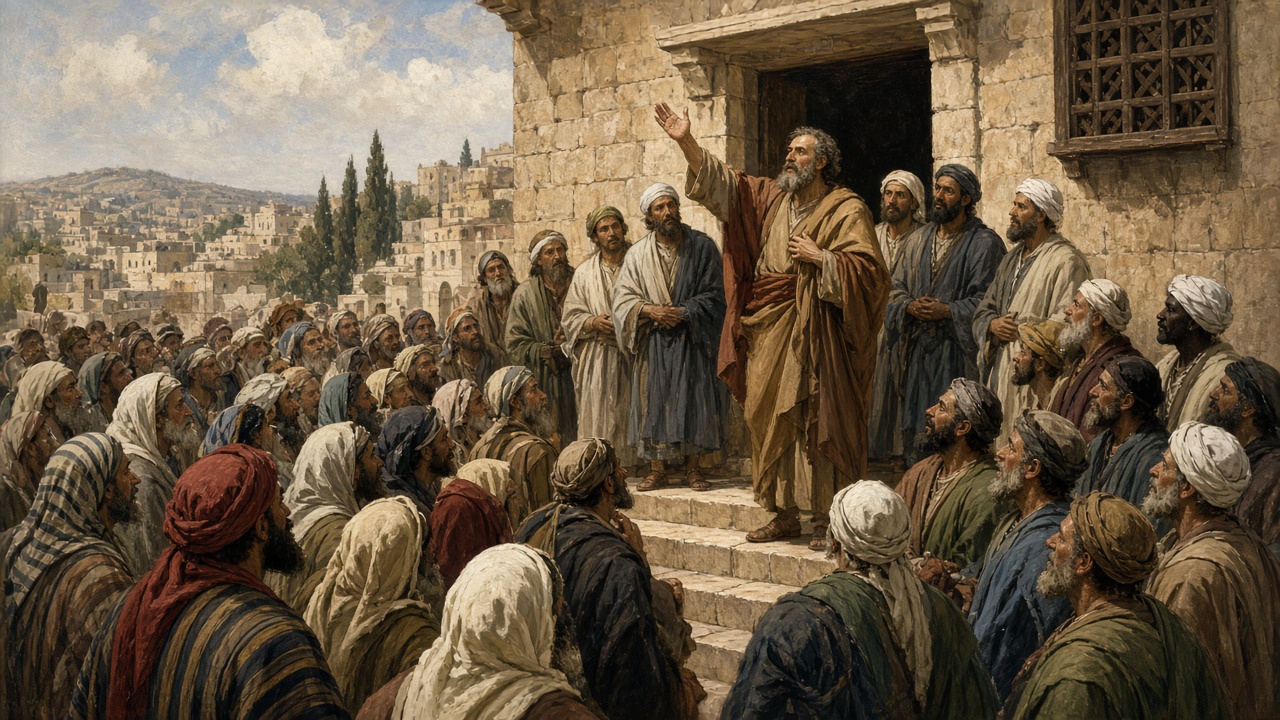
Peter Addresses the Crowd
14But Kefa, having stood with the Achad Asar, lifted up his voice and declared to them, Anashim Yehudim! And the ones inhabiting Yerushalayim, have da'as of all this and be goires (listen to) my devarim: 15For these ones are not, as you assume, in their schnaps, for it is only the third hour of the day (nine o'clock in the morning). 16But this is what has been spoken by Yoel HaNavi; 17And it shall be in the Acharit Hayamim, ne'um Hashem, ESHPOCH ES RUCHI AL KOL BASAR V'NIB'U BNEICHEM U'VENOTEICHEM ZIKNEICHEM CHALOMOT YACHALOMUN BACHUREICHEM CHEZYONOT YIRU (I will pour out my Spirit on all flesh: and your sons and daughters will prophesy, your old men will dream dreams and your bochrim will see visions). 18And upon My avadim and upon My shfakhot in BAYYAMIM HAHEMMAH ESHPOCH ES RUCHI (in those days I will pour out my Ruach [Hakodesh]) and they will speak devarim hanevu'ah: 19And I will give MOFTIM BASHOMAYIM and signs on ha'aretz below, DAHM VA'EISH V'TIMROT ASHAM (blood and fire and billows of smoke). 20The shemesh (sun) will be transformed into choshech (darkness) and the moon into blood before the great and dreadful YOM HASHEM. 21And it will be that everyone whoever calls upon the Name of Adonoi will be saved.
22Anshei Yisroel, listen to these devarim: Yehoshua of Natzeret, a man having been attested by Hashem to you by gevurot and moftim which Hashem did through him in your midst, just as you yourselves have da'as, 23This one, delivered up by the determined cheshbon (plan) and yedi'ah mukdemet (foreknowledge) of Hashem, and by the hand of lawless Bnei Adam you made him talui al HaEtz (being hanged on the Tree) and put him to death. 24But in fact Hashem made Rebbe, Melech HaMoshiach to stand up alive again, having destroyed the Chevlei HaMavet, because it was impossible for Rebbe, Melech HaMoshiach to be held by Deathʼs ko'ach. 25For Dovid Hamelech says of him, SHIVVITI HASHEM L'NEGDI TAMID, KI MIMINI BAL EMMOT (I set Adonoi before me always, because he is at my right hand I will not be shaken.) 26Therefore my heart was cheered up and my tongue exulted and in addition also my flesh, my body, will live in secure [hope]. 27Because you will not abandon the nefesh (soul) of me to destruction nor will you give your Chasid to see corruption. 28TODIEINI ORACH CHAYYIM SOVA SEMACHOT ES PANECHA (You made known to me the path of Chayyim, you will fill me with simcha in your presence).
29Anashim Achim, it is permitted to speak with bitachon (confidence) to you benoigeia (regarding) Dovid Avinu, that also he died and was buried and his kever (tomb) is with us until this day. 30Therefore, being a Navi and having da'as that with a shevu'ah (an oath) HASHEM swore to him that from his loins his zera would sit upon his KISSE… 31Foreseeing this, Dovid Hamelech spoke about the Techiyas HaMoshiach: neither was he “abandoned to destruction nor did his BASAR see corruption.” 32This Yehoshua in fact Hashem made to stand up alive again, of which we all are Edim. 33Having been exalted to the right hand of Hashem and having received the havtachah of the Ruach Hakodesh from [Elohim] HaAv, Moshiach poured out this which you also see and hear. 34For Dovid Hamelech did not ascend into Shomayim, but he says, Hashem says to Adoni, SHEV LIMINI (sit down at my right hand), 35Until I make OYVECHA (your enemies) your footstool. 36Therefore, assuredly let Klal Yisroel have da'as that this Yehoshua, whom you made talui al HaEtz (being hanged on the Tree), this one Hashem has made both Adoneinu and Rabbeinu, Melech HaMoshiach.
Three Thousand Believe
37And when they heard this, they were pierced with conviction in their levavot, and they said to Kefa and to the other of Moshiachʼs Shlichim, Achim, what shall we do? 38And Kefa said to them, Make teshuva (repentance, turning from chet to Hashem) and each of you submit to a tevilah of teshuva in the Shem of Yehoshua HaMoshiach, for the selichat avon of you, and you will receive the matanah of the Ruach Hakodesh. 39For to you is the havtachah and to your yeladim and to all the ones at a distance, as many as may YIKRA B'SHEM ADONOI ELOHEINU. 40And with many other devarim, Kefa gave solemn edut (testimony) and was warning them, Receive yeshu'at Eloheinu from this DOR IKKESH U'FETALTOL (warped and crooked generation)! 41Those, who were mekabel Besuras HaGeulah and welcomed his dvar, submitted to a tevilah of teshuva and there were added in that day nefashot (souls) beerech (approximately, dacht zich) shloshet alafim (three thousand).
The Fellowship of Believers
42And they were keseder (constantly) shtark (steadfastly) devoting themselves to the Moshiachʼs pnimiyus (innermost) Torah as handed on by Moshiachʼs Shlichim (emmisaries of the Rebbe, Melech HaMoshiach) and to being mishtatef (involved, joining) in the Messianic Chavurah (fellowship, company, group), and to the tishen (shared meals) with Betzi'at HaLechem (Breaking Bread) at the Seudos Moshiach and to the Tefillos. 43All were filled with yirat Shomayim and were nispoyel (in awe), and many moftim and otot through Moshiachʼs Shlichim were taking place. 44And all the [Jewish] Ma'aminim HaMeshichiyim were together and they were having all things in common. 45And they were selling their properties and possessions and were distributing tzedakah to everyone as someone had need. 46And yom yom, devoting themselves with one mind in the courts of the Beis Hamikdash, and from bais to bais, offering the Betzi'at HaLechem, they were together at tish with single-hearted exultation and hitlahavut. 47Praising Hashem, and having favor with all the people while G-d was adding to their number yom yom those receiving yeshu'at Eloheinu.
¿Sabías que…?
El Espíritu viene en Pentecostés
- Judíos temerosos de Dios, de todas las naciones bajo el cielo, ya vivían en Jerusalén cuando un sonido como el de un viento fuerte e impetuoso vino del cielo y llenó la casa, y los que hablaban comenzaron a proclamar las maravillas de Dios en otras lenguas. En este capítulo, “Asia” es la provincia romana de Asia Proconsular, en la parte occidental de Asia Menor, cuya capital era Éfeso, y no el continente de ese nombre. El Ponto, a lo largo de la costa sur del mar Euxino, era una provincia romana en tiempos de los apóstoles y un lugar frecuentado por muchos judíos de la Dispersión; Capadocia era la provincia más oriental y la más grande de Asia Menor.Fuentes: el propio texto bíblico · Asia · Pontus · Cappadocia
- La multitud quedó asombrada de que los que hablaban fueran galileos. Quien se puso en pie con los Once y les habló fue Simón Pedro, llamado antes Simón —es decir, Simeón, que significa “oír”—, un pescador de Betsaida, en la costa occidental del mar de Galilea, a quien su hermano menor, Andrés, llevó primero a Jesús.Fuentes: el propio texto bíblico · Simon Peter
- Pedro dijo que aquello era lo que había hablado el profeta Joel. Joel, el segundo de los doce profetas menores, era hijo de Petuel, y su historia personal solo se conoce por su libro. Pedro también citó a David, el octavo y el menor de los hijos de Isaí, de Belén, y dijo a la multitud que ese patriarca había muerto y había sido sepultado, y que su sepulcro aún estaba con ellos en Jerusalén.Fuentes: el propio texto bíblico · Joel · David
Notas escritas con ayuda de IA a partir de fuentes abiertas (Theographic Bible Metadata, CC BY-SA 4.0; Easton’s Bible Dictionary, dominio público) y revisadas antes de publicarse.
Lugares de este capítulo
- Jerusalem · 31.777, 35.234 · versículos 5, 14
- Galilee · 32.760, 35.527 · versículo 7
- Asia · 38.400, 28.300 · versículo 9
- Cappadocia · 38.671, 34.839 · versículo 9
- Judea · Hoy: Judea 1 · 31.777, 35.234 · versículos 9, 14
- Mesopotamia · Hoy: Aram-naharaim · 36.864, 39.033 · versículo 9
- Pontus · 40.680, 37.830 · versículo 9
- Cyrene · 32.821, 21.851 · versículo 10
- Egypt · 30.129, 31.308 · versículo 10
- Libya · 32.821, 21.851 · versículo 10
- Pamphylia · 37.000, 31.000 · versículo 10
- Phrygia · 39.000, 31.000 · versículo 10
- Rome · 41.892, 12.485 · versículo 10
- Nazareth · 32.702, 35.298 · versículo 22
Solo aparecen lugares identificados con alta confianza (90 % o más según las fuentes académicas reunidas por OpenBible). Mapa de la época: DARE (Digital Atlas of the Roman Empire), CC BY 4.0; mapa actual: © colaboradores de OpenStreetMap; lugares: OpenBible.info (CC BY 4.0).
Créditos y licencia de esta traducción
The Orthodox Jewish Bible
The Orthodox Jewish Bible - Tanakh and Orthodox Jewish Brit Chadasha - The Holy Bible
copyright © 2002-2011, 2021, 2024 Artists for Israel International
Language: English
Contributor: Artists for Israel International
THE ORTHODOX JEWISH TANAKH
Artists For Israel Intl Inc.
This version also appears with the Orthodox Yiddish Triglot which presents the Hebrew Yiddish script in Latin script and an English word for word translation, available at afii.org/Torah
To donate PayPal.Me
This translation is made available to you under the terms of the
Creative Commons Attribution license 4.0.
You may share and redistribute this Bible translation or extracts from it in any format, provided that:
You include the above copyright and source information.
If you make any changes to the text, you must indicate that you did so in a way that makes it clear that the original licensor is not necessarily endorsing your changes.
Pictures included with Scriptures and other documents on this site are licensed just for use with those Scriptures and documents.
For other uses, please contact the respective copyright owners.
Note that in addition to the rules above, revising and adapting God's Word involves a great responsibility to be true to God's Word. See Revelation 22:18-19.
2026-01-06
Títulos de sección adaptados de la Berean Standard Bible (dominio público); no forman parte del texto bíblico de esta traducción.
Fuente: http://ebible.org/engojb/ · eBible.org