Hechos 13
The Orthodox Jewish Bible · Toca un versículo para ver sus referencias cruzadas.
Paul’s First Missionary Journey Begins
1Now there was in Antioch there among the Moshiachʼs Kehillah nevi'im and morim: Bar-Nabba, and Shim'on called Niger, and Lucius from Cyrene, and Menachem (brought up with Herod the tetrarch) and [Rav] Sha'ul. 2They were ministering to Adonoi and under a tzom when the Ruach Hakodesh said to them, Set apart for Me Bar-Nabba and Sha'ul for the avodas kodesh ministry to which I have called them. 3Then, having continued the tzom and having davened and having laid their hands upon them, they sent them off.
On Cyprus
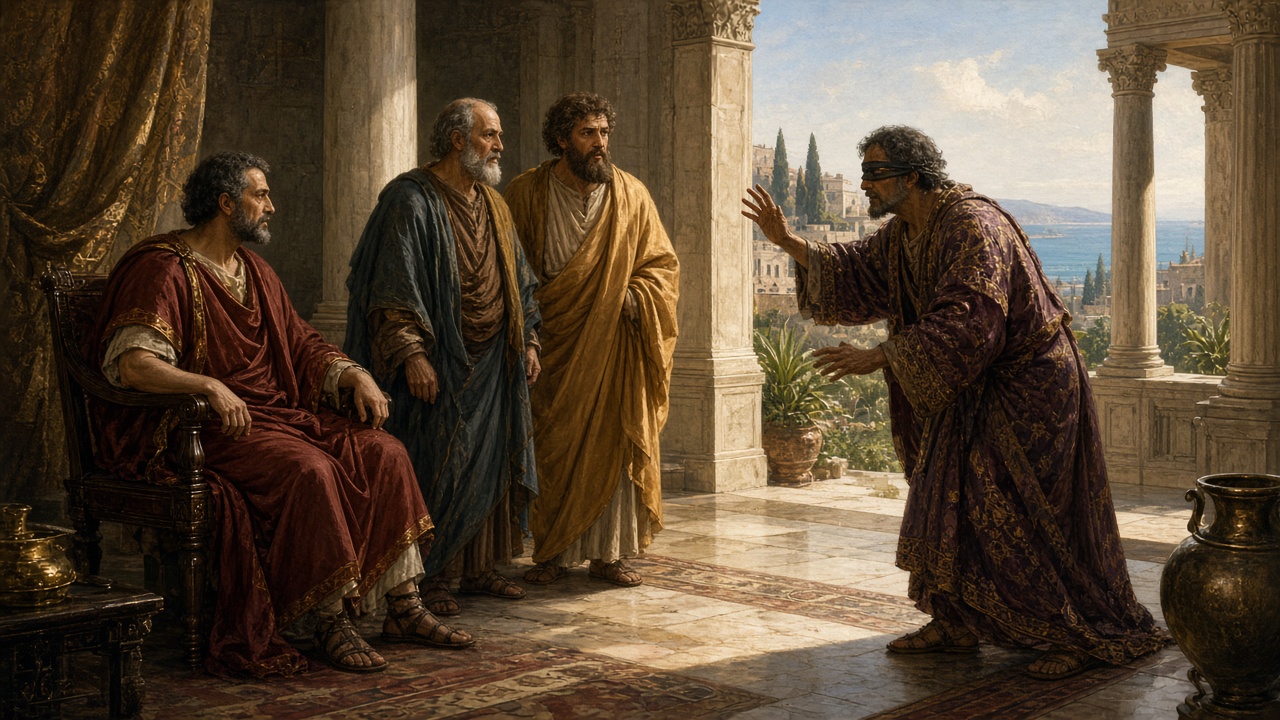
4They, then, having been sent out by the Ruach Hakodesh, went down to Seleucia, and from there sailed away to Cyprus. 5Having arrived in Salamis, they were proclaiming the dvar Hashem in the shuls, with Yochanan Markos also as ozer (helper). 6Having passed through the whole island as far as Paphos, they found a certain ish, a magician, a Jewish navi sheker, by name of Bar-Yehoshua, 7who was with the proconsul Sergius Paulus, an ish of seichel. This one, having summoned Bar-Nabba and Sha'ul, sought to hear the dvar Hashem. 8But Elymas the magician was opposing them — for thus is his name translated — and was seeking to be mashpia on the proconsul (seeking to sway him to think undesirably) about the emunah (faith). 9But Rav Sha'ul, the one also called Paulos, having been filled with the Ruach Hakodesh, gazed at him, 10and said, O ish full of all mirmah (deceit, fraud) and all resha, ben haSatan, oyev (enemy) of all Tzedek, will you not cease making crooked the straight paths of Hashem? 11Now — hinei — the yad Hashem is on you, and you will be blind, not seeing the shemesh (sun) for awhile. Immediately mistiness and choshech (darkness) fell on him, and, going about, he was seeking someone to lead him by the hand. 12Then, the proconsul, having seen what had happened, had emunah, being nispoyel (standing in awe) at the torah about Rebbe, Melech HaMoshiach Adoneinu.
In Pisidian Antioch
13And having put out to sea from Paphos, Rav Sha'ul and those with him came to Perga of Pamphylia. But Yochanan (Markos), having left them, returned to Yerushalayim. 14But having gone on from Perga, they came to Pisidian Antioch, and, having entered the shul on Shabbos, they sat down. 15After the kri'at HaTorah (reading of the Sefer Torah) and the kri'at HaNevi'im, the Rashei Beit HaKnesset sent to them, saying Anashim Achim, if there is any dvar hachizzuk among you to the people, say it. 16And having got up and having motioned with his hand, Rav Sha'ul said, Anshei Yisroel, and Yirei Elohim, listen! 17Elohei HaAm Yisroel chose Avoteinu. Hashem made the people great during their sojourn in Eretz Mitzrayim, and with an uplifted arm He led them out of it, 18and lav davka (approximately) ARBA'IM SHANAH He put up with them in the desert. 19And having destroyed SHIVAH GOYIM in eretz Kena'an, he gave as a nachalah (an inheritance) their land 20during lav davka (approximately) arba me'ot vachamashim shanah. After these things, He gave shofetim until Shmuel HaNavi. 21And then they asked for a melech, and Hashem gave to them Sha'ul Ben Kish, an ish from the shevet of Binyamin, for arba'im shanah. 22And after having removed Sha'ul, Hashem raised up Dovid as a Melech for them. About Dovid also Hashem testified, saying, I found Dovid Ben Yishai an ISH KILEVAVI who will do all My ratzon. 23From the zera (seed) of this man, according to the havtachah (promise), Hashem has brought to Yisroel a Moshi'a (Savior), Yehoshua. 24Now previously, before the coming of Moshiach, Yochanan proclaimed to Klal Yisroel a tevilah of teshuva. 25Now as Yochanan was completing his course, he was saying, What do you suppose me to be? I am not! But, hinei, he comes after me of whom I am not worthy to untie the sandal of his feet.
26Achim, Bnei Mishpochah Avraham, and Yirei Elohim, it is to us that the dvar of this Yeshu'ah HaGedolah (Great Deliverance) was sent out. 27For the ones dwelling in Yerushalayim and their moshlim (rulers) did not have da'as of this one or of the devarim of the Nevi'im being read every Shabbos; they fulfilled these devarim by condemning him. 28Even without finding a cause for a mishpat mavet, they asked Pilate that he be done away with. 29When they finished all the things having been written about him, he was taken down from HaEtz, and they put him into a kever (tomb). 30But Hashem made him to stand up alive again from the Mesim, 31and he was seen over many yamim by the ones having come up with him from the Galil to Yerushalayim who now are his edim to the people. 32And we are preaching to you the Besuras HaGeulah of the Havtachah made to Avoteinu, 33That Hashem has fulfilled this havtachah for us, their banim, having made to stand up alive again Rebbe, Melech HaMoshiach Yehoshua, as also in the Tehillim it has been written, BENI ATAH, ANI HAYOM YELIDETICHA (You are My son; today I have become your father). 34And that He made him to stand up alive again from the Mesim, no longer to return to decay, thus he has said, I will give you CHASEDEI DOVID HANE'EMANIM. 35Therefore, also elsewhere in the Tehillim, he says LO TITEN CHASIDECHA LIR'OT SHACHAT (You will not allow your Chasid [Moshiach] to undergo decay). 36For Dovid, after in his own dor (generation) he had served birtzon Hashem, fell asleep, and VAYISHKAV DOVID IM AVOTAV (and Dovid rested with his fathers) and he experienced decay. 37But whom Hashem made to stand up alive again did not experience decay. 38Let it be known, therefore, to you, Anashim Achim, that through this one, selicha (forgiveness) of chatta'im (averos [sins]) is proclaimed to you; and from all things of which by the Torah of Moshe Rabbenu you were not able to be justified, 39By this one everyone having emunah is justified. 40Be shomer then that the thing having been spoken by the Nevi'im (Prophets) may not come upon you, 41Look, scoffers, And be amazed and marvel, and stand in awe and perish, because I am working a work in your yamim, a work which you may by no means believe if someone should tell you.
A Light for the Gentiles
42And as Rav Sha'ul and Bar-Nabba were going out, the people were begging that these devarim be spoken to them the following Shabbos. 43And when the gathering was dismissed, rabbim (many) of the Yehudim and of the Gerim (Proselytes) with chassidus followed Rav Sha'ul and Bar-Nabba, who urged them to remain in the Chen v'Chesed Hashem.
44Now on the following Shabbos nearly all the city was assembled to hear the dvar Hashem. 45But when the Yehudim saw the multitudes, they were filled with kinah and were choilek (taking issue) and speaking keneged (against, in opposition to) the things being spoken by Rav Sha'ul, and they were committing Chillul Hashem. 46And having spoken with ometz lev (boldness), Rav Sha'ul and Bar-Nabba said, To you it was necessary rishonah (first) for the dvar Hashem to be spoken; vi-bahlt (since) you reject it, and judge yourselves not worthy of Chayyei Olam, hinei, we are turning to the Goyim. 47For thus has Hashem commanded us, I have placed you as a light to the Nations, that you should bring salvation to the end of the earth.
48Now hearing this, the Goyim rejoiced with simcha gedolah and were praising the dvar Hashem. And as many as had been destined to Chayyei Olam became ma'aminim hameshichiyim. 49And the dvar Hashem was spreading through the entire region. 50But the Yehudim aroused the chashuve (prominent) G-d fearing nashim and the gontser machers of the city, and they instigated redifah keneged Rav Sha'ul and Bar-Nabba, and they drove them from out of their territory. 51And having shaken off the dust of their feet against them, Rav Sha'ul and Bar-Nabba came to Iconium; 52And the talmidim were being filled with simcha and the Ruach Hakodesh.
¿Sabías que…?
La misión enviada desde Antioquía
- El Diccionario Bíblico de Easton (1897) describe a Antioquía de Siria como la tercera ciudad en importancia del Imperio romano, después de Roma y Alejandría; fue la iglesia de allí la que apartó a Bernabé y a Saulo. Entre sus profetas y maestros estaban Simeón, llamado Níger, un sobrenombre que significa negro, quizá por su tez oscura, y Lucio de Cirene, en el norte de África.Fuentes: Antioch (Syria) · el propio texto bíblico · Simeon · Lucius
- En Pafos, capital de Chipre y residencia del gobernador romano, un hechicero judío llamado Barjesús, también conocido como Elimas, un nombre árabe que significa mago o hechicero, intentó apartar de la fe al procónsul Sergio Paulo. Es aquí donde Saulo también es llamado Pablo; el Diccionario Bíblico de Easton (1897) dice que el nombre Pablo probablemente le fue dado en la infancia para usarlo en el mundo gentil, mientras que Saulo era su nombre hebreo de casa.Fuentes: Paphos · Elymas · Paul · el propio texto bíblico
- Enviados desde Antioquía, bajaron a Seleucia, el puerto de la ciudad cerca de la desembocadura del Orontes, y navegaron hasta Chipre; después desembarcaron en Perge, capital de Panfilia, a orillas del río Cestro. Allí Juan los dejó y regresó a Jerusalén; su nombre romano, Marcos, poco a poco llegó a reemplazar su nombre judío, y era primo de Bernabé.Fuentes: Seleucia · Perga · John Mark · el propio texto bíblico
Notas escritas con ayuda de IA a partir de fuentes abiertas (Theographic Bible Metadata, CC BY-SA 4.0; Easton’s Bible Dictionary, dominio público) y revisadas antes de publicarse.
Lugares de este capítulo
- Antioch · Hoy: Antioch on the Orontes · 36.227, 36.172 · versículo 1
- Cyrene · 32.821, 21.851 · versículo 1
- Cyprus · 35.000, 33.000 · versículo 4
- Seleucia · Hoy: Seleucia Pieria · 36.124, 35.922 · versículo 4
- Salamis · 35.185, 33.902 · versículo 5
- Paphos · Hoy: New Paphos · 34.756, 32.404 · versículos 6, 13
- Jerusalem · 31.777, 35.234 · versículos 13, 27, 31
- Pamphylia · 37.000, 31.000 · versículo 13
- Perga · 36.960, 30.854 · versículos 13, 14
- Antioch · Hoy: Antioch in Pisidia · 38.306, 31.189 · versículo 14
- Pisidia · 38.306, 31.189 · versículo 14
- Egypt · 30.129, 31.308 · versículo 17
- Canaan · 32.767, 35.333 · versículo 19
- Galilee · 32.760, 35.527 · versículo 31
- Iconium · Hoy: Konya · 37.872, 32.492 · versículo 51
Solo aparecen lugares identificados con alta confianza (90 % o más según las fuentes académicas reunidas por OpenBible). Mapa de la época: DARE (Digital Atlas of the Roman Empire), CC BY 4.0; mapa actual: © colaboradores de OpenStreetMap; lugares: OpenBible.info (CC BY 4.0).
Créditos y licencia de esta traducción
The Orthodox Jewish Bible
The Orthodox Jewish Bible - Tanakh and Orthodox Jewish Brit Chadasha - The Holy Bible
copyright © 2002-2011, 2021, 2024 Artists for Israel International
Language: English
Contributor: Artists for Israel International
THE ORTHODOX JEWISH TANAKH
Artists For Israel Intl Inc.
This version also appears with the Orthodox Yiddish Triglot which presents the Hebrew Yiddish script in Latin script and an English word for word translation, available at afii.org/Torah
To donate PayPal.Me
This translation is made available to you under the terms of the
Creative Commons Attribution license 4.0.
You may share and redistribute this Bible translation or extracts from it in any format, provided that:
You include the above copyright and source information.
If you make any changes to the text, you must indicate that you did so in a way that makes it clear that the original licensor is not necessarily endorsing your changes.
Pictures included with Scriptures and other documents on this site are licensed just for use with those Scriptures and documents.
For other uses, please contact the respective copyright owners.
Note that in addition to the rules above, revising and adapting God's Word involves a great responsibility to be true to God's Word. See Revelation 22:18-19.
2026-01-06
Títulos de sección adaptados de la Berean Standard Bible (dominio público); no forman parte del texto bíblico de esta traducción.
Fuente: http://ebible.org/engojb/ · eBible.org