1 Samuel 9
The Orthodox Jewish Bible · Toca un versículo para ver sus referencias cruzadas.
Saul Chosen as King
1Now there was an ish of Binyamin, shmo Kish Ben Aviel Ben Tzeror Ben Bechorat Ben Aphiach, an ish of Binyamin, a gibbor chayil (man of valor). 2And he had a ben, shmo Sha'ul, a handsome bochur; and there was not among the Bnei Yisroel one more handsome than he; he was head and shoulders taller than kol HaAm.
3And the donkeys of Kish Avi Sha'ul were lost. And Kish said to Sha'ul bno, Take now one of the ne'arim with thee, and arise, go look for the donkeys.
4And he passed through har Ephrayim, and passed through Eretz Shalishah, but they found them not; then they passed through Eretz Sha'alim, and they were not there; and he passed through the territory of Binyamin, but they found them not. 5And when they were come to Eretz Tzuph, Sha'ul said to his na'ar that was with him, Come, and let us return; lest Avi stop caring for the donkeys, and become concerned for us. 6And he said unto him, Hinei now, there is in this town an Ish Elohim, an ish nikhbad (an honorable man); all that he saith cometh surely to pass; now let us go there; perhaps he can show us darkeinu (our way) that we should go. 7Then said Sha'ul to his na'ar, But, hinei, if we go, what shall we bring the Ish? For the lechem is all gone in our vessels, and there is not a teshurah (gift) for the Ish HaElohim: what have we? 8And the na'ar answered Sha'ul again, and said, Hinei, I have here at hand the fourth part of a shekel of kesef; that will I give to the Ish HaElohim, to tell us darkeinu (our way).
9Beforetime in Yisroel, when an ish went to inquire of Elohim, thus he spoke, Come, and let us go to the ro'eh (seer): for he that is now called a navi was beforetime called a ro'eh (seer).
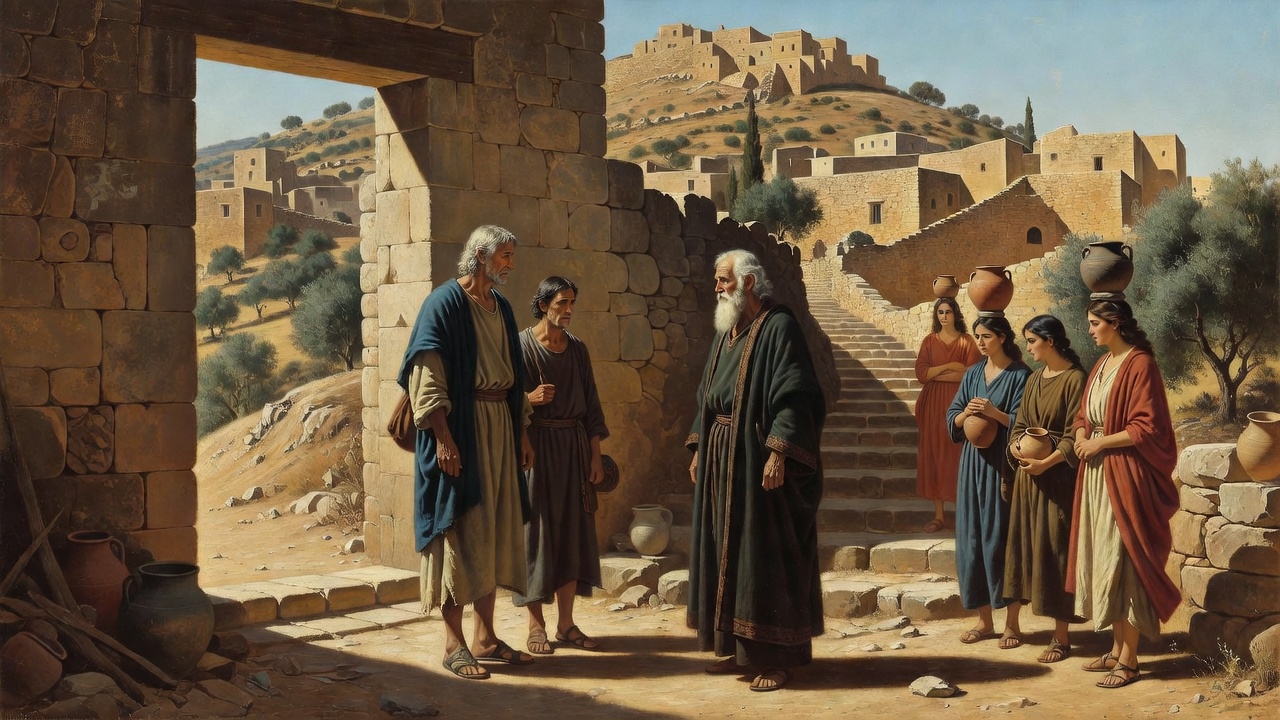
10Then said Sha'ul to his na'ar, Well said; come, let us go. So they went unto the town where the Ish HaElohim was. 11And as they went up the hill to the town, they found ne'arot (girls) going out to draw mayim, and said unto them, Is the ro'eh here? 12And they answered them, and said, He is; hinei, he is ahead of you; make haste now, for he came today to the town; for there is a zevach (sacrifice) for HaAm today in the bamah (high place); 13As soon as ye be come into the town, ye shall straightway find him, before he go up to the high place to eat; for HaAm will not eat until he come, because hu yevarech hazevach (he doth bless the sacrifice); and afterwards hakeru'im (the ones being invited) eat. Now therefore get you up; for about this time ye shall find him.
14And they went up into the town; and when they were come into the town, hinei, Shmuel came out toward them as he was going up to the bamah (high place). 15Now Hashem galah (had revealed, unveiled) in the ozen (ear) of Shmuel yom echad before Sha'ul came, saying, 16Makhar (tomorrow) about this time I will send thee an ish out of Eretz Binyamin, and umeshachto (thou shalt anoint him) to be Nagid over My people Yisroel, that he may save My people out of the yad Pelishtim; for I have looked upon My people, because their cry has come unto Me.
17And when Shmuel saw Sha'ul, Hashem said unto him, Hinei haIsh whom I spoke to thee of! This same shall rule over My people. 18Then Sha'ul drew near to Shmuel in the sha'ar, and said, Tell me, now, where is the Bais HaRo'eh. 19And Shmuel answered Sha'ul, and said, I am the Ro'eh (seer): go up before me unto the bamah (high place); for ye shall eat with me hayom, and baboker I will let thee go, and will tell thee all that is in thine levav.
20And as for thine donkeys that were lost hayom sheloshet hayamim (now three days), set not thy mind on them; for they are found. And on whom is kol chemdat Yisroel (all the Desire of Yisroel)? Is it not on thee, and on Kol Bais Avicha? 21And Sha'ul answered and said, Am not I of Binyamin, of the smallest of the Shivtei Yisroel? And my mishpakhat the least of all the mishpekhot of the Shivtei Binyamin? Wherefore then speakest thou so to me?
22And Shmuel took Sha'ul and his na'ar, and brought them into the room, and made them sit at the makom berosh (chief place) among hakeru'im (the ones being invited), which were about shloshim ish. 23And Shmuel said unto the tabakh (cook), Bring the portion which I gave thee, of which I said unto thee, Set it aside for thee. 24And the tabakh took up the shok (thigh piece), and that which was upon it, and set it before Sha'ul. And Shmuel said, Hinei that which is set aside! Set it before thee, and eat; for unto this mo'ed hath it been set aside for thee since I said, I have invited HaAm. So Sha'ul did eat with Shmuel that day. 25And when they were come down from the bamah (high place) into the town, Shmuel communed with Sha'ul upon the gag (rooftop).
26And they arose early; and it came to pass about shachar, that Shmuel called Sha'ul to the gag (rooftop), saying, Up, that I may send thee away. And Sha'ul arose, and they went out both of them, he and Shmuel, outside. 27And as they were going down to the outskirts of the town, Shmuel said to Sha'ul, Bid the na'ar pass on before us (and he passed on), but stand thou still a while, that I may show thee the Devar Elohim.
¿Sabías que…?
La búsqueda de Saúl y el encuentro con Samuel
- El recorrido de Saúl en busca de las asnas perdidas de su padre lo llevó por la región montañosa de Efraín, la tierra de Salisa, la región de Saalim y finalmente al distrito de Zuf, donde se encontraba Ramá, la ciudad natal de Samuel.Fuentes: el propio texto bíblico · Saul · Zuph
- El relato aclara que el término 'profeta' reemplazó al más antiguo 'vidente' con el paso del tiempo. Consultar a un hombre de Dios solía incluir la entrega de un modesto presente de cortesía, como el cuarto de siclo de plata que ofreció el siervo de Saúl.Fuentes: el propio texto bíblico
- En los banquetes sacrificiales locales celebrados en los lugares altos, era costumbre que el sacerdote o profeta bendijera la comida antes de que los invitados comieran. Samuel honró a Saúl sentándolo en el lugar de honor entre unos treinta invitados y sirviéndole una porción selecta reservada.Fuentes: el propio texto bíblico
Notas escritas con ayuda de IA a partir de fuentes abiertas (Theographic Bible Metadata, CC BY-SA 4.0; Easton’s Bible Dictionary, dominio público) y revisadas antes de publicarse.
Créditos y licencia de esta traducción
The Orthodox Jewish Bible
The Orthodox Jewish Bible - Tanakh and Orthodox Jewish Brit Chadasha - The Holy Bible
copyright © 2002-2011, 2021, 2024 Artists for Israel International
Language: English
Contributor: Artists for Israel International
THE ORTHODOX JEWISH TANAKH
Artists For Israel Intl Inc.
This version also appears with the Orthodox Yiddish Triglot which presents the Hebrew Yiddish script in Latin script and an English word for word translation, available at afii.org/Torah
To donate PayPal.Me
This translation is made available to you under the terms of the
Creative Commons Attribution license 4.0.
You may share and redistribute this Bible translation or extracts from it in any format, provided that:
You include the above copyright and source information.
If you make any changes to the text, you must indicate that you did so in a way that makes it clear that the original licensor is not necessarily endorsing your changes.
Pictures included with Scriptures and other documents on this site are licensed just for use with those Scriptures and documents.
For other uses, please contact the respective copyright owners.
Note that in addition to the rules above, revising and adapting God's Word involves a great responsibility to be true to God's Word. See Revelation 22:18-19.
2026-01-06
Títulos de sección adaptados de la Berean Standard Bible (dominio público); no forman parte del texto bíblico de esta traducción.
Fuente: http://ebible.org/engojb/ · eBible.org