1 Samuel 6
The Orthodox Jewish Bible · Toca un versículo para ver sus referencias cruzadas.
The Ark Returned to Israel
1And the Aron Hashem was in the territory of the Pelishtim (Philistines) shivah chodashim. 2And the Pelishtim (Philistines) called for the kohanim and the kosemim (sorcerers), saying, What shall we do with the Aron Hashem? Tell us wherewith we shall send it to its makom (place). 3And they said, If ye send away the Aron Elohei Yisroel, send it not away empty; but ye shall surely return to Him an asham (trespass offering); then ye shall be healed, and it shall be known to you why His Yad is not removed from you. 4Then they said, What shall be the asham (trespass offering) which we shall return to Him? They answered, Five techorim of zahav, and five akhbarim (rats) of zahav, according to the number of rulers of the Pelishtim: for one magefah (plague) was on you all, and on your rulers. 5So ye shall make tzalmei techorim (likenesses of tumors) of yours, and tzalmei akhabarim (likenesses of rats) of yours, of that which mar the land; and ye shall give kavod unto Elohei Yisroel; perhaps He will lighten His Yad from off you, and from off eloheichem (your g-ds), and from off your land. 6Now then why do ye harden levavchem, as the Mitzrayim and Pharaoh hardened their hearts? When He had wrought wonderfully among them, did they not send them away, so that they departed? 7Now therefore make an agalah chadashah (new cart, wagon), and take two milch cows, on which there hath come no ol (yoke), and hitch the cows to the agalah, and take their calves home, away from them; 8And take the Aron Hashem, and lay it upon the agalah; and put the kelei hazahav, which ye send back to Him for an asham (trespass offering), in a box by the side thereof; and send it away, that it may go. 9And see: if it goeth up by the derech of its own territory toward Beit-Shemesh, then He hath done us this ra'ah hagedolah (great disaster); but if not, then we shall know that it is not His Yad that struck us; the evil came upon us mikreh (by chance, by accident).
10And the anashim did so; and took two milch cows, and hitched them to the agalah, and penned up their calves babayit; 11And they laid the Aron Hashem upon the agalah, and the box with the akhbarim of zahav and the tzalmei techorim (likenesses of tumors) of theirs. 12And the cows took the straight derech to the derech Beit-Shemesh, and went along the path, lowing as they went, and turned not aside to the yamin or to the semol; and the rulers of the Pelishtim went after them as far as the border of Beit-Shemesh.
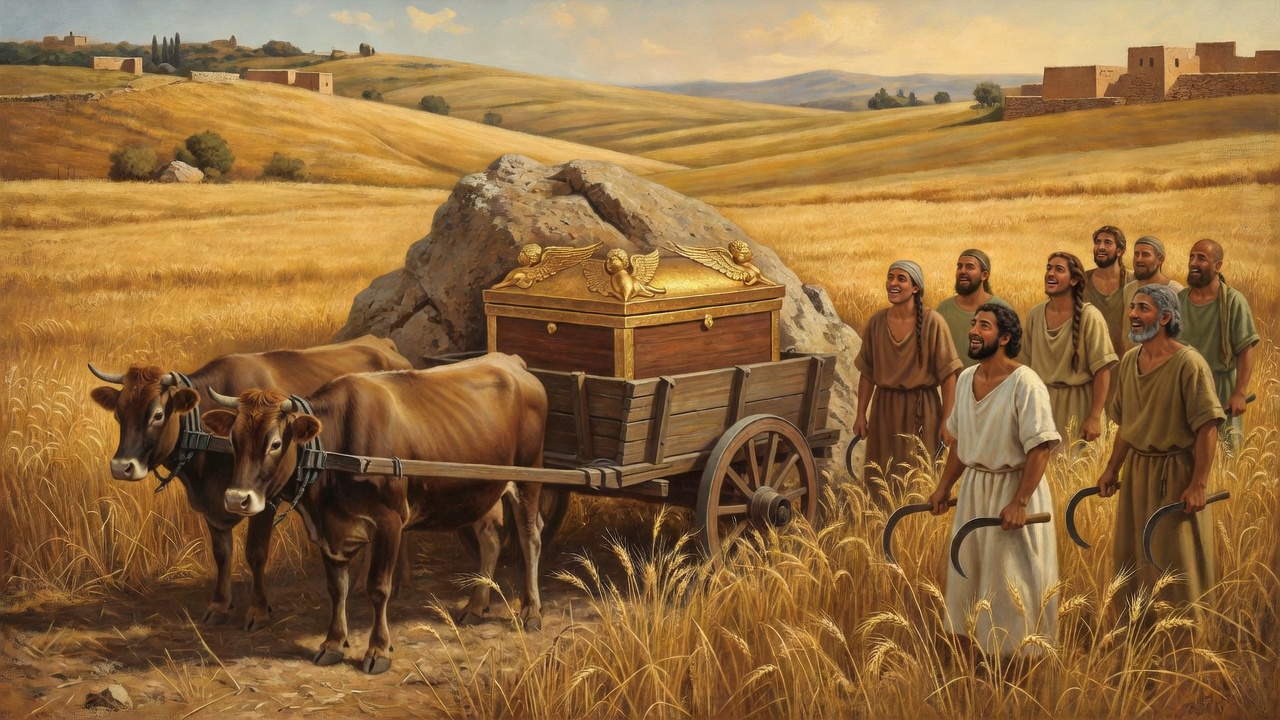
13And they of Beit-Shemesh were kotzerim (harvesting) their ketzir chittim (wheat harvest) in the valley; and they lifted up their eyes, and saw the Aron, and they rejoiced to see it. 14And the agalah came into the sadeh of Yehoshua, a man of Beit-Shemesh, and stopped there, where there was an even gedolah (a large rock); and they chopped up the wood of the agalah, and offered the cows as an olah (burnt offering) unto Hashem. 15And the Levi'im took down the Aron Hashem, and the box that was with it, wherein were the kelei zahav, and put them on the even hagedolah (large rock); and the anashim of Beit-Shemesh offered olot (burnt offerings) and sacrificed zevakhim (sacrifices) on that day unto Hashem.
16And when the five rulers of the Pelishtim saw it, they returned to Ekron on that same day.
17And these are the techorim (tumors) of zahav which the Pelishtim (Philistines) returned for an asham (trespass offering) unto Hashem; for Ashdod one, for Azah (Gaza) one, for Ashkelon one, for Gat one, for Ekron one; 18And the akhbarim of zahav, according to the mispar of all the towns of the Pelishtim (Philistines) belonging to the five rulers, both of fortified cities and of country villages, even unto Avel HaGedolah, whereon they set down the Aron Hashem; it [the even hagedolah] remaineth unto this day in the sadeh of Yehoshua, the man of Beit-Shemesh.
19And He struck down the anashim of Beit-Shemesh, because they had looked into the Aron Hashem, even He struck down of HaAm shivim ish; and HaAm mourned, because Hashem had struck down many of HaAm with a makkah gedolah (a great stroke, blow). 20And the anashim of Beit-Shemesh said, Who is able to stand before Hashem HaElohim HaKadosh Hazeh ( Hashemthis holy G-d)? And to whom shall He go up from us?
21And they sent malachim to the inhabitants of Kiryat-Ye'arim saying, The Pelishtim (Philistines) have returned the Aron Hashem; come ye down, and take it up to you.
¿Sabías que…?
El retorno del Arca
- Los gobernantes filisteos representaban una confederación de cinco ciudades principales: Asdod, Gaza, Ascalón, Gat y Ecrón. Para buscar alivio de las plagas que sufrieron, sus sacerdotes y adivinos aconsejaron enviar una ofrenda por la culpa con cinco tumores y cinco ratones de oro, que correspondían a los cinco príncipes y sus territorios.Fuentes: el propio texto bíblico · Ashdod · Gaza · Ashkelon
- Bet-semes era una ciudad sacerdotal en el límite norte de Judá. Esta condición sacerdotal explica la presencia de levitas que pudieron bajar el Arca y colocarla sobre la gran roca en el campo durante la siega del trigo.Fuentes: el propio texto bíblico · Beth-shemesh
- Para comprobar si sus calamidades provenían del Dios de Israel o si habían ocurrido por casualidad, los filisteos uncieron al carro dos vacas que criaban y que nunca habían llevado yugo, encerrando a sus terneros. Contra el instinto maternal natural, las vacas avanzaron directamente por el camino hacia Bet-semes sin desviarse.Fuentes: el propio texto bíblico
Notas escritas con ayuda de IA a partir de fuentes abiertas (Theographic Bible Metadata, CC BY-SA 4.0; Easton’s Bible Dictionary, dominio público) y revisadas antes de publicarse.
Lugares de este capítulo
- Ekron · Hoy: Tel Miqne · 31.777, 34.852 · versículos 16, 17
- Ashdod · Hoy: Tel Ashdod · 31.757, 34.658 · versículo 17
- Ashkelon · Hoy: Tel Ashkelon · 31.664, 34.546 · versículo 17
- Gaza · Hoy: Tell Harube · 31.504, 34.464 · versículo 17
- Kiriath-jearim · Hoy: Deir el Azar · 31.809, 35.104 · versículo 21
Solo aparecen lugares identificados con alta confianza (90 % o más según las fuentes académicas reunidas por OpenBible). Mapa de la época: DARE (Digital Atlas of the Roman Empire), CC BY 4.0; mapa actual: © colaboradores de OpenStreetMap; lugares: OpenBible.info (CC BY 4.0).
Créditos y licencia de esta traducción
The Orthodox Jewish Bible
The Orthodox Jewish Bible - Tanakh and Orthodox Jewish Brit Chadasha - The Holy Bible
copyright © 2002-2011, 2021, 2024 Artists for Israel International
Language: English
Contributor: Artists for Israel International
THE ORTHODOX JEWISH TANAKH
Artists For Israel Intl Inc.
This version also appears with the Orthodox Yiddish Triglot which presents the Hebrew Yiddish script in Latin script and an English word for word translation, available at afii.org/Torah
To donate PayPal.Me
This translation is made available to you under the terms of the
Creative Commons Attribution license 4.0.
You may share and redistribute this Bible translation or extracts from it in any format, provided that:
You include the above copyright and source information.
If you make any changes to the text, you must indicate that you did so in a way that makes it clear that the original licensor is not necessarily endorsing your changes.
Pictures included with Scriptures and other documents on this site are licensed just for use with those Scriptures and documents.
For other uses, please contact the respective copyright owners.
Note that in addition to the rules above, revising and adapting God's Word involves a great responsibility to be true to God's Word. See Revelation 22:18-19.
2026-01-06
Títulos de sección adaptados de la Berean Standard Bible (dominio público); no forman parte del texto bíblico de esta traducción.
Fuente: http://ebible.org/engojb/ · eBible.org