1 Crónicas 2
The Orthodox Jewish Bible · Toca un versículo para ver sus referencias cruzadas.
The Sons of Israel
1These are the Bnei Yisroel: Reuven, Shim'on, Levi, and Yehudah, Yissakhar, and Zevulun, 2Dan, Yosef, and Binyamin, Naphtali, Gad, and Asher.
3The Bnei Yehudah: Er, and Onan, and Shelah, which three were born unto him of Bat-Shu'a the Kena'anit. And Er, the bechor of Yehudah, was rah in the eyes of Hashem; and He put him to death. 4And Tamar his kallah (daughter-in-law) bore him Peretz and Zerach. All the Bnei Yehudah were five.
5The Bnei Peretz: Chetzron, and Chamul. 6And the Bnei Zerach; Zimri, and Eitan, and Heman, and Kalkol, and Dara, five of them in all. 7And the Bnei Carmi: Achar, the troubler of Yisroel, who transgressed the cherem. 8And the Bnei Eitan; Azaryah.
9The Bnei Chetzron also, that were born unto him: Yerachme'el, and Ram, and Keluvai. 10And Ram fathered Amminadav; and Amminadav fathered Nachshon Nasi Bnei Yehudah; 11And Nachshon fathered Salma; Salma fathered Boaz, 12And Boaz fathered Oved, and Oved fathered Yishai, 13And Yishai fathered his bechor Eliav, and Avinadav the second, and Shime'a the third, 14Netanel the fourth, Raddai the fifth, 15Otzem the sixth, Dovid the seventh; 16Whose achayot (sisters) were Tzeruyah, and Avigal. And the Bnei Tzeruyah: Avishai, and Yoav, and Asahel, three. 17And Avigal bore Amasa, and avi Amasa was Yeter the Yishme'eli.
18And Kalev Ben Chetzron fathered by Azuvah his isha, and by Yeriot; her banim are these; Yesher, and Shovav, and Ardon. 19And when Azuvah was dead, Kalev took [as isha] unto him Ephrat, which bore him Chur. 20And Chur fathered Uri, and Uri fathered Betzalel.
21And afterward Chetzron went in to the Bat Machir avi Gil'ad, whom he married when his age was threescore shanim; and she bore him Seguv. 22And Seguv fathered Yair, who had three and twenty towns in Eretz Gil'ad. 23And he took Geshur, and Aram, with Chavvot Yair, from them, with Kenat, and the towns thereof, even threescore towns. All these belonged to the Bnei Machir avi Gil'ad. 24And after that Chetzron was dead in Kalev Ephratah, then Aviyah Chetzronʼs isha bore him Ashchur avi Tekoa.
25And the Bnei Yerachme'el the bechor of Chetzron were Ram the bechor, and Bunah, and Oren, and Otzem, and Achiyah. 26Yerachme'el had also another isha, whose shem was Atarah; she was the em of Onam.
27And the Bnei Ram the bechor of Yerachme'el were Ma'atz, and Yamin, and Eker. 28And the Bnei Onam were Shammai, and Yada. And the Bnei Shammai; Nadav and Avishur. 29And the shem of the isha of Avishur was Avihayil, and she bore him Achban, and Molid. 30And the Bnei Nadav: Seled, and Apayim, but Seled died without banim. 31And the Bnei Apayim; Yishi. And the Bnei Yishi; Sheshan. And the Bnei Sheshan; Achlai. 32And the Bnei Yada the brother of Shammai: Yeter, and Yonatan, and Yeter died without banim.
33And the Bnei Yonatan: Pelet, and Zaza. These were the Bnei Yerachme'el.
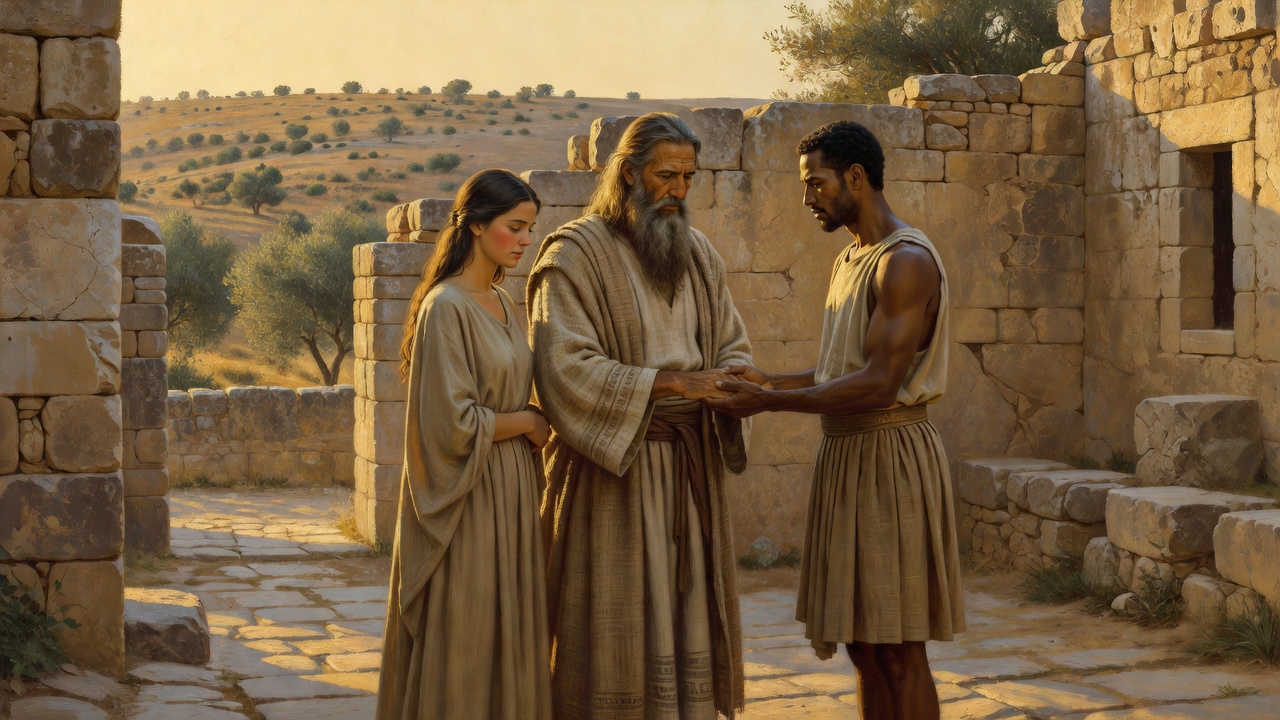
34Now Sheshan had no banim, but only banot. And Sheshan had an eved, a Mitzri (an Egyptian), shmo Yarcha. 35And Sheshan gave his bat to Yarcha his eved as isha; and she bore him Attai. 36And Attai fathered Natan, and Natan fathered Zavad, 37And Zavad fathered Ephlal, and Ephlal fathered Oved, 38And Oved fathered Yehu, and Yehu fathered Azaryah, 39And Azaryah fathered Cheletz, and Cheletz fathered El'asah, 40And El'asah fathered Sismai, and Sismai fathered Shallum, 41And Shallum fathered Yekamyah, and Yekamyah fathered Elishama.
42Now the Bnei Kalev the brother of Yerachme'el were Mesha his bechor, who was avi Ziph; and the Bnei Mareshah avi Chevron. 43And the Bnei Chevron; Korach, and Tapuach, and Rekem, and Shema. 44And Shema fathered Racham avi Yorko'am; and Rekem fathered Shammai. 45And the Ben of Shammai was Ma'on, and Ma'on was avi Beit-Tzur. 46And Ephah, Kalevʼs pilegesh, bore Charan, Motza, Gazez; and Charan fathered Gazez. 47And the Bnei Yahdai; Regem, and Yotam, and Geshan, and Pelet, and Eiphah, and Sha'aph. 48Ma'achah, Kalevʼs pilegesh (concubine), bore Shever, and Tirchanah. 49She bore also Sha'aph avi Madmannah, Sheva avi Machbenah, and avi Giv'a; and the Bat Kalev was Achsah. 50These were the Bnei Kalev.
Ben Chur, the bechor of Ephratah; Shoval avi Kiryat-Ye'arim. 51Salma avi Beit-lechem, Chareph avi Beit-Gader. 52And Shoval avi Kiryat-Ye'arim had banim; Haroeh, and half of Menuchot. 53And the mishpekhot of Kiryat-Ye'arim; the Yitri, and the Puti, and the Shumati, and the Mishra'i; of them came the Tzorati, and the Eshta'oli.
54The Bnei Salma; Beit-lechem, and the Netophati, Atrot Bais Yoav, and half of the Manachati, the Tzori. 55And the mishpekhot of the sofrim (scribes) which dwelt at Yabetz; the Tiratim, the Shime'atim, and Sukhatim. These are the Kenim that came of Chammat avi Bais Rechav.
¿Sabías que…?
La genealogía de Judá y la línea real
- El linaje en este capítulo traza la descendencia de Judá a través de Fares y Hezrón hasta Ram, culminando en David, el séptimo hijo de Isaí. Esta línea destaca antepasados notables, incluidos Naasón, un líder de la tribu durante la travesía por el desierto, y Booz de Belén.Fuentes: el propio texto bíblico · Nahshon · Boaz · Ram
- Las genealogías en 1 Crónicas a menudo vinculan familias directamente con los asentamientos que establecieron. Los descendientes de Caleb, hijo de Hezrón, y de su nieto Hur son identificados como padres o fundadores de ciudades destacadas de Judá como Belén, Quiriat-jearim y Madmana.Fuentes: el propio texto bíblico · Caleb · Madmannah
- Cuando Sesán, de la rama de Jerameel, no tuvo hijos varones, preservó su linaje casando a su hija con su siervo egipcio Jarha, cuyos descendientes se registran a lo largo de trece generaciones.Fuentes: el propio texto bíblico
Notas escritas con ayuda de IA a partir de fuentes abiertas (Theographic Bible Metadata, CC BY-SA 4.0; Easton’s Bible Dictionary, dominio público) y revisadas antes de publicarse.
Lugares de este capítulo
- Gilead · Hoy: Gilead 1 · 32.187, 35.692 · versículo 22
- Aram · 33.511, 36.306 · versículo 23
- Geshur · 32.767, 35.700 · versículo 23
- Havvoth-jair · 32.588, 35.726 · versículo 23
- Tekoa · Hoy: Khirbet Teku’a · 31.632, 35.210 · versículo 24
- Kiriath-jearim · Hoy: Deir el Azar · 31.809, 35.104 · versículos 50, 52, 53
- Bethlehem · 31.704, 35.208 · versículos 51, 54
Solo aparecen lugares identificados con alta confianza (90 % o más según las fuentes académicas reunidas por OpenBible). Mapa de la época: DARE (Digital Atlas of the Roman Empire), CC BY 4.0; mapa actual: © colaboradores de OpenStreetMap; lugares: OpenBible.info (CC BY 4.0).
Créditos y licencia de esta traducción
The Orthodox Jewish Bible
The Orthodox Jewish Bible - Tanakh and Orthodox Jewish Brit Chadasha - The Holy Bible
copyright © 2002-2011, 2021, 2024 Artists for Israel International
Language: English
Contributor: Artists for Israel International
THE ORTHODOX JEWISH TANAKH
Artists For Israel Intl Inc.
This version also appears with the Orthodox Yiddish Triglot which presents the Hebrew Yiddish script in Latin script and an English word for word translation, available at afii.org/Torah
To donate PayPal.Me
This translation is made available to you under the terms of the
Creative Commons Attribution license 4.0.
You may share and redistribute this Bible translation or extracts from it in any format, provided that:
You include the above copyright and source information.
If you make any changes to the text, you must indicate that you did so in a way that makes it clear that the original licensor is not necessarily endorsing your changes.
Pictures included with Scriptures and other documents on this site are licensed just for use with those Scriptures and documents.
For other uses, please contact the respective copyright owners.
Note that in addition to the rules above, revising and adapting God's Word involves a great responsibility to be true to God's Word. See Revelation 22:18-19.
2026-01-06
Títulos de sección adaptados de la Berean Standard Bible (dominio público); no forman parte del texto bíblico de esta traducción.
Fuente: http://ebible.org/engojb/ · eBible.org