Hechos 27
Open English Bible (U. S. spelling) · Toca un versículo para ver sus referencias cruzadas.
Paul Sails for Rome
1As it was decided that we were to sail to Italy, Paul and some other prisoners were put in charge of a centurion of the Augustan Guard, named Julius. 2We went on board a ship from Adramyttium, which was on the point of sailing to the ports along the coast of Roman Asia, and put to sea. Aristarchus, a Macedonian from Thessalonica, went with us. 3The next day we put in to Sidon, where Julius treated Paul in a friendly manner, and allowed him to go to see his friends and receive their hospitality. 4Putting to sea again, we sailed under the lee of Cyprus, because the wind was against us; 5and, after crossing the sea of Cilicia and Pamphylia, we reached Myra in Lycia. 6There the Roman officer found an Alexandrian ship on her way to Italy, and put us on board of her. 7For several days our progress was slow, and it was only with difficulty that we arrived off Cnidus. As the wind was still unfavorable when we came off Cape Salmone, we sailed under the lee of Crete, 8and with difficulty, by keeping close in shore, we reached a place called ‘Fair Havens,’ near which was the town of Lasea.
9This had taken a considerable time, and sailing was already dangerous, for the Fast was already over; and so Paul gave this warning. 10“My friends,” he said, “I see that this voyage will be attended with injury and much damage, not only to the cargo and the ship, but to our own lives also.”
11The Roman officer, however, was more influenced by the captain and the owner than by what was said by Paul. 12And, as the harbor was not a suitable one to winter in, the majority were in favor of continuing the voyage, in hope of being able to reach Phoenix, and winter there. Phoenix was a Cretan harbor, open to the north-east and south-east.
The Storm at Sea
13So, when a light wind sprang up from the south, thinking that they had found their opportunity, they weighed anchor and kept along the coast of Crete, close in shore. 14But shortly afterward a hurricane came down on us off the land – a north-easter, as it is called. 15The ship was caught by it and was unable to keep her head to the wind, so we had to give way and let her drive before it. 16Running under the lee of a small island called Cauda, we only just managed to secure the ship’s boat, 17and, after hoisting it on board, the men frapped the ship. But, afraid of being driven on to the Syrtis Sands, they lowered the yard, and then drifted. 18So violently were we tossed about by the storm, that the next day they began throwing the cargo overboard, 19and, on the following day, threw out the ship’s tackle with their own hands. 20As neither sun nor stars were visible for several days, and, as the gale still continued severe, all hope of our being saved was at last abandoned.
21It was then, when they had gone a long time without food, that Paul came forward, and said, “My friends, you should have listened to me, and not have sailed from Crete and so incurred this injury and damage. 22Yet, even as things are, I beg you not to lose courage, for there will not be a single life lost among you – only the ship. 23For last night an angel of the God to whom I belong, and whom I serve, stood by me, and said – 24‘Have no fear, Paul; you must appear before the Emperor, and God himself has given you the lives of all your fellow voyagers.’ 25Therefore, courage, my friends! For I believe God, that everything will happen exactly as I have been told. 26We will, however, have to be driven on some island.”
The Shipwreck
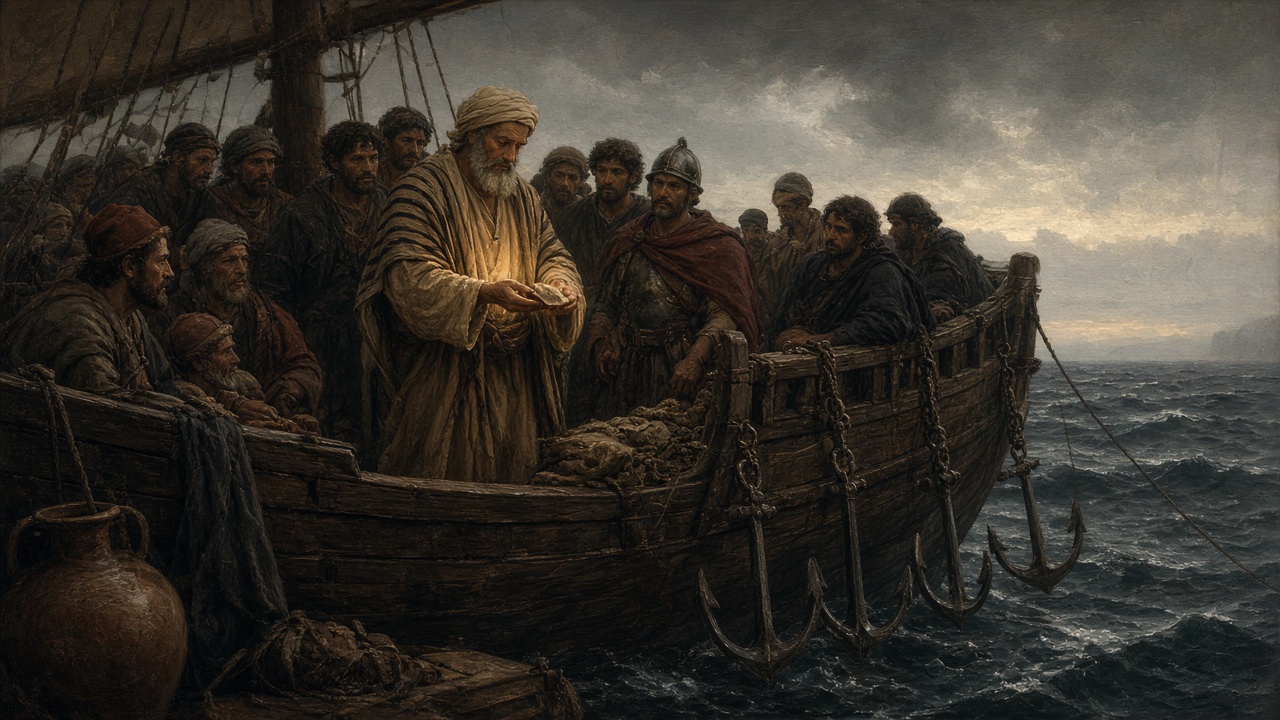
27It was now the fourteenth night of the storm, and we were drifting about in the Adriatic Sea, when, about midnight, the sailors began to suspect that they were drawing near land. 28So they took soundings, and found twenty fathoms of water. After waiting a little, they took soundings again, and found fifteen fathoms. 29Then, as they were afraid of our being driven on some rocky coast, they let go four anchors from the stern, and longed for daylight. 30The sailors wanted to leave the ship, and had lowered the boat, on pretense of running out anchors from the bows, 31when Paul said to the Roman officer and his men, “Unless the sailors remain on board, you cannot be saved.” 32So the soldiers cut the ropes which held the boat, and let her drift away. 33In the interval before daybreak Paul kept urging them all to take something to eat.
“It is a fortnight today,” he said, “that, owing to your anxiety, you have gone without food, taking nothing. 34So I beg you to take something to eat; your safety depends on it, for not one of you will lose even a hair of his head.” 35With these words he took some bread, and, after saying the thanksgiving to God before them all, broke it in pieces, and began to eat; 36and the men all felt cheered and had something to eat themselves. 37There were about seventy-six of us on board, all told. 38After satisfying their hunger, they further lightened the ship by throwing the grain into the sea. 39When daylight came, they could not make out what land it was, but, observing a creek in which there was a beach, they consulted as to whether they could run the ship safely into it. 40Then they cast off, and abandoned the anchors, and at the same time unlashed the gear of the steering oars, hoisted the foresail to the wind, and made for the beach. 41They got, however, into a kind of channel, and there ran the ship aground. The bows stuck fast and could not be moved, while the stern began breaking up under the strain. 42The advice of the soldiers was that the prisoners should be killed, so that none of them could swim away and make their escape. 43But the Roman officer, anxious to save Paul, prevented their carrying out their intention, and ordered that those who could swim should be the first to jump into the sea and try to reach the shore; 44and that the rest should follow, some on planks, and others on different pieces of the ship. In these various ways everyone managed to get safely ashore.
¿Sabías que…?
Tormenta y naufragio camino a Roma
- Pablo y los demás prisioneros no navegaron directo a Italia. En Cesarea abordaron un barco de Adramitio, ciudad de la costa de Misia, en Asia Menor, con rumbo a puertos a lo largo de la costa de Asia, nombre que el Easton's Bible Dictionary entiende en este versículo probablemente como Asia Menor, y ese barco los llevó solo hasta Mira, en Licia. Allí el centurión los hizo subir a un barco alejandrino que navegaba hacia Italia; el diccionario señala que era raro que un barco zarpara de cualquier puerto de Palestina directo a Italia.Fuentes: Adramyttium · Asia · el propio texto bíblico
- Los prisioneros fueron entregados a Julio, centurión del Regimiento Imperial. El Easton's Bible Dictionary lo identifica como centurión de la cohorte Augusta, o de la guardia personal del emperador, y describe el trato cortés que tuvo con Pablo. En Sidón, a unas veinticinco millas al norte de Tiro, le permitió visitar a sus amigos y recibir atención; más tarde impidió el plan de los soldados de matar a los prisioneros, para que se salvara la vida de Pablo.Fuentes: Julius · Sidon · el propio texto bíblico
- Después de Gnido, el barco avanzó a lo largo de Creta, una de las islas más grandes del Mediterráneo, de unas 140 millas de largo y 35 de ancho, que Pablo visitó en este viaje a Roma. El relato dice que el viaje ya se había vuelto peligroso porque era después del Ayuno, y que Buenos Puertos no era adecuado para invernar. Una cronología fecha el inicio del viaje a Roma en el año 56 d.C. y el naufragio en la tormenta en el 57 d.C.Fuentes: Crete · Journey to Rome begins · Paul is shipwrecked by a storm · el propio texto bíblico
Notas escritas con ayuda de IA a partir de fuentes abiertas (Theographic Bible Metadata, CC BY-SA 4.0; Easton’s Bible Dictionary, dominio público) y revisadas antes de publicarse.
Lugares de este capítulo
- Italy · 41.892, 12.485 · versículos 1, 6
- Adramyttium · Hoy: Oren · 39.501, 26.933 · versículo 2
- Asia · 38.400, 28.300 · versículo 2
- Thessalonica · Hoy: Thessaloniki · 40.638, 22.946 · versículo 2
- Sidon · Hoy: Sandikli archaeological site in Sidon · 33.561, 35.372 · versículo 3
- Cyprus · 35.000, 33.000 · versículo 4
- Cilicia · 36.913, 34.892 · versículo 5
- Lycia · 36.733, 29.900 · versículo 5
- Myra · 36.259, 29.985 · versículo 5
- Pamphylia · 37.000, 31.000 · versículo 5
- Alexandria · 31.183, 29.896 · versículo 6
- Cnidus · 36.686, 27.375 · versículo 7
- Crete · 35.310, 24.893 · versículos 7, 8, 12, 13, 14, 21
- Salmone · Hoy: Cape Sideros · 35.316, 26.312 · versículo 7
- Fair Havens · Hoy: Kaloi Limenes · 34.930, 24.800 · versículos 8, 12
- Lasea · Hoy: Lasaea · 34.941, 24.811 · versículo 8
- Cauda · Hoy: Gavdos · 34.833, 24.083 · versículo 16
- Syrtis · Hoy: Sidra · 31.500, 18.000 · versículo 17
- Adriatic Sea · Hoy: Adriatic and Ionian Seas · 38.000, 19.000 · versículo 27
Solo aparecen lugares identificados con alta confianza (90 % o más según las fuentes académicas reunidas por OpenBible). Mapa de la época: DARE (Digital Atlas of the Roman Empire), CC BY 4.0; mapa actual: © colaboradores de OpenStreetMap; lugares: OpenBible.info (CC BY 4.0).
Créditos y licencia de esta traducción
Open English Bible (U. S. spelling)
The Holy Bible, Open English Bible translation, U. S. spelling edition
Public Domain
Language: English
Translation by: OpenEnglishBible.org
Please see OpenEnglishBible.org/ for information about this translation.
2026-10-02
Títulos de sección adaptados de la Berean Standard Bible (dominio público); no forman parte del texto bíblico de esta traducción.
Fuente: http://ebible.org/engoebus/ · eBible.org