Hechos 19
Open English Bible (U. S. spelling) · Toca un versículo para ver sus referencias cruzadas.
The Holy Spirit Received at Ephesus
1While Apollos was at Corinth, Paul passed through the inland districts of Roman Asia, and went to Ephesus. There he found some disciples, of whom he asked, 2“Did you, when you became believers in Christ, receive the Holy Spirit?”
“No,” they answered, “we did not even hear that there was a Holy Spirit.”
3“What then was your baptism?” Paul asked. 4“John’s baptism was a baptism on repentance,” rejoined Paul, “and John told the people (speaking of the ‘one coming’ after him) that they should believe in him – that is in Jesus.”
5On hearing this, they were baptized in the name of the Lord Jesus, 6and, after Paul had placed his hands on them, the Holy Spirit descended on them, and they began to speak in other languages and to preach. 7There were about twelve of them in all.
Paul Ministers in Ephesus
8Paul went to the synagogue there, and for three months spoke out fearlessly, giving addresses and trying to convince his hearers, about the kingdom of God. 9Some of them, however, hardened their hearts and refused to believe, denouncing the Way before the people. So Paul left them and withdrew his disciples, and gave daily addresses in the lecture-hall of Tyrannus. 10This went on for two years, so that all who lived in Roman Asia, Jews and Greeks alike, heard the Lord’s message.
11God did miracles of no ordinary kind by Paul’s hands; 12so that people would carry home to the sick handkerchiefs or aprons that had touched his body, and their diseases would leave them and the wicked spirits go out of them.
Seven Sons of Sceva
13An attempt was made by some itinerant Jews, who were exorcists, to use the name of the Lord Jesus over those who had wicked spirits in them.
“I order you,” they would say, “by the Jesus, whom Paul preaches.” 14The seven sons of Sceva, a Jewish chief priest, were doing this; 15but the wicked spirit answered them, “Jesus I acknowledge, and Paul I know, but you – who are you?”
16Then the man with the wicked spirit sprang on them, overpowered them, with such violence that they fled out of the house, stripped of their clothes and wounded. 17This incident came to the knowledge of all the Jews and Greeks living at Ephesus; they were all awe-struck, and the name of the Lord Jesus was held in the highest honor. 18Many, too, of those who had become believers in Christ came with a full confession of their practices; 19while a number of people, who had practiced magic, collected their books and burnt them publicly; and on reckoning up the price of these, they found it amounted to fifty thousand silver coins. 20So irresistibly did the Lord’s message spread and prevail.
The Riot in Ephesus
21Sometime after these events Paul resolved to go through Macedonia and Greece, and then make his way to Jerusalem. “And after I have been there,” he said, “I must visit Rome also.” 22So he sent to Macedonia two of his helpers, Timothy and Erastus, while he himself stayed for some time longer in Roman Asia.
23Just about that time a great disturbance arose about the Way. 24A silversmith named Demetrius, who made silver models of the shrine of Artemis, and so gave a great deal of work to the artisans, 25got these men together, as well as the workmen engaged in similar occupations, and said:
“Men, you know that our prosperity depends on this work, 26and you see and hear that not only at Ephesus, but in almost the whole of Roman Asia, this Paul has convinced and won over great numbers of people, by his assertion that those Gods which are made by hands are not Gods at all. 27So that not only is this business of ours likely to fall into discredit, but there is the further danger that the Temple of the great Goddess Artemis will be thought nothing of, and that she herself will be deprived of her splendor – though all Roman Asia and the whole world worship her.”
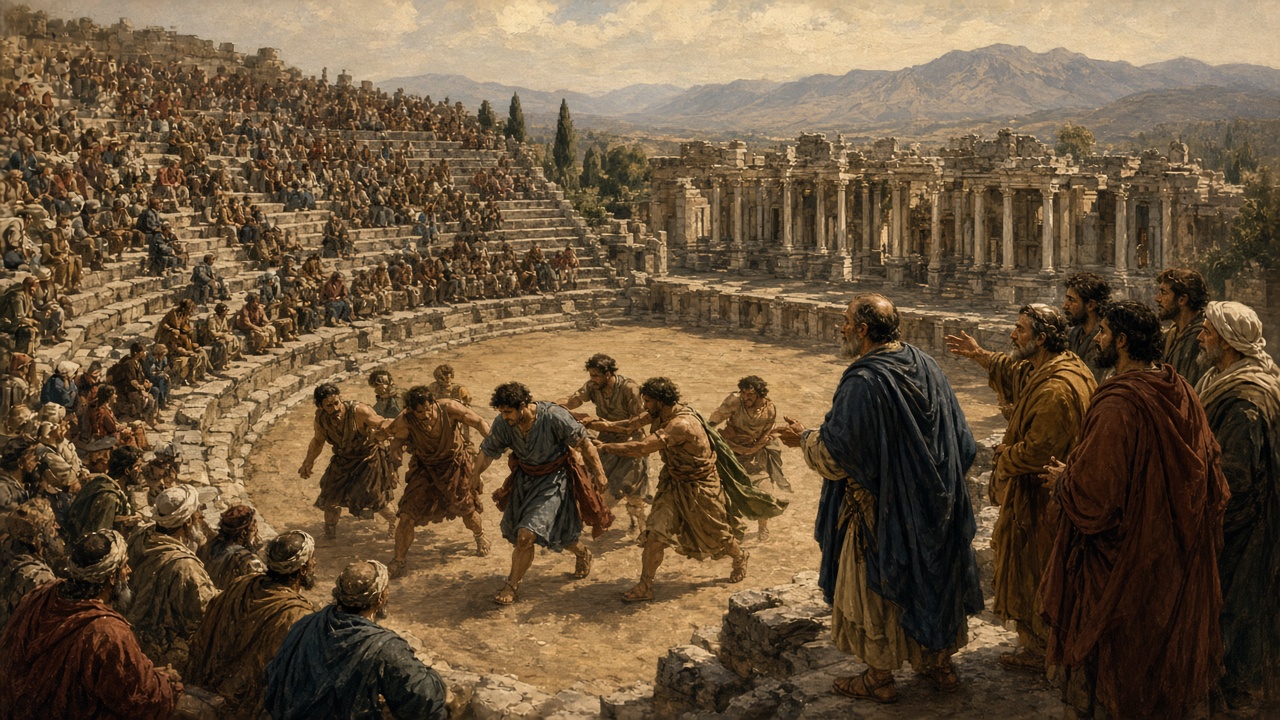
28When they heard this, the men were greatly enraged, and began shouting – “Great is Artemis of the Ephesians!” 29The commotion spread through the whole city, and the people rushed together into the amphitheater, dragging with them Gaius and Aristarchus, two Macedonians who were Paul’s traveling companions. 30Paul wished to go into the amphitheater and face the people, but the disciples would not let him, 31while some of the chief religious officials of the province, who were friendly to him, sent repeated entreaties to him not to trust himself inside. 32Meanwhile some were shouting one thing and some another, for the Assembly was all in confusion, most of those present not even knowing why they had met. 33But some of the crowd prompted Alexander, whom several of the Jewish leaders had pushed to the front, and he waved his hand to show that he wanted to speak in their defense to the people. 34However, when they recognized him as a Jew, one cry broke from them all, and they continued shouting for two hours – “Great is Artemis of the Ephesians!”
35When the Recorder had succeeded in quieting the crowd, he said, “People of Ephesus, who is there, I ask you, who needs to be told that this city of Ephesus is the Warden of the Temple of the great Artemis, and of the statue which fell down from Zeus? 36As these are undeniable facts, you ought to keep calm and do nothing rash; 37for you have brought these men here, though they are neither robbers of Temples nor blasphemers of our Goddess. 38If, however, Demetrius and the artisans who are acting with him have a charge to make against anyone, there are court days and there are Magistrates; let both parties take legal proceedings. 39But if you want anything more, it will have to be settled in the regular Assembly. 40For I tell you that we are in danger of being proceeded against for today’s riot, there being nothing to account for it; and in that case we will be at a loss to give any reason for this disorderly gathering.”
41With these words he dismissed the Assembly.
¿Sabías que…?
Pablo, el Camino y Artemisa en Éfeso
- Éfeso era la capital del Asia proconsular, la provincia romana que abarcaba la parte occidental de Asia Menor, y en tiempos romanos llevaba el título de primera y más grande metrópoli de Asia. La ciudad se distinguía por el templo de Artemisa, a quien los romanos llamaban Diana, construido fuera de las murallas y contado entre las siete maravillas del mundo antiguo. En el centro había una imagen antigua de la diosa, de la que se decía que había caído del cielo.Fuentes: Ephesus · Diana · Asia
- Demetrio, un platero de Éfeso, hacía santuarios de plata de Artemisa, modelos del templo o de la estatua de la diosa, que se vendían con facilidad a los visitantes llegados de toda Asia Menor. Hechos dice que ese oficio era la fuente de prosperidad de los artesanos y que Demetrio les advirtió del peligro para el negocio y para el honor del templo de Artemisa, la diosa que, según él, era adorada en toda la provincia de Asia y en el mundo entero.Fuentes: Demetrius · el propio texto bíblico
- La multitud se lanzó al teatro de Éfeso, que el Diccionario Bíblico de Easton (1897) describe como el más grande del mundo, a cielo abierto y capaz de albergar a 50.000 espectadores. Amigos de Pablo entre los jefes de Asia, ciudadanos ricos elegidos cada año para presidir los juegos y las fiestas religiosas de sus ciudades, le rogaron que no entrara. El secretario de la ciudad recordó entonces a la asamblea que Éfeso era guardiana del templo de la gran Artemisa y de su imagen, de la que se decía que había caído del cielo.Fuentes: Ephesus · Asia · el propio texto bíblico
Notas escritas con ayuda de IA a partir de fuentes abiertas (Theographic Bible Metadata, CC BY-SA 4.0; Easton’s Bible Dictionary, dominio público) y revisadas antes de publicarse.
Lugares de este capítulo
- Corinth · 37.906, 22.879 · versículo 1
- Ephesus · 37.939, 27.341 · versículos 1, 17, 23, 26, 35
- Asia · 38.400, 28.300 · versículos 10, 22, 26, 27, 31
- Achaia · 38.720, 22.540 · versículo 21
- Jerusalem · 31.777, 35.234 · versículo 21
- Macedonia · 41.600, 22.540 · versículos 21, 22, 29
- Rome · 41.892, 12.485 · versículos 21, 40
Solo aparecen lugares identificados con alta confianza (90 % o más según las fuentes académicas reunidas por OpenBible). Mapa de la época: DARE (Digital Atlas of the Roman Empire), CC BY 4.0; mapa actual: © colaboradores de OpenStreetMap; lugares: OpenBible.info (CC BY 4.0).
Créditos y licencia de esta traducción
Open English Bible (U. S. spelling)
The Holy Bible, Open English Bible translation, U. S. spelling edition
Public Domain
Language: English
Translation by: OpenEnglishBible.org
Please see OpenEnglishBible.org/ for information about this translation.
2026-10-02
Títulos de sección adaptados de la Berean Standard Bible (dominio público); no forman parte del texto bíblico de esta traducción.
Fuente: http://ebible.org/engoebus/ · eBible.org