Génesis 40
Open English Bible (Commonwealth Spelling) · Toca un versículo para ver sus referencias cruzadas.
The Two Dreams
1Some time after these things the cupbearer of the king of Egypt and his baker offended their master the king of Egypt, 2so that Pharaoh was angry with these two officers and imprisoned them in the house of the captain of the guard, in the same prison where Joseph was confined. 3The captain of the guard assigned Joseph to them, and he waited on them; 4and they remained in confinement for some time.
5Meanwhile the king of Egypt’s cupbearer and baker, who were confined in the prison, both had dreams the same night, each with a particular meaning. 6When Joseph came in to them in the morning, he saw plainly that they were sad. 7So he asked Pharaoh’s officers, ‘Why do you look so sad today?’ 8They answered. ‘We have had a dream and there is no one who can interpret it.’ Then Joseph said to them, ‘Do not the interpretations of dreams belong to God? Tell them to me.’
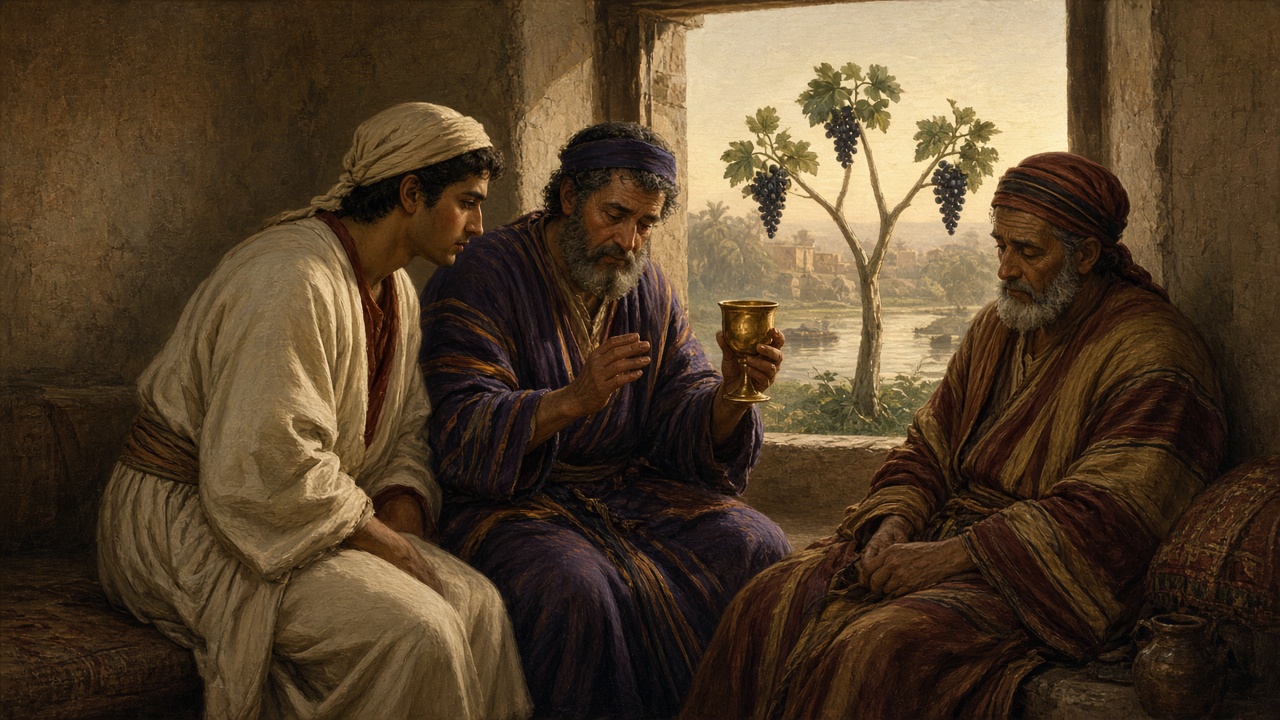
9Then the chief cupbearer told his dream to Joseph and said to him, ‘In my dream I saw a vine before me, 10and on the vine were three branches, and as if budding it put out blossoms and its clusters brought forth ripe grapes. 11Pharaoh’s cup was in my hand, and I took the grapes and pressed them into his cup and gave the cup to Pharaoh.’
12Then Joseph said to him, ‘This is its interpretation: the three branches are three days; 13within three days Pharaoh will release you from prison and restore you to your office, and you will give Pharaoh’s cup into his hand as you used to do when you were his cupbearer. 14But when all goes well with you, remember me, show kindness to me and speak in my behalf to Pharaoh and bring me out of this house; 15for I was unjustly stolen from the land of the Hebrews, and here also I have done nothing that they should put me in the dungeon.’
16When the chief baker saw that the interpretation was favourable, he said to Joseph, ‘I also saw something in my dream: there were three baskets of white bread on my head, 17and in the uppermost basket there were all kinds of baked food for Pharaoh, and the birds were eating them out of the basket on my head.’ 18Joseph answered, ‘This is its interpretation: the three baskets are three days; 19within three days Pharaoh will take off your head and hang you on a tree, and the birds will eat your flesh.’
20Now on the third day, which was Pharaoh’s birthday, he made a feast for all his officials. Then he released the chief cupbearer and the chief baker. 21He restored the chief butler to his office, so that he again gave the cup into Pharaoh’s hand, 22but the chief baker he hanged, as Joseph had interpreted to them. 23Yet the chief cupbearer did not remember Joseph, but forgot him.
¿Sabías que…?
Sueños en la prisión del faraón
- El faraón se enojó con dos oficiales, el jefe de los coperos y el jefe de los panaderos, y los puso en la casa del capitán de la guardia, la misma prisión donde José estaba encerrado. El capitán los encomendó a José, quien pasó a ser su asistente personal.Fuentes: el propio texto bíblico
- En la misma noche, el copero y el panadero soñaron, cada uno con el suyo, y José dijo que las interpretaciones pertenecen a Dios. Él tomó las tres ramas y las tres canastas como tres días: el faraón levantaría la cabeza del copero y lo restauraría, pero le quitaría la cabeza al panadero y lo colgaría de un árbol. Al tercer día, cumpleaños del faraón, el rey ofreció un banquete a sus oficiales, restauró al copero y ahorcó al panadero.Fuentes: el propio texto bíblico
- José pidió al copero que, una vez restaurado, se acordara de él y lo mencionara al faraón. Dijo que había sido secuestrado de la tierra de los hebreos y que no había hecho nada para que lo encerraran en el calabozo. El Easton's Bible Dictionary (1897) identifica al faraón de los días de José probablemente como Apopi, o Apopis, el último de los reyes hicsos; algunos argumentan, en cambio, que José llegó a Egipto más tarde, bajo Thothmes III.Fuentes: el propio texto bíblico · Pharaoh (of Joseph)
Notas escritas con ayuda de IA a partir de fuentes abiertas (Theographic Bible Metadata, CC BY-SA 4.0; Easton’s Bible Dictionary, dominio público) y revisadas antes de publicarse.
Lugares de este capítulo
Solo aparecen lugares identificados con alta confianza (90 % o más según las fuentes académicas reunidas por OpenBible). Mapa de la época: DARE (Digital Atlas of the Roman Empire), CC BY 4.0; mapa actual: © colaboradores de OpenStreetMap; lugares: OpenBible.info (CC BY 4.0).
Créditos y licencia de esta traducción
Open English Bible (Commonwealth Spelling)
The Holy Bible, Open English Bible translation, with Commonwealth spelling
Public Domain
Language: English
Translation by: OpenEnglishBible.org
Please see OpenEnglishBible.org/ for information about this translation.
2026-10-02
Fuente: http://ebible.org/engoebcw/ · eBible.org