Cantares 7
George Noyes Bible · Toca un versículo para ver sus referencias cruzadas.
Admiration by the Bridegroom
1[[Lov.]] How beautiful are thy feet in sandals, O prince's daughter! The roundings of thy hips are like neck ornaments, The work of the hands of the artificer; 2Thy navel is like a round goblet, that wanteth not the spiced wine; Thy belly like a heap of wheat, inclosed with lilies; 3Thy two breasts are like two young twin gazelles; 4Thy neck is as a tower of ivory; Thine eyes are like the pools at Heshbon, by the gate of Bath-rabbim; Thy nose is as the tower of Lebanon, which looketh toward Damascus; 5Thy head upon thee is like Carmel, And the hair of thy head like purple; The king is captivated by thy locks. 6How fair, how pleasant art thou, love, in delights! 7This thy stature is like the palm-tree, And thy breasts like clusters of dates. 8I will go up, say I to myself, upon the palm-tree; I will take hold of its boughs, And thy breasts shall be as clusters of the vine, And the fragrance of thy nose like apples, 9And thy mouth like the best wine— [[M.]] — that goeth down smoothly for my beloved, Flowing over the lips of them that sleep.
The Bride
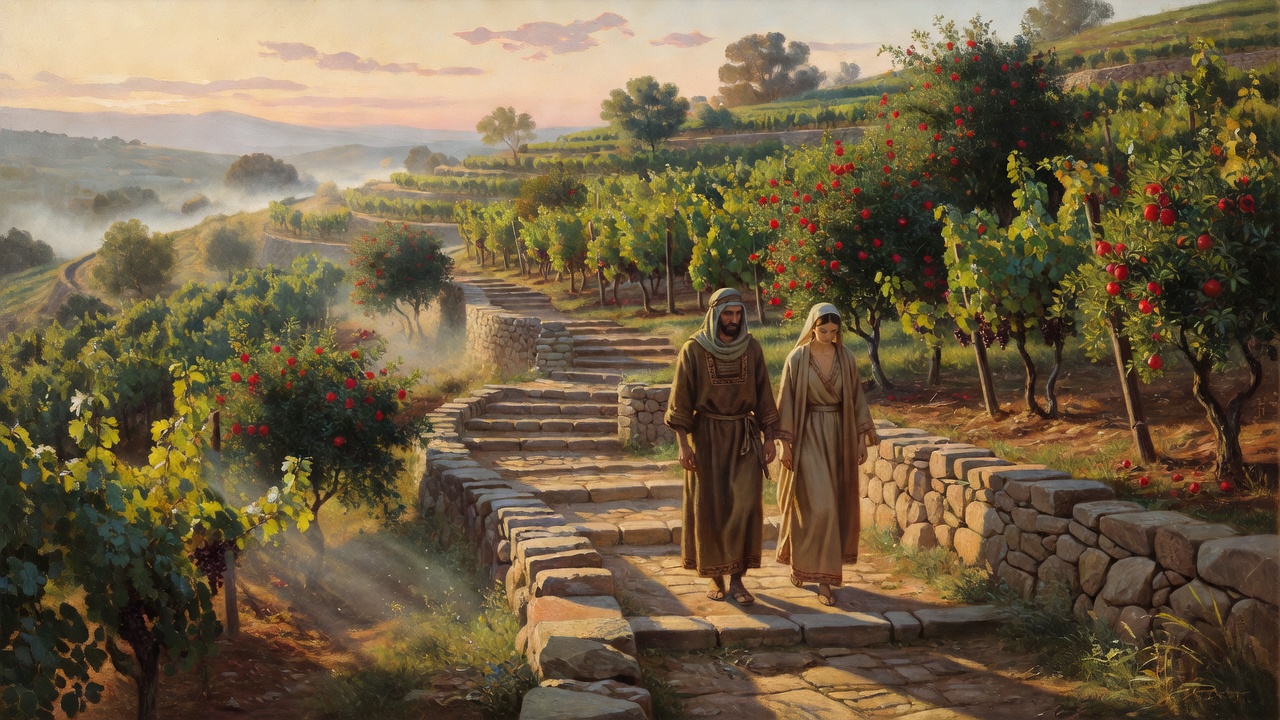
10I am my beloved's, And his desire is toward me. 11Come, my beloved, let us go forth into the country; Let us lodge in the villages! 12Then will we go early to the vineyards, To see whether the vine putteth forth, Whether its blossom openeth, And the pomegranates bud forth; There will I give thee my love! 13The love-apples give forth fragrance; And at our doors are all kinds of precious fruits, new and old: I have kept them for thee, my beloved!
¿Sabías que…?
Poesía de Amor y Paisaje
- El poema describe la belleza de la mujer utilizando destacados puntos geográficos de la región. Sus ojos son comparados con los estanques de Hesbón, cerca de la puerta de Bat-rabim al este del Jordán, mientras que su perfil se asemeja a una torre majestuosa en la cordillera del Líbano que mira hacia Damasco.Fuentes: el propio texto bíblico · Heshbon · Bath-rabbim · Lebanon
- El capítulo concluye con una invitación al campo durante el despertar de la primavera. Los amantes salen a observar los brotes de las vides, la floración de los granados y el aroma de las mandrágoras, reflejando la estrecha relación en la poesía hebrea antigua entre la intimidad romántica y la naturaleza.Fuentes: el propio texto bíblico
Notas escritas con ayuda de IA a partir de fuentes abiertas (Theographic Bible Metadata, CC BY-SA 4.0; Easton’s Bible Dictionary, dominio público) y revisadas antes de publicarse.
Lugares de este capítulo
- Bath-rabbim · Hoy: in Tell Hesban · 31.801, 35.809 · versículo 4
- Damascus · 33.511, 36.306 · versículo 4
- Lebanon · 33.540, 35.584 · versículo 4
- Mount Carmel · 32.672, 35.023 · versículo 5
Solo aparecen lugares identificados con alta confianza (90 % o más según las fuentes académicas reunidas por OpenBible). Mapa de la época: DARE (Digital Atlas of the Roman Empire), CC BY 4.0; mapa actual: © colaboradores de OpenStreetMap; lugares: OpenBible.info (CC BY 4.0).
Créditos y licencia de esta traducción
George Noyes Bible
The Holy Bible, translated into English by George Noyes (1869)
Public Domain
Language: English
Dialect: archaic British
Translation by: George Noyes
2019-10-24
Títulos de sección adaptados de la Berean Standard Bible (dominio público); no forman parte del texto bíblico de esta traducción.
Fuente: http://ebible.org/engnoy/ · eBible.org