Juan 12
George Noyes Bible · Toca un versículo para ver sus referencias cruzadas.
Mary Anoints Jesus
1Jesus, therefore, six days before the passover, came to Bethany, where Lazarus was, whom Jesus raised from the dead. 2They made therefore a supper for him there, and Martha served; but Lazarus was one of those who reclined at the table with him. 3Then Mary, taking a pound of ointment of pure spikenard, very costly, anointed the feet of Jesus, and wiped his feet with her hair; and the house was filled with the odor of the ointment. 4But Judas Iscariot, one of his disciples, he who was about to betray him, saith, 5Why was not this ointment sold for three hundred denaries, and given to the poor? 6And this he said, not because he cared for the poor, but because he was a thief, and kept the purse, and bore what was put therein. 7Then said Jesus, Let her alone, that she may keep it until the day of my burial. 8For the poor ye have always with you, but me ye have not always.
The Plot to Kill Lazarus
9The great multitude of the Jews therefore knew that he was there; and they came, not only on account of Jesus, but that they might see Lazarus also, whom he raised from the dead. 10But the priests consulted together that they might put Lazarus also to death; 11because on his account many of the Jews were going away, and believing in Jesus.
The Triumphal Entry
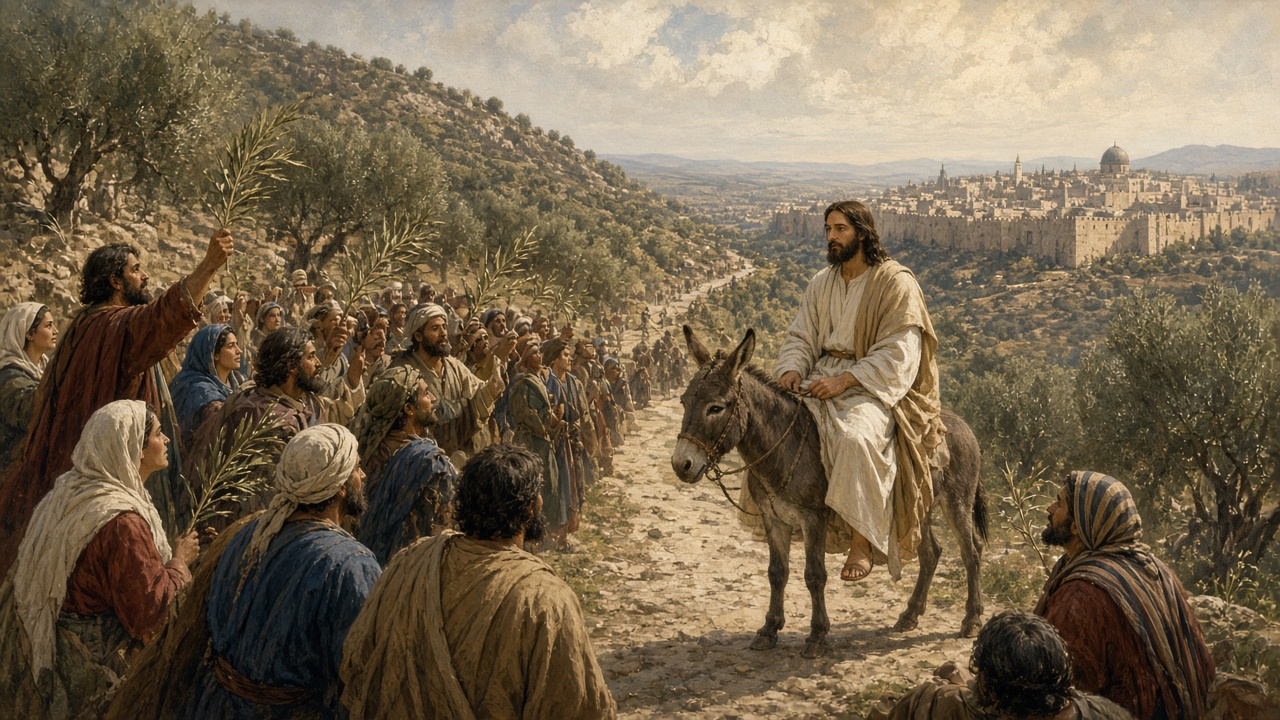
12On the next day, a great multitude that had come to the feast, hearing that Jesus was coming to Jerusalem, 13took branches of palm-trees, and went forth to meet him, crying aloud, Hosanna! blessed is he who cometh in the name of the Lord, even the king of Israel! 14And Jesus, having found a young ass, sat thereon, as it is written, 15“Fear not, daughter of Zion! lo! thy king cometh, sitting on an ass's colt.” 16These things his disciples did not understand at the first; but when Jesus had been glorified, then they remembered that these things were written of him, and that they had done these things to him. 17The multitude therefore that was with him when he called Lazarus out of the tomb and raised him from the dead bore witness. 18For this cause also the multitude met him, because they had heard that he had wrought, this sign. 19The Pharisees therefore said among themselves, Ye see that ye effect nothing; o! the world hath gone after him.
Jesus Predicts His Death
20Now there were certain Greeks among those who came up to worship at the feast. 21These came therefore to Philip, who was of Bethsaida of Galilee, and asked him, saying, Sir, we wish to see Jesus. 22Philip goeth and telleth Andrew; Andrew and Philip go and tell Jesus. 23But Jesus answereth them, saying, The hour hath come that the Son of man should be glorified. 24Truly, truly do I say to you, Unless a grain of wheat fall into the ground and die, itself abideth alone; but if it die, it beareth much fruit. 25He that loveth his life loseth it; and he that hateth his life in this world will keep it unto everlasting life. 26If any one be a servant to me, let him follow me; and where I am, there also will my servant be; if any one serve me, the Father will honor him. 27Now is my soul troubled; and what shall I say? Father, save me from this hour! But for this cause I came to this hour. 28Father, glorify thy name! Then came there a voice from heaven: Yea, I have glorified it, and will glorify it again. 29The multitude therefore that stood by, hearing this, said that it thundered. Others said, An angel hath spoken to him. 30Jesus answered and said, This voice hath come not for my sake, but for yours. 31Now is the judgment of this world; now will the prince of this world be cast out; 32and I, if I be lifted up from the earth, shall draw all men to me. 33This he said, signifying what kind of death he was to die. 34The multitude therefore answered him, We have heard out of the Law that the Christ abideth for ever; how then dost thou say that the Son of man must be lifted up? Who is this Son of man? 35Jesus therefore said to them, Yet a little while is the light among you. Walk while ye have the light, that darkness may not overtake you; and he that walketh in the darkness knoweth not whither he goeth. 36While ye have the light, believe in the light, that ye may become sons of light. These things spoke Jesus, and went away, and hid himself from them.
Belief and Unbelief
37But though he had wrought so many signs before them, they did not believe in him; 38that what was spoken by Isaiah the prophet might be fulfilled, “Lord, who hath believed our report? and to whom hath the arm of the Lord been revealed?” 39For this cause they could not believe, because Isaiah said again, 40“He hath blinded their eyes, and hardened their heart; lest they should see with their eyes, and understand with their heart, and turn from their ways, and I should heal them.” 41These things said Isaiah, because he saw his glory, and spoke of him. 42Yet even of the rulers many believed in him; but on account of the Pharisees they did not acknowledge him, lest they should be put of the synagogue; 43for they loved the glory that is of men more than the glory that is of God. 44But Jesus cried aloud, and said, He that believeth in me, believeth not in me, but in him that sent me; 45and he that beholdeth me, beholdeth him that sent me. 46I have come a light into the world, that whoever believeth in me may not remain in the darkness. 47And if any one hear my words, and keep them not, I do not judge him; for I came not to judge the world, but to save the world. 48He that rejecteth me, and receiveth not my words, hath one that judgeth him; the word that I have spoken, that will judge him in the last day. 49Because I have not spoken from myself; but the Father who sent me hath himself committed to me what I should say, and what I should speak; 50and I know that what he hath committed to me is everlasting life. What I speak therefore, I speak as the Father hath directed me.
¿Sabías que…?
La unción en Betania y la entrada en Jerusalén
- Betania, adonde Jesús llegó seis días antes de la Pascua, estaba a unas dos millas al este de Jerusalén, en la ladera sureste del monte de los Olivos, junto al camino a Jericó, y tomó su nombre de las palmeras que crecían allí. Era el hogar de Lázaro, a quien Jesús había resucitado de entre los muertos después de cuatro días en el sepulcro, y de sus hermanas Marta y María; los principales sacerdotes planearon matar también a Lázaro, porque por causa de él mucha gente estaba creyendo en Jesús.Fuentes: el propio texto bíblico · Bethany · Lazarus
- En una cena en la que Marta servía y Lázaro estaba reclinado a la mesa, María ungió los pies de Jesús con alrededor de una pinta de perfume costoso hecho de nardo puro y los secó con sus cabellos, de modo que la casa se llenó de la fragancia. Judas Iscariote, hijo de Simón, cuyo sobrenombre significa un hombre de Kerioth, preguntó por qué el perfume no se vendió por trescientos denarios para los pobres; era un ladrón que, como encargado de la bolsa, solía sacar de lo que se ponía en ella, y iba a traicionar a Jesús.Fuentes: el propio texto bíblico · Judas Iscariot · Simon
- Al día siguiente, la gran multitud que había venido para la fiesta tomó ramas de palma y salió al encuentro de Jesús, que venía a Jerusalén sentado en un burrito, gritando alabanza al Rey de Israel, como está escrito acerca de la Hija de Sion. Sion era la colina sureste de Jerusalén, donde David construyó una ciudadela y un palacio después de tomarla, de modo que llegó a ser la ciudad de David. Al principio sus discípulos no entendieron estas cosas, pero después de que Jesús fue glorificado recordaron que también habían sido escritas acerca de él.Fuentes: el propio texto bíblico · Zion
Notas escritas con ayuda de IA a partir de fuentes abiertas (Theographic Bible Metadata, CC BY-SA 4.0; Easton’s Bible Dictionary, dominio público) y revisadas antes de publicarse.
Lugares de este capítulo
- Jerusalem · 31.777, 35.234 · versículos 11, 12, 20
- Zion · Hoy: Jerusalem · 31.777, 35.234 · versículo 15
- Galilee · 32.760, 35.527 · versículo 21
Solo aparecen lugares identificados con alta confianza (90 % o más según las fuentes académicas reunidas por OpenBible). Mapa de la época: DARE (Digital Atlas of the Roman Empire), CC BY 4.0; mapa actual: © colaboradores de OpenStreetMap; lugares: OpenBible.info (CC BY 4.0).
Créditos y licencia de esta traducción
George Noyes Bible
The Holy Bible, translated into English by George Noyes (1869)
Public Domain
Language: English
Dialect: archaic British
Translation by: George Noyes
2019-10-24
Títulos de sección adaptados de la Berean Standard Bible (dominio público); no forman parte del texto bíblico de esta traducción.
Fuente: http://ebible.org/engnoy/ · eBible.org