Jeremías 40
George Noyes Bible · Toca un versículo para ver sus referencias cruzadas.
Jeremiah Remains in Judah
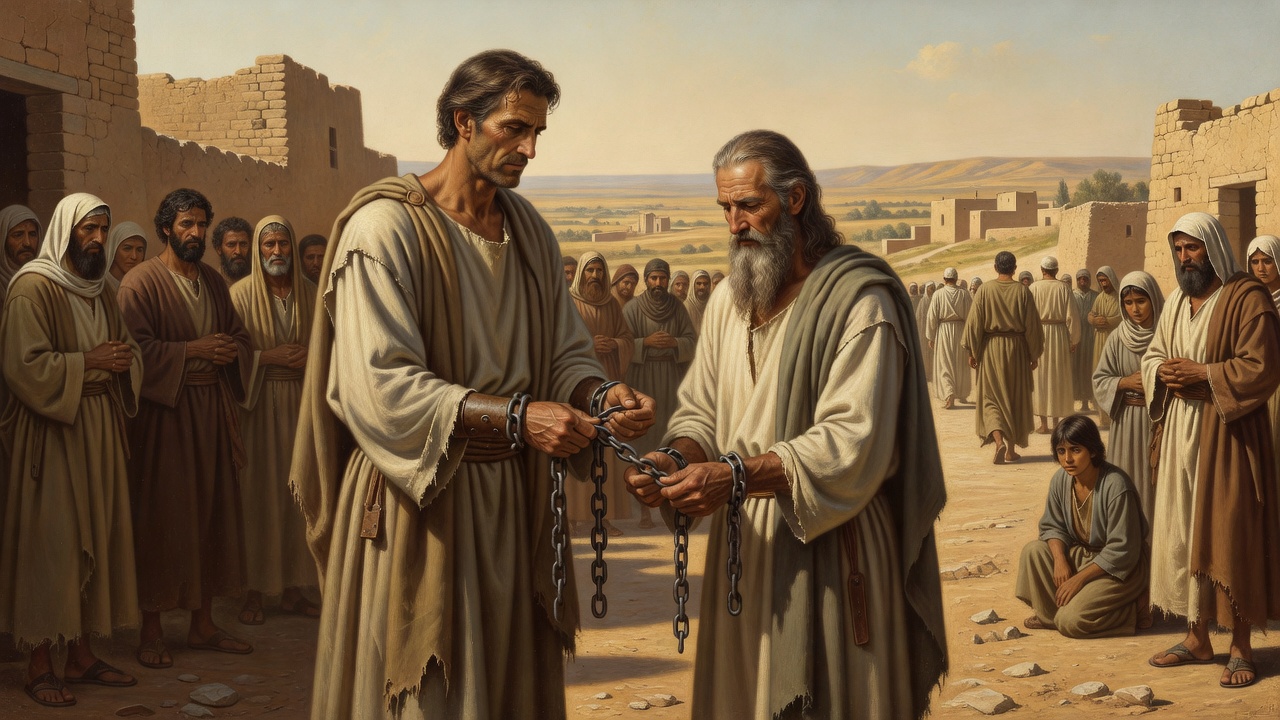
1The word which came to Jeremiah from Jehovah, after that Nebuzaradan, captain of the guard, had let him go from Ramah. For he had taken him, and he had been bound with chains among all the captives of Jerusalem and Judah which were carried away captive to Babylon. 2And the captain of the guard took Jeremiah, and said to him: “Jehovah, thy God, pronounced this evil against this place; 3and now Jehovah hath brought it, and done according as he spake, because ye sinned against Jehovah, and obeyed not his voice; therefore hath this thing come upon you. 4And now, behold, I loose thee this day from the chains upon thy hands. If it seem good to thee to come with me to Babylon, come; and I will set my eyes upon thee; but if it seem evil to thee to come with me to Babylon, forbear; behold, the whole land is before thee; whither it seemeth good and desirable for thee to go, thither go.” 5And while he was not yet gone away [[he said]]: “Go to Gedaliah, the of son Ahikam, the son of Shaphan, whom the king of Babylon hath made governor over the cities of Judah, and dwell with him among the people; or go whithersoever it seemeth good to thee to go.” And the captain of the guard gave him provisions, and a present, and dismissed him. 6And Jeremiah went to Gedaliah, the son of Ahikam, to Mizpah, and dwelt with him among the people that were left in the land.
Gedaliah Governs in Judah
7Now when all the captains of the forces which were in the fields, they and their men, heard that the king of Babylon had made Gedaliah, the son of Ahikam, governor over the land, and had committed to his charge men and women and children, of the poor of the land, of them that were not carried away captive to Babylon, 8then they came to Gedaliah, to Mizpah; namely, Ishmael, the son of Nethaniah, and Johanan and Jonathan, the sons of Kareah, and Seraiah, the son of Tanhumeth, and the sons of Ephai the Netophathite, and Jezaniah, the son of the Maachathite, they and their men; 9and Gedaliah, the son of Ahikam, the son of Shaphan, swore to them and to their men, saying, “Fear not to serve the Chaldaeans; dwell in the land, and serve the king of Babylon, and it shall be well with you. 10As for me, behold, I will dwell at Mizpah, to stand before the Chaldaeans, who shall come to us; but ye, gather ye in wine, and summer fruits, and oil, and put them in your vessels, and dwell in your cities which ye have taken.” 11Also when all the Jews that were in Moab, and among the children of Ammon, and in Edom, and that were in all the countries, heard that the king of Babylon had left a remnant to Judah, and that he had set over them Gedaliah, the son of Ahikam, the son of Shaphan, 12then all the Jews returned from all the places whither they were driven, and came to the land of Judah, to Gedaliah, to Mizpah, and gathered wine and summer fruits in abundance.
The Plot against Gedaliah
13And Johanan, the son of Kareah, and all the captains of the forces that were in the fields, came to Gedaliah, to Mizpah, 14and said to him, “Dost thou know that Baalis, the king of the children of Ammon, hath sent Ishmael, the son of Nethaniah, to slay thee?” But Gedaliah, the son of Ahikam, believed them not. 15And Johanan, the son of Kareah, spake to Gedaliah in private at Mizpah, saying, “Let me go, I pray thee, and smite Ishmael, the son of Nethaniah, and no man shall know it. Wherefore should he slay thee, that all the Jews which are gathered to thee should be scattered, and the remnant in Judah perish?” 16But Gedaliah, the son of Ahikam, said to Johanan, the son of Kareah, “Thou shalt not do this thing, for thou speakest falsely of Ishmael.”
¿Sabías que…?
Gedalías y el remanente en Mizpa
- En Ramá, el capitán de la guardia babilónica, Nabuzaradán, liberó a Jeremías de sus cadenas y le ofreció la opción de viajar protegido a Babilonia o quedarse en Judá. Jeremías decidió permanecer y se unió a Gedalías hijo de Ahicam en Mizpa.Fuentes: el propio texto bíblico · Nebuzar-adan · Ramah
- Nabucodonosor nombró a Gedalías, cuya familia había protegido anteriormente a Jeremías, como gobernador sobre la gente más pobre que quedó en la tierra. Gedalías estableció su sede en Mizpa y animó a los refugiados y oficiales judíos a cultivar la tierra y vivir en paz bajo el dominio babilónico.Fuentes: el propio texto bíblico · Gedaliah · Ahikam · Mizpah
- El comandante militar Johanán advirtió a Gedalías que Ismael hijo de Netanías había sido enviado por el rey amonita para asesinarlo. Gedalías se negó a creer el informe y rechazó la propuesta de Johanán de eliminar a Ismael en secreto.Fuentes: el propio texto bíblico · Johanan · Ishmael · Gedaliah
Notas escritas con ayuda de IA a partir de fuentes abiertas (Theographic Bible Metadata, CC BY-SA 4.0; Easton’s Bible Dictionary, dominio público) y revisadas antes de publicarse.
Lugares de este capítulo
- Babylon · 32.543, 44.422 · versículos 1, 4, 5, 7, 9, 11
- Jerusalem · 31.777, 35.234 · versículo 1
- Chaldea · 30.962, 46.104 · versículos 9, 10
- Ammon · 31.955, 35.934 · versículos 11, 14
- Edom · 30.746, 35.604 · versículo 11
- Moab · Hoy: Moab 1 · 31.181, 35.701 · versículo 11
Solo aparecen lugares identificados con alta confianza (90 % o más según las fuentes académicas reunidas por OpenBible). Mapa de la época: DARE (Digital Atlas of the Roman Empire), CC BY 4.0; mapa actual: © colaboradores de OpenStreetMap; lugares: OpenBible.info (CC BY 4.0).
Créditos y licencia de esta traducción
George Noyes Bible
The Holy Bible, translated into English by George Noyes (1869)
Public Domain
Language: English
Dialect: archaic British
Translation by: George Noyes
2019-10-24
Títulos de sección adaptados de la Berean Standard Bible (dominio público); no forman parte del texto bíblico de esta traducción.
Fuente: http://ebible.org/engnoy/ · eBible.org