Hechos 19
George Noyes Bible · Toca un versículo para ver sus referencias cruzadas.
The Holy Spirit Received at Ephesus
1And it came to pass, while Apollos was at Corinth, that Paul, having passed through the upper districts, came to Ephesus. And finding certain disciples, 2he said to them, Did ye receive the Holy Spirit when ye believed? And they said to him, No, we did not even hear whether there is a Holy Spirit. 3And he said, Into what then were ye baptized? And they said, Into John's baptism. 4Then said Paul, John indeed baptized with the baptism of repentance, saying to the people, that they should believe on him that was coming after him; that is, on Jesus. 5And when they heard this, they were baptized into the name of the Lord Jesus. 6And when Paul bad laid his hands on them, the Holy Spirit came upon them, and they spoke with tongues, and prophesied. 7And the men were about twelve in all.
Paul Ministers in Ephesus
8And he went into the synagogue, and spoke boldly for three months, discoursing and persuading concerning the kingdom of God. 9But when some were hardened, and believed not, but spoke evil of the way [[of the Lord]] before the multitude, he departed from them, and separated the disciples, discoursing daily in the school of Tyrannus. 10And this continued for two years, so that all who dwelt in Asia heard the word of the Lord, both Jews and Greeks. 11And God wrought special miracles by the hands of Paul; 12so that even handkerchiefs, or aprons, were carried from his body to the sick, and the diseases departed from them, and the evil spirits went out.
Seven Sons of Sceva
13Then some of the wandering Jewish exorcists undertook to name over those who had evil spirits the name of the Lord Jesus, saying, I adjure you by that Jesus whom Paul preacheth. 14And there were seven sons of Scevas, a Jewish chief priest, who did this. 15And the evil spirit answering said, Jesus I knew, and Paul I well know; but who are ye? 16And the man in whom the evil spirit was leaped on them, and overcame them both, and prevailed against them, so that they fled out of that house naked and wounded. 17And this became known to all, both Jews and Greeks, who dwelt at Ephesus; and fear fell on them all, and the name of the Lord Jesus was magnified. 18And many of the believers came, confessing and declaring their practices. 19Many also of those who had practised magical arts brought their books together, and burned them before all men; and they counted the price of them, and found it fifty thousand pieces of silver. 20So the word of the Lord grew and prevailed mightily.
The Riot in Ephesus
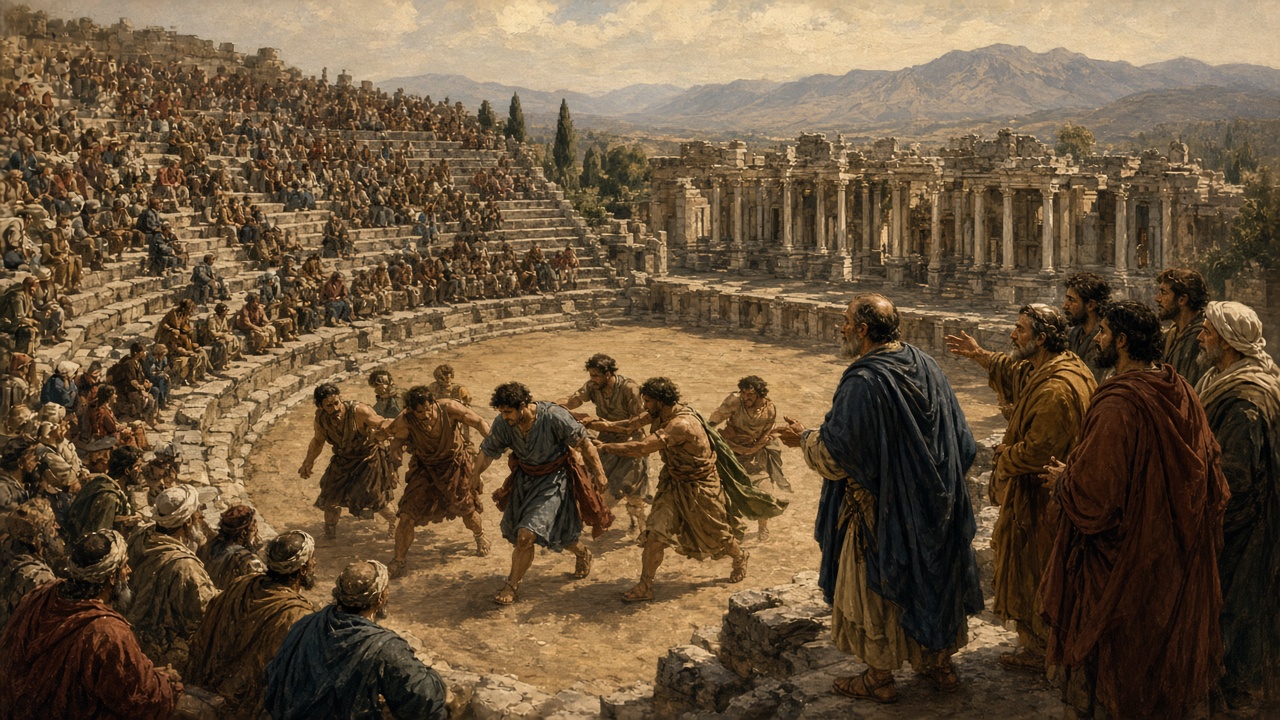
21And when these things were ended, Paul resolved to pass through Macedonia and Achaia, and to go to Jerusalem, saying, After I have been there, I must also see Rome. 22And having sent into Macedonia two of those who ministered to him, Timothy and Erastus, he himself stayed in Asia for a season. 23And about that time there arose no small tumult concerning the faith. 24For a certain man named Demetrius, a silversmith, made silver shrines of Diana, and brought no small gain to the craftsmen. 25And having called them together, with the workmen of like occupation, he said, Sirs, ye know that by this craft we have our wealth; 26and ye see and hear, that this Paul hath persuaded and turned away much people, not only of Ephesus, but of almost all Asia, saying, that those are not gods, which are made with hands. 27And there is not only danger that this branch of our business will come into disrepute, but also that the temple of the great goddess Diana will be despised, and her magnificence destroyed, whom all Asia and the world worship. 28And hearing this they became full of wrath, and kept crying out, saying, Great is Diana of the Ephesians! 29And the city was filled with confusion; and they rushed with one accord into the theatre, having seized Gaius and Aristarchus, men of Macedonia, Paul's companions in travel. 30And when Paul wished to go in to the people, the disciples would not suffer him. 31And some also of the Asiarchs, who were his friends, sent to him, and entreated him not to venture into the theatre. 32Some therefore were crying one thing, and some another; for the assembly was in confusion, and the greater part knew not wherefore they had come together. 33And they brought forward Alexander out of the multitude, the Jews putting him forward; and Alexander beckoned with his hand, desiring to make his defence to the people. 34But when they knew that he was a Jew, all with one voice for about two hours cried out, Great is Diana of the Ephesians! 35But when the Recorder had quieted the multitude, he said, Men of Ephesus, who is there among men that doth not know that the city of the Ephesians is guardian of the great Diana, and of the image which fell down from Jupiter? 36Since then these things cannot be denied, ye ought to be quiet, and do nothing rashly. 37For ye have brought hither these men, who are neither robbers of temples, nor blasphemers of your goddess. 38If then Demetrius and the craftsmen with him have a complaint against any one, the courts are open, and there are proconsuls; let them bring their charges against each other. 39But if ye ask for any thing further, it shall be determined in the lawful assembly. 40For we are in danger of being called to answer concerning this day's riot, there being no ground on which we shall be able to give an account of this concourse. 41And when he had thus spoken, he dismissed the assembly.
¿Sabías que…?
Pablo, el Camino y Artemisa en Éfeso
- Éfeso era la capital del Asia proconsular, la provincia romana que abarcaba la parte occidental de Asia Menor, y en tiempos romanos llevaba el título de primera y más grande metrópoli de Asia. La ciudad se distinguía por el templo de Artemisa, a quien los romanos llamaban Diana, construido fuera de las murallas y contado entre las siete maravillas del mundo antiguo. En el centro había una imagen antigua de la diosa, de la que se decía que había caído del cielo.Fuentes: Ephesus · Diana · Asia
- Demetrio, un platero de Éfeso, hacía santuarios de plata de Artemisa, modelos del templo o de la estatua de la diosa, que se vendían con facilidad a los visitantes llegados de toda Asia Menor. Hechos dice que ese oficio era la fuente de prosperidad de los artesanos y que Demetrio les advirtió del peligro para el negocio y para el honor del templo de Artemisa, la diosa que, según él, era adorada en toda la provincia de Asia y en el mundo entero.Fuentes: Demetrius · el propio texto bíblico
- La multitud se lanzó al teatro de Éfeso, que el Diccionario Bíblico de Easton (1897) describe como el más grande del mundo, a cielo abierto y capaz de albergar a 50.000 espectadores. Amigos de Pablo entre los jefes de Asia, ciudadanos ricos elegidos cada año para presidir los juegos y las fiestas religiosas de sus ciudades, le rogaron que no entrara. El secretario de la ciudad recordó entonces a la asamblea que Éfeso era guardiana del templo de la gran Artemisa y de su imagen, de la que se decía que había caído del cielo.Fuentes: Ephesus · Asia · el propio texto bíblico
Notas escritas con ayuda de IA a partir de fuentes abiertas (Theographic Bible Metadata, CC BY-SA 4.0; Easton’s Bible Dictionary, dominio público) y revisadas antes de publicarse.
Lugares de este capítulo
- Corinth · 37.906, 22.879 · versículo 1
- Ephesus · 37.939, 27.341 · versículos 1, 17, 23, 26, 35
- Asia · 38.400, 28.300 · versículos 10, 22, 26, 27, 31
- Achaia · 38.720, 22.540 · versículo 21
- Jerusalem · 31.777, 35.234 · versículo 21
- Macedonia · 41.600, 22.540 · versículos 21, 22, 29
- Rome · 41.892, 12.485 · versículos 21, 40
Solo aparecen lugares identificados con alta confianza (90 % o más según las fuentes académicas reunidas por OpenBible). Mapa de la época: DARE (Digital Atlas of the Roman Empire), CC BY 4.0; mapa actual: © colaboradores de OpenStreetMap; lugares: OpenBible.info (CC BY 4.0).
Créditos y licencia de esta traducción
George Noyes Bible
The Holy Bible, translated into English by George Noyes (1869)
Public Domain
Language: English
Dialect: archaic British
Translation by: George Noyes
2019-10-24
Títulos de sección adaptados de la Berean Standard Bible (dominio público); no forman parte del texto bíblico de esta traducción.
Fuente: http://ebible.org/engnoy/ · eBible.org