Marcos 1
Nyangumarta English Bible · Toca un versículo para ver sus referencias cruzadas.
Acerca de este libro
Acerca de Marcos
- El Diccionario Bíblico de Easton (1897) identifica al evangelista como Juan, de sobrenombre Marcos. Marcos, o Marcus, era su nombre romano y poco a poco reemplazó el nombre judío Juan. Era hijo de María, mujer de ciertos recursos e influencia, probablemente nació en Jerusalén, donde ella vivía, y era primo de Bernabé; del padre, dice el artículo, no se sabe nada.Fuentes: Easton: Mark
- El Diccionario Bíblico de Easton (1897) no da una fecha para el Evangelio. Sitúa a Marcos con Pablo y Bernabé en su primer viaje, hacia el 47 d.C., como ayudante, a quien llama ministro; Marcos se volvió en Perge de Panfilia, y unos tres años después Pablo se negó a llevarlo, lo que provocó una fuerte discusión con Bernabé. El artículo dice que luego se reconcilió, estuvo con Pablo durante su primera prisión en Roma, después con Pedro en Babilonia —entonces, y durante algunos siglos después, una de las principales sedes del saber judío— y con Timoteo en Éfeso.Fuentes: Easton: Mark
- Bajo los romanos, en tiempos de Cristo, Judea era la más meridional de las tres divisiones de Palestina y parte de la provincia de Siria, aunque el nombre a veces se usaba para Palestina entera. Poncio Pilato, el sexto procurador de Judea (26–36 d.C.), tenía su sede en Cesarea, pero subía a menudo a Jerusalén; su gobierno abarcó los ministerios de Juan el Bautista y de Jesús.Fuentes: Judea · Pontius Pilate
- Los judíos llamaban a la región Galil; como los habitantes originales permanecieron allí mucho tiempo, también se la llamó Galilea de los gentiles, y la Galilea Superior se distinguía de la Galilea Inferior, al sur. Simón Pedro, de Betsaida, en la costa occidental del mar de Galilea, se formó como pescador, y Jacobo y Juan, hijos de Zebedeo, también trabajaban como pescadores en ese lago.Fuentes: Galilee · Simon Peter · James (Son of Zebedee) · John the Apostle
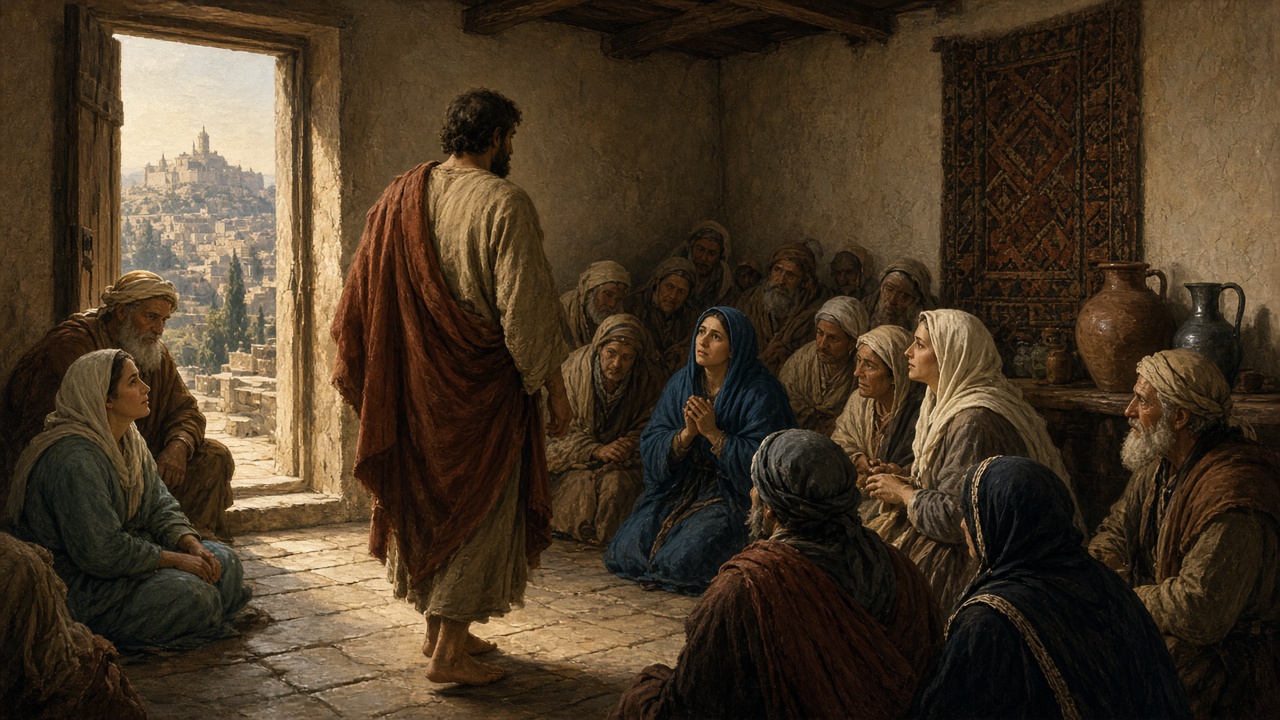
- Easton considera probable que Marcos fuera convertido por Pedro en la casa de su madre, en Jerusalén, donde Pedro, recién liberado de la cárcel, halló a muchos reunidos en oración, y señala que Pedro lo llama su hijo. El mismo artículo también juzga probable que el joven mencionado en Marcos 14:51–52 fuera el propio Marcos.Fuentes: Easton: Mark
Notas escritas con ayuda de IA a partir de fuentes abiertas (Theographic Bible Metadata, CC BY-SA 4.0; Easton’s Bible Dictionary, dominio público) y revisadas antes de publicarse.
1This word is good, I am teaching you about Jesus. He is God's own child.
JOHN CAME TO TELL THAT GOD WOULD SEND JESUS (1:2-8)
2Long ago God spoke to a man, his name was Isaiah. God told him, “I will send a boss to people. I will send another one ahead of that boss with a word for them. That first man will be in the desert. He will tell them, 'Our boss will come. Fix up a straight road for him.'” In that way God spoke to Isaiah. That man Isaiah wrote that word for them on paper. 4After a very long time that man now came. His name was John. 6His poor sort of clothes were made from camel hair. He tied his waist with a leather belt. He used to eat food from the desert, grasshoppers and honey. Very many people were coming to John to listen to him. They were coming to him from the country Judea, and from the big town Jerusalem also. He was telling them, “You have been ignoring God. Be ashamed. You have been doing bad things. Stop it! Come close, come to God! Then God will not look at you with anger, he will become pleased with you. After that I will baptise you.” In that sort of way John was talking to them. After hearing John's words one by one they were saying to God, “Truly I have been ignoring you. I am ashamed of myself. I want to return to you.” In that sort of way they were talking to God. After that John baptised them in the river, in Jordan. 7John was saying to them, “About now another man will come. He is a really big boss. Not like me, I am really unimportant, a scrap. This other one is an important boss. I truly should not touch his shoes. 8I only baptised you in water. This other one will send to you God's Spirit.” In that way John was talking to them.
JOHN BAPTISED JESUS (1:9-11)
9After that Jesus came to John from the town of Nazareth, in the country of Galilee. At that time John baptised Jesus in that river Jordan. 10As Jesus was coming up from the water he looked up. While he was looking God split the sky. God's spirit came down to Jesus like a dove, he sat on him. 11God spoke to Jesus from above, “You are truly my own child. I love you. I am pleased with you.”
THE EVIL SPIRIT TRIED IN VAIN TO PERSUADE JESUS TO IGNORE GOD (1:12-13)
12After that God's Spirit sent Jesus to the desert, to country that was truly without people. 13He was there 40 days and nights. While he was there truly the big evil spirit was trying in vain to persuade him to ignore God's word. Nothing. Jesus was without evil all the time. Wild and biting animals were there. God sent angels from above to take care of him.
THEY IMPRISONED JOHN (1:14)
14The big boss for the Jews, King Herod became angry with John. He told soldiers, “Tie John up and put him in gaol.”
JESUS WAS TEACHING THEM ABOUT GOD (1:14b-15)
14After that Jesus left that country, Judea, he went north to the country of Galilee. There he was telling many people God's word. 15He was saying to them, “Listen! I am telling you a good word from God. You have been ignoring God, you did not listen to him. Be ashamed! You have been doing bad things. Stop it! Believe his good word. In return he will be happy with you. He will make you his people. For this very word our old people who died long ago truly were waiting a long time. For this same word you also have been waiting.” In that sort of way Jesus was talking to them.
JESUS CALLED FISHERMEN TO FOLLOW HIM (1:16-20)
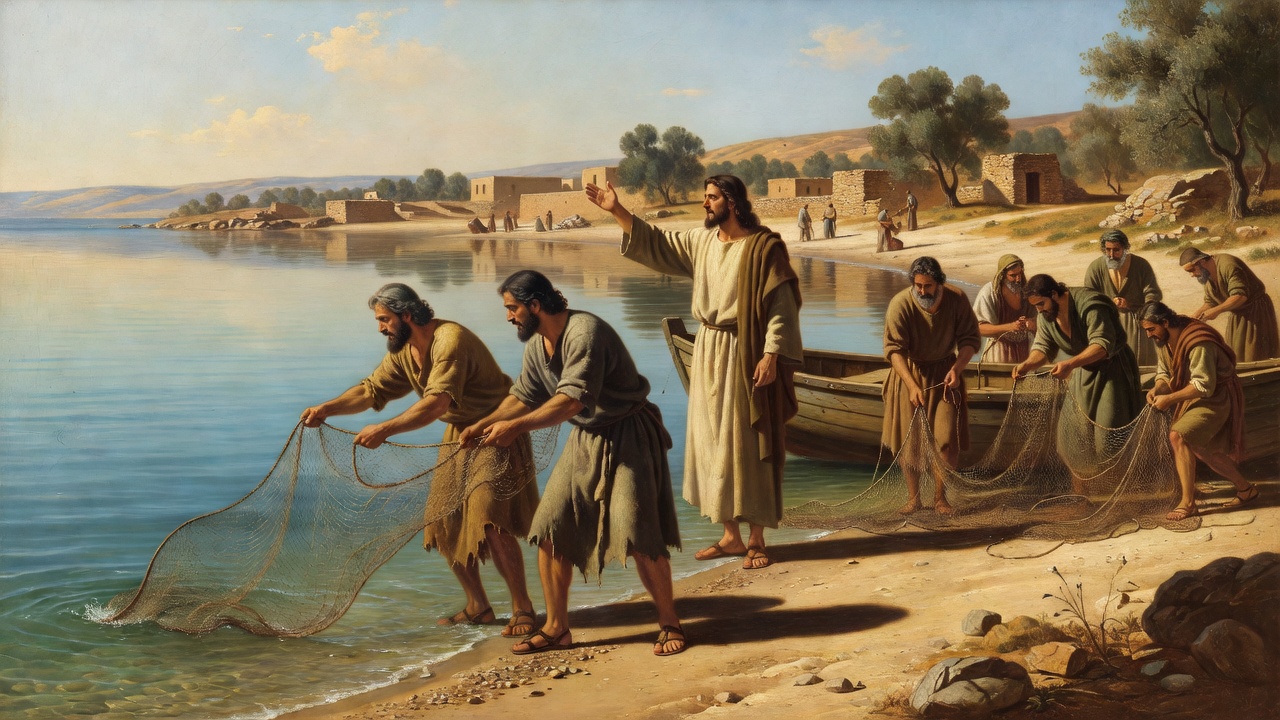
16He was going along the edge of the water, the water-hole Galilee. That is a large amount of water. He saw two people who habitually got fish, Simon and his younger brother Andrew. They used to get fish with nets. 17Jesus said to them, “Follow me. I will teach you about God. Then you will tell others about God. They will believe in God as a result of your word, they will become God's people. Before you used to bring fish to the land with nets. From now with a word you will bring people to God.” 18Right then in response to his word they left the nets, they followed him. 19Very soon after that Jesus went a little way, he saw two others, James and his younger brother John. The father of those two was named Zebedee. Those two were sitting in a dinghy with their father and his workers. They were fixing a torn net. 20Right then Jesus called James and John. Right then in response to his word they left their father in the dinghy and they left the workers, they followed Jesus.
JESUS SENT AN EVIL SPIRIT RIGHT AWAY (1:21-28)
21After that they went with Jesus towards that town, towards Capernaum. They arrived there. Saturday came. On Saturday the Jewish people did not work. That was their law. Saturday was for them to think about God's word. In the towns they used to gather in a meeting house to listen to God's word and to talk to God. There in Capernaum Saturday came for them, Jesus entered their meeting house. He was teaching them about God. The people were listening to him. 22They were puzzling about his word. “Truly it is different. This man truly talks correctly. Not like our teachers. They are just talkers of other peoples' words. This Jesus teaches us with a correct word. Truly God told him to talk like that.” 23Right then a man entered the meeting house. An evil spirit was making him crazy. 24He was afraid, he called out loudly, “Jesus from Nazareth! What do you want for us spirits? Having come will you hit us to kill us? I know you. God sent you. You are God's one who is truly without evil.” 25Jesus rebuked the evil spirit, “Be quiet! Leave the man! Go elsewhere!” 26The spirit really made that man thrash around, then it called out loudly, it left, it went away for good. 27All the people were puzzling about Jesus. They said to each other, “Who is this? This is a different kind of word. He talks correctly. He might say a word, and in response to his word whatever it is the evil spirits also do it.” 28At that time they kept telling each other Jesus' words everywhere in the country of Galilee.
JESUS WAS MAKING SICK PEOPLE WELL (1:29-34)
29After leaving that meeting house Jesus went to the camp of Simon and Andrew. Two also went, those other two, James and John. 30Simon's mother-in-law was sick. She was lying down in the house with a fever. As soon as Jesus came they told him that. 31Jesus went to her, he held her hand, the woman stood up. Right then the sickness left her, she walked around well, she brought food for them. 32Soon after the sunset, after twilight, they were bringing many people to Jesus, some of them sick, others crazy from evil spirits. 33The people gathered there, they all came to him at the door of the house. 34Jesus made many with various sickness well, and from many he sent away evil spirits. They knew him. Because of that Jesus stopped the spirits from talking.
JESUS WAS GOING AROUND IN GALILEE, HE WAS TELLING THEM ABOUT GOD (1:35-39)
35In the morning, before sunrise, Jesus got up from sleep, he left the house. After that he left the town, he went outside the town to the desert alone. There he talked to God. 36Simon and others were searching for Jesus. 37When they saw him they said to him, “Everyone has been looking for you.” 38He said to them, “We will not return to Capernaum now. We will go to other towns, I will tell them about God. God sent me to do that.” 39He was going around to them in Galilee, in the meeting places he was teaching many about God and was sending away evil spirits.
JESUS HEALED A MAN WITH SKIN SICKNESS (1:40-45)
40One day a man came to Jesus. He was sick, his skin was very bad. According to the law of the Jews all with that sickness should stay far away, truly alone. They should not enter a camp. That man when he came kneeled down to him, he begged Jesus, “Please make me well, make my skin good. What do you wish?” 41Jesus was sorry for him. After stretching out his hand he touched the sick one. “Yes, I want to make you well. I will make you really smooth.” 42Straightaway that sickness disappeared (lit. 'it became nothing for him'), that man's skin became smooth. 43Jesus told him sternly, “Listen! 44Do not tell them I made you well. Go straight to the ceremonial leader. He will look at your body all over, your skin is smooth. You know that law about your sickness. A long time ago God told Moses to write it in a book. In accordance with his word take a live sheep to the ceremonial leader. That leader will cook it till it is dry, right to ashes. Because of that when other people see that they will know about you, you are smooth, without sickness. After that you can again enter the camp.” In that way Jesus talked to him. Then he sent him to the ceremonial leader. 45That man did not stay quiet. He ignored Jesus. As he was going about he was continually telling people everywhere, “Jesus made my skin well.” Because of that talk Jesus did not go to the towns, he did not enter (them) so as to avoid many people. He was staying out in the country. Still people were coming to him from everywhere.
¿Sabías que…?
El evangelio comienza en el Jordán y en Galilea
- Juan, que aparece en el desierto predicando un bautismo de arrepentimiento, era de linaje sacerdotal. Su padre, Zacarías, era sacerdote del turno de Abías, y su madre, Elisabet, era de las hijas de Aarón; se dice que su nacimiento ocurrió seis meses antes que el de Jesús. Su misión se describe como tema de profecía en Isaías y Malaquías.Fuentes: John the Baptist · el propio texto bíblico
- Simón y su hermano Andrés eran pescadores de Betsaida, en la costa occidental del mar de Galilea. Andrés había sido discípulo de Juan el Bautista y ya había llevado a Simón a Jesús; los hermanos siguieron trabajando como pescadores hasta después del encarcelamiento de Juan. Santiago y Juan eran hijos de Zebedeo, un pescador galileo de cierta posición en Capernaúm, que tenía jornaleros propios; ellos lo dejaron en la barca con esos hombres.Fuentes: Simon Peter · Andrew · Zebedee · el propio texto bíblico
- El mar de Galilea, también llamado mar de Tiberíades, mide unas doce millas y media de largo y de cuatro a siete millas y media de ancho, y su superficie está a 682 pies bajo el Mediterráneo. Jesús vino desde Nazaret, en Galilea, para ser bautizado; esa ciudad no se menciona en el Antiguo Testamento y era el hogar de José y María. Bajo los romanos, Judea era la más meridional de las tres divisiones de Palestina, y la gente salía al encuentro de Juan desde Jerusalén y la campiña de Judea.Fuentes: Sea of Galilee · Nazareth · Judea · el propio texto bíblico
Notas escritas con ayuda de IA a partir de fuentes abiertas (Theographic Bible Metadata, CC BY-SA 4.0; Easton’s Bible Dictionary, dominio público) y revisadas antes de publicarse.
Lugares de este capítulo
- Jerusalem · 31.777, 35.234 · versículo 5
- Jordan · Hoy: Jordan River · 31.761, 35.558 · versículos 5, 9
- Judea · Hoy: Judea 1 · 31.777, 35.234 · versículo 5
- Galilee · 32.760, 35.527 · versículos 9, 14, 28, 39
- Nazareth · 32.702, 35.298 · versículos 9, 24
- Sea of Galilee · 32.819, 35.590 · versículo 16
Solo aparecen lugares identificados con alta confianza (90 % o más según las fuentes académicas reunidas por OpenBible). Mapa de la época: DARE (Digital Atlas of the Roman Empire), CC BY 4.0; mapa actual: © colaboradores de OpenStreetMap; lugares: OpenBible.info (CC BY 4.0).
Créditos y licencia de esta traducción
Nyangumarta English Bible
Portions of the Holy Bible in English, translated to be a companion to the Nyangumarta Bible
copyright © 1980-2010 Wycliffe Bible Translators, Inc.
Language: English
Bible translation copyright © 1980-2010 Wycliffe Bible Translators, Inc.
Reader Series (book XXC) copyright © 1996 Bible Society Australia. Bible overview (XXA) copyright © 1996 Mission Publications of Australia (PO Box 21, Lawson NSW 2783)
This translation is made available to you under the terms of the
Creative Commons Attribution-Noncommercial-No Derivatives license 4.0.
You may share and redistribute this Bible translation or extracts from it in any format, provided that:
You include the above copyright and source information.
You do not sell this work for a profit.
You do not change any of the words or punctuation of the Scriptures.
Pictures included with Scriptures and other documents on this site are licensed just for use with those Scriptures and documents.
For other uses, please contact the respective copyright owners.
2026-01-06
Fuente: http://ebible.org/engnna/ · eBible.org