Lucas 15
Nyangumarta English Bible · Toca un versículo para ver sus referencias cruzadas.

Acerca de este libro
Sobre Lucas
- El Diccionario Bíblico de Easton (1897) presenta al evangelista Lucas como un gentil; se desconocen la fecha y las circunstancias de su conversión. Según su propia declaración, señala Easton, no fue testigo ocular ni ministro de la palabra desde el principio. Easton considera probable que fuera médico en Troas, convertido allí por Pablo, a quien luego se unió.Fuentes: Easton: Luke
- Ese diccionario no fecha el Evangelio. Sitúa a Lucas con Pablo en Filipos, después como compañero en el viaje de Filipos a Jerusalén, ausente durante los encarcelamientos en Jerusalén y Cesarea, y de nuevo presente cuando Pablo partió hacia Roma, permaneciendo con él hasta el fin del primer encarcelamiento; la última mención del médico amado está en 2 Timoteo 4:11.Fuentes: Easton: Luke
- Bajo los romanos, en tiempos de Jesús, Judea era la más meridional de las tres divisiones de Palestina y parte de la provincia de Siria. Poncio Pilato, sexto procurador de Judea del año 26 al 36 d.C., tenía su sede en Cesarea y subía a menudo a Jerusalén; su gobierno abarcó los ministerios de Juan el Bautista y de Jesús. Herodes Antipas, hijo de Herodes y Malthace, es nombrado en el relato de Lucas.Fuentes: Judea · Pontius Pilate · Herod Antipas
- El relato inicial de Lucas trata de Juan el Bautista, de linaje sacerdotal: su padre, Zacarías, era sacerdote del turno de Abías, y su madre, Isabel, era de las hijas de Aarón; el nacimiento de Juan ocurrió seis meses antes que el de Jesús. María, esposa de José, de la tribu de Judá y del linaje de David, vivía en Nazaret cuando el ángel Gabriel anunció que ella sería la madre del Mesías; después visitó a su prima Isabel. La entrada sobre María afirma que su genealogía se da en Lucas 3.Fuentes: John the Baptist · Mary (Mother of Jesus) · Nazareth
- Easton cita muchos pasajes en los escritos de Lucas y en las cartas de Pablo como muestra del alcance y la exactitud del conocimiento médico de Lucas. Después de que Jesús fue expulsado de Nazaret, Capernaúm, ciudad de Galilea no mencionada en el Antiguo Testamento, llegó a ser su propia ciudad y escenario de muchos hechos de su vida. Galilea era conocida desde hacía tiempo como Galilea de los gentiles.Fuentes: Easton: Luke · Capernaum · Galilee
Notas escritas con ayuda de IA a partir de fuentes abiertas (Theographic Bible Metadata, CC BY-SA 4.0; Easton’s Bible Dictionary, dominio público) y revisadas antes de publicarse.
The Parable of the Lost Sheep
1Jesus was telling the people about God. Many were there listening to him. Bad people also were coming to him to listen.
2In the crowd [in the many'] some teachers of the Jews' law were there among them. Others also were there, they called themselves Pharisees. All those Pharisees and teachers were watching Jesus. They were saying to each other, “This Jesus is talking with the bad people, and he's eating food in their camps. That's bad.”
3Jesus knew about them what they were saying to each other. Therefore he told them this story to teach them.
4“Listen to this! Maybe one of you may have 100 sheep way out in the bush. Then perhaps one sheep may wander off and get lost. What will you do? You will leave the other 99 sheep in the bush. Then you will search carefully for the one sheep that ran away. 5When you find the one that got lost, you will become very happy. You will pick up that one sheep that ran away. Then you will carry it on your shoulders, you will return to your camp. 6Then you will call out to all your people, “Come here! This sheep of mine ran away into the bush. Truly I have found it. Now I am very happy. Let us all be happy.”
7Then Jesus said to them, “Yes! You are very happy after picking up your sheep. Like this God up above and his angels will be happy after one person after doing bad (things) returns to God. They are happy about the 99 good people who follow God. Truly they will be very happy about one person who after doing bad turns around in his tracks and returns to follow God.”
The Parable of the Lost Coin
8Then Jesus told them this other story. “Maybe a woman might have 10 coins. Then perhaps she will lose one. What will she do? She will light the lamp, she will sweep the house, she will search carefully in every direction. 9When she finds (the coin), she will call to the other people, “Come here! That money that I lost, truly I have found it! Now I am very happy. Let's all be happy!”
10Then Jesus said to them, “Yes! Like this God and his angels will be happy about one man returning from his bad ways.”
The Parable of the Prodigal Son
11Then he told them this other story. “Yes. Previously there lived a man who had two sons. 12One day the youngest one asked their father, “Father, when you die we (du.ex) will get your country. Share this country with us now, give me my share now.” Then truly the father divided it for those two.
13Then the youngest one gave his country to others for money [sold it], left home, and went far off to another country. In that country he was making mistakes with all that money. He was drinking, he was gambling [playing], truly he messed up his life for himself with all his money.
14Then he was puzzling hard, with no money.
Then at that time in that country there was no rain, the trees and the grass were dying. The people in that country were staying without food. That youngest one was hungry.
15Then he was thinking, “How will I get anything to eat? I will ask them for a job. Then truly they will give me food (in exchange) for work.”
He was working for a local person of that country. That local person told him, “Look after my pigs here, and give them food.”
16Then he was looking after the pigs. His boss didn't give him anything to eat. He was very hungry for the pigs’ rubbishy food.
17At last he realized. “My father’s work men are eating good food till they're full, and I here am starving, from starvation I might die. 18I will go, I will return to my father, I will tell him, ‘Father, I have done wrong. I have disobeyed God and I have disobeyed you. 19Don't call me your son, just tell me I will be your worker, I will work for you.’#”
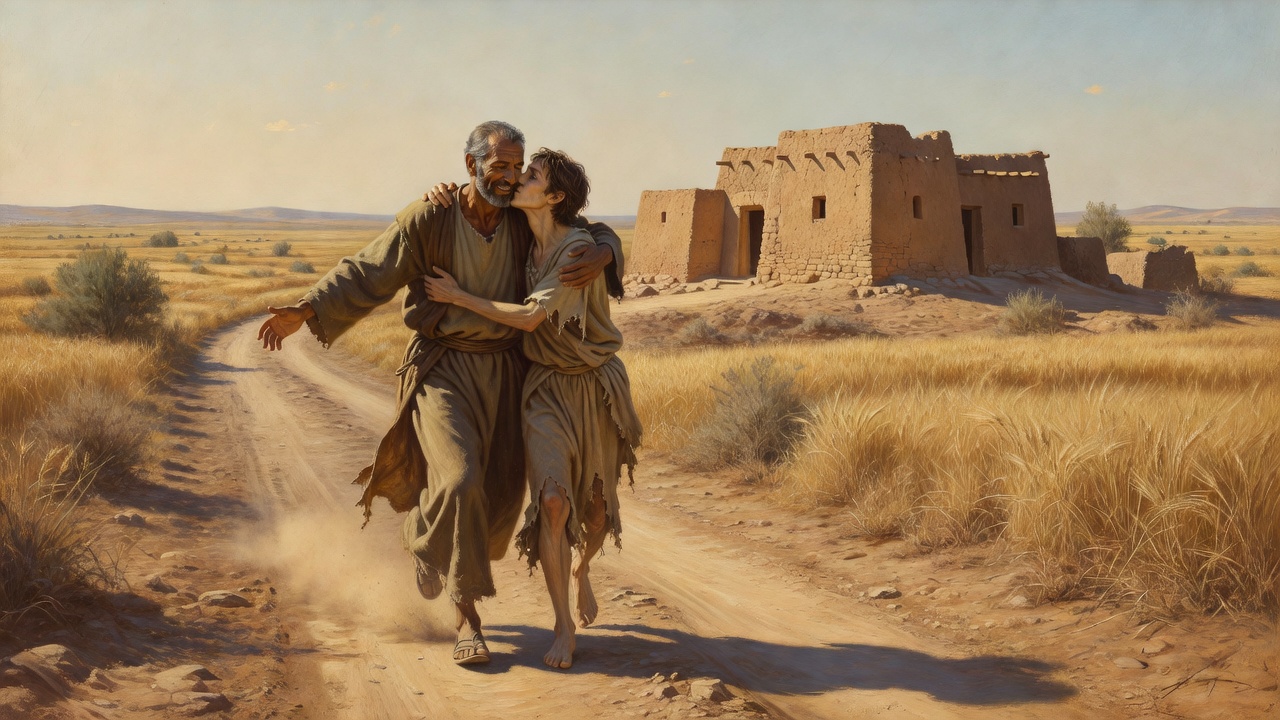
20A short time later went, he returned to his father's place. His father saw him from a distance. He felt sorry for him, he ran to meet his son. He hugged him, and they cried for each other.
21The son told him, “Father, I have done wrong (things). I have disobeyed God and I have disobeyed you. Don't call me your son.”
22In response the father didn't listen to his son. He told his workers, “Quick! Get some nice clothes for him, put them on him, and put shoes on his feet. Then put a ring on his finger. 23Then get the bullock, the fat one, kill it, and after you've killed it, cook it. Then we will all eat for my son. We'll truly be happy! 24I thought my son was as good as dead for ever. He’s not! He’s alive! He went far away. It was as if he had left me for ever. Not so! He has returned to me still alive!’
Then they were happily singing and dancing.
25The eldest was working somewhere far away. Then after work he was returning home. As he was getting close (to the camp) he heard them singing and dancing in the camp.
26Then he called out to a man, one of his father's working men. (He asked him,) “Why are they happily singing and dancing?”
27In reply that man told him, ‘Your younger brother returned today. Your father told us, “This my son returned to me. Kill the bullock, the fat one.”#’
28The eldest son got sulky and didn't go to the house to meet his brother, he stayed outside a fair way off.
Then his father went out to him, he begged him, ‘Come inside the house.’
29The eldest one answered his father sulkily, “I have truly stayed with you always, I have worked for you through the winter and the summer. I have always obeyed you [listened for your word]. In return you didn't give me a little goat. I and my fellows could have (but didn't) eat an animal with happiness. No indeed! You didn't give me an animal to kill and to eat. 30I am not like this youngest one of yours, (that) you gave your country to. He got money for that country, he messed up [made a mistake with] all his money on women. Now when he returns home you kill the fat bullock for him.
31His father told him, “Son, you have been with me, I your father am looking after you. Everything here is yours. I am holding it all for you. Truly when I die all of these things will be yours. 32I thought this younger brother of yours was as good as dead for ever. He's not! He’s alive! He went far away. It was as if he had left me for ever. Not so! He has returned to me, still alive! For that reason it is right that we should all be happy.”
¿Sabías que…?
Perdido y encontrado
- Los recaudadores de impuestos y los pecadores se estaban reuniendo para escuchar a Jesús, y los fariseos y los escribas comenzaron a murmurar que él acoge a los pecadores y come con ellos. Jesús entonces les contó parábolas sobre una oveja perdida, una moneda de plata perdida y un hijo perdido.Fuentes: el propio texto bíblico
- La enseñanza y la sanidad en Perea hacia Jerusalén se registran como comenzando en el año 30 d.C. con una duración de un día.Fuentes: Teaching and Healing in Perea to Jerusalem
Notas escritas con ayuda de IA a partir de fuentes abiertas (Theographic Bible Metadata, CC BY-SA 4.0; Easton’s Bible Dictionary, dominio público) y revisadas antes de publicarse.
Créditos y licencia de esta traducción
Nyangumarta English Bible
Portions of the Holy Bible in English, translated to be a companion to the Nyangumarta Bible
copyright © 1980-2010 Wycliffe Bible Translators, Inc.
Language: English
Bible translation copyright © 1980-2010 Wycliffe Bible Translators, Inc.
Reader Series (book XXC) copyright © 1996 Bible Society Australia. Bible overview (XXA) copyright © 1996 Mission Publications of Australia (PO Box 21, Lawson NSW 2783)
This translation is made available to you under the terms of the
Creative Commons Attribution-Noncommercial-No Derivatives license 4.0.
You may share and redistribute this Bible translation or extracts from it in any format, provided that:
You include the above copyright and source information.
You do not sell this work for a profit.
You do not change any of the words or punctuation of the Scriptures.
Pictures included with Scriptures and other documents on this site are licensed just for use with those Scriptures and documents.
For other uses, please contact the respective copyright owners.
2026-01-06
Títulos de sección adaptados de la Berean Standard Bible (dominio público); no forman parte del texto bíblico de esta traducción.
Fuente: http://ebible.org/engnna/ · eBible.org