Números 6
NET Bible · Toca un versículo para ver sus referencias cruzadas.
1Then the Lord spoke to Moses: 2“Speak to the Israelites, and tell them, ‘When either a man or a woman takes a special vow, to take a vow as a Nazirite, to separate himself to the Lord, 3he must separate himself from wine and strong drink, he must drink neither vinegar made from wine nor vinegar made from strong drink, nor may he drink any juice of grapes, nor eat fresh grapes or raisins. 4All the days of his separation he must not eat anything that is produced by the grapevine, from seed to skin.
5“‘All the days of the vow of his separation no razor may be used on his head until the time is fulfilled for which he separated himself to the Lord. He will be holy, and he must let the locks of hair on his head grow long.
6“‘All the days that he separates himself to the Lord he must not contact a dead body. 7He must not defile himself even for his father or his mother or his brother or his sister if they die, because the separation for his God is on his head. 8All the days of his separation he must be holy to the Lord.
Contingencies for Defilement
9“‘If anyone dies very suddenly beside him and he defiles his consecrated head, then he must shave his head on the day of his purification – on the seventh day he must shave it. 10On the eighth day he is to bring two turtledoves or two young pigeons to the priest, to the entrance to the tent of meeting. 11Then the priest will offer one for a purification offering and the other as a burnt offering, and make atonement for him, because of his transgression in regard to the corpse. So he must reconsecrate his head on that day. 12He must rededicate to the Lord the days of his separation and bring a male lamb in its first year as a reparation offering, but the former days will not be counted because his separation was defiled.
Fulfilling the Vows
13“‘Now this is the law of the Nazirite: When the days of his separation are fulfilled, he must be brought to the entrance of the tent of meeting, 14and he must present his offering to the Lord: one male lamb in its first year without blemish for a burnt offering, one ewe lamb in its first year without blemish for a purification offering, one ram without blemish for a peace offering, 15and a basket of bread made without yeast, cakes of fine flour mixed with olive oil, wafers made without yeast and smeared with olive oil, and their grain offering and their drink offerings.
16“‘Then the priest must present all these before the Lord and offer his purification offering and his burnt offering. 17Then he must offer the ram as a peace offering to the Lord, with the basket of bread made without yeast; the priest must also offer his grain offering and his drink offering.
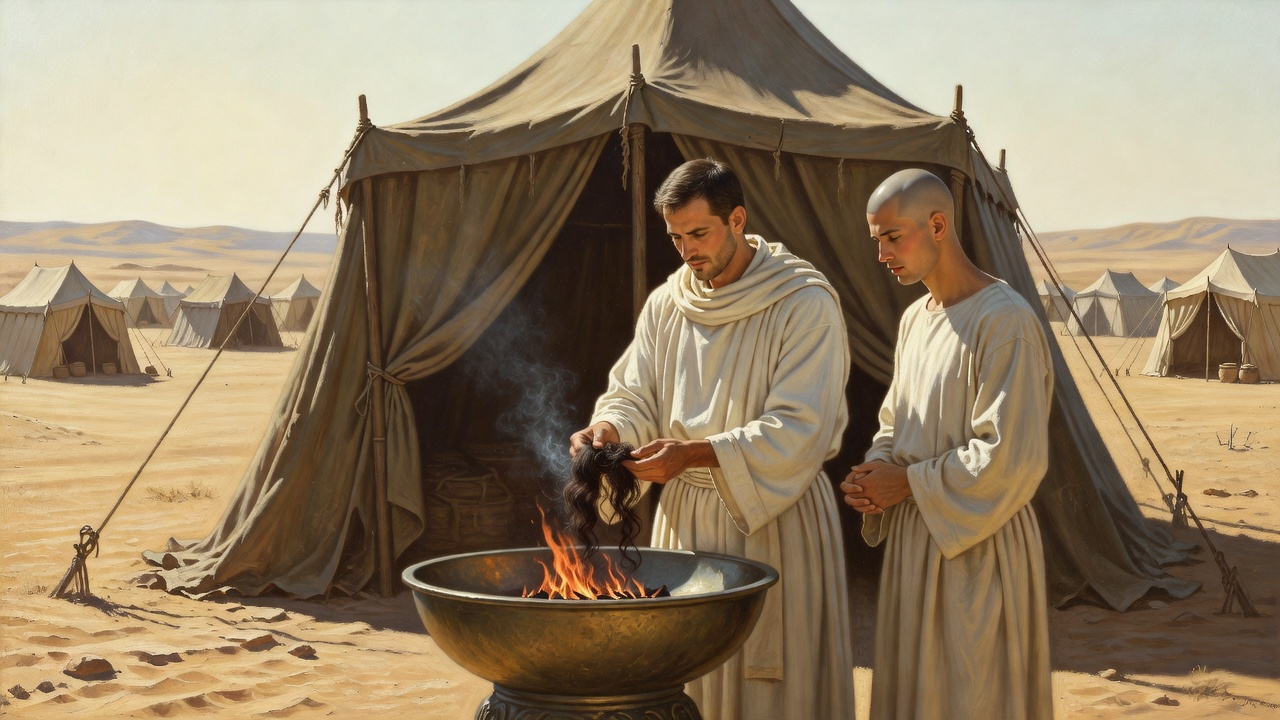
18“‘Then the Nazirite must shave his consecrated head at the entrance to the tent of meeting and must take the hair from his consecrated head and put it on the fire where the peace offering is burning. 19And the priest must take the boiled shoulder of the ram, one cake made without yeast from the basket, and one wafer made without yeast, and put them on the hands of the Nazirite after he has shaved his consecrated head; 20then the priest must wave them as a wave offering before the Lord; it is a holy portion for the priest, together with the breast of the wave offering and the thigh of the raised offering. After this the Nazirite may drink wine.’
21“This is the law of the Nazirite who vows to the Lord his offering according to his separation, as well as whatever else he can provide. Thus he must fulfill his vow that he makes, according to the law of his separation.”
The Priestly Benediction
22The Lord spoke to Moses: 23“Tell Aaron and his sons, ‘This is the way you are to bless the Israelites. Say to them:
24“The Lord bless you and protect you;
25The Lord make his face to shine upon you,
and be gracious to you;
26The Lord lift up his countenance upon you
and give you peace.”’
27So they will put my name on the Israelites, and I will bless them.”
¿Sabías que…?
El Voto de Nazareo y la Bendición Sacerdotal
- El voto de nazareo era un período voluntario de consagración especial a Dios disponible tanto para hombres como para mujeres. Durante este tiempo, la persona debía abstenerse por completo de productos derivados de la vid y bebidas fermentadas, dejarse crecer el cabello sin cortar y evitar la impureza ritual por cualquier cadáver, incluso de familiares cercanos.Fuentes: el propio texto bíblico
- Al concluir el período de separación, el nazareo presentaba sacrificios a la entrada de la Tienda de Reunión, se afeitaba la cabeza y quemaba el cabello en el fuego debajo del sacrificio de paz. Después de que el sacerdote presentaba las ofrendas prescritas ante Dios, el voto concluía y la persona podía volver a beber vino.Fuentes: el propio texto bíblico
- El capítulo concluye con la bendición sacerdotal que Dios ordenó a Moisés transmitir a Aarón y a sus hijos. Al invocar la protección, el rostro resplandeciente, la gracia y la paz de Dios, los sacerdotes ponían el nombre divino sobre el pueblo de Israel.Fuentes: el propio texto bíblico · Moses · Aaron
Notas escritas con ayuda de IA a partir de fuentes abiertas (Theographic Bible Metadata, CC BY-SA 4.0; Easton’s Bible Dictionary, dominio público) y revisadas antes de publicarse.
Créditos y licencia de esta traducción
NET Bible
NET Bible®, New English Translation (NET)
copyright © 1996-2016 Biblical Studies Press, L. L. C.
Please see https://netbible.com/copyright/ for full NET Bible copyright and permissions information. You can also read the NET Bible at http://NETBible.org .
Language: English
Dialect (if applicable): American
Language in English: English
Translation by:
Please see https://netbible.com/copyright/ for full NET Bible copyright and permissions information. You can also read the NET Bible at http://NETBible.org .
The NET Bible (New English Translation) is a completely new translation of the Bible with 58,506 translators’ notes ! It was completed by more than 25 scholars – experts in the original biblical languages – who worked directly from the best currently available Hebrew, Aramaic, and Greek texts. Turn the pages and see the breadth of the translators’ notes, documenting their decisions and choices as they worked.
The translators’ notes make the original languages far more accessible, allowing you to look over the translator’s shoulder at the very process of translation. This level of documentation is a first for a Bible translation, making transparent the textual basis and the rationale for key renderings (including major interpretive options and alternative translations).
This unparalleled level of detail helps connect people to the Bible in the original languages in a way never before possible without years of study of Hebrew, Aramaic, and Greek. It unlocks the riches of the Bible’s truth from entirely new perspectives.
A donation is appreciated. Donate at Bible.org/donations_form so we can continue to provide our material for free for our 16,000+ articles on Bible.org and our world class Bible Study tool at lumina.bible.org .
2026-10-02
Fuente: http://ebible.org/engnet/ · eBible.org