Números 21
NET Bible · Toca un versículo para ver sus referencias cruzadas.
1When the Canaanite king of Arad who lived in the Negev heard that Israel was approaching along the road to Atharim, he fought against Israel and took some of them prisoner.
2So Israel made a vow to the Lord and said, “If you will indeed deliver this people into our hand, then we will utterly destroy their cities.” 3The Lord listened to the voice of Israel and delivered up the Canaanites, and they utterly destroyed them and their cities. So the name of the place was called Hormah.
Fiery Serpents
4Then they traveled from Mount Hor by the road to the Red Sea, to go around the land of Edom, but the people became impatient along the way. 5And the people spoke against God and against Moses, “Why have you brought us up out of Egypt to die in the wilderness, for there is no bread or water, and we detest this worthless food.”
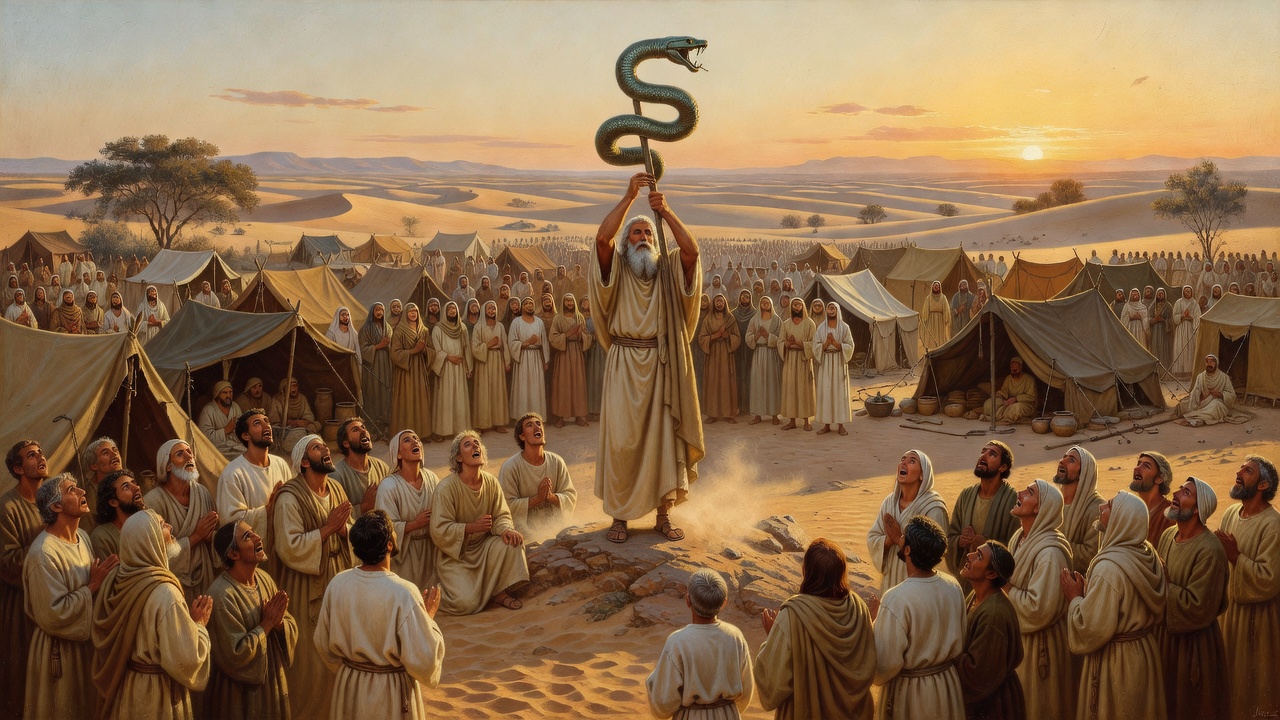
6So the Lord sent poisonous snakes among the people, and they bit the people; many people of Israel died. 7Then the people came to Moses and said, “We have sinned, for we have spoken against the Lord and against you. Pray to the Lord that he would take away the snakes from us.” So Moses prayed for the people.
8The Lord said to Moses, “Make a poisonous snake and set it on a pole. When anyone who is bitten looks at it, he will live.” 9So Moses made a bronze snake and put it on a pole, so that if a snake had bitten someone, when he looked at the bronze snake he lived.
The Approach to Moab
10The Israelites traveled on and camped in Oboth. 11Then they traveled on from Oboth and camped at Iye Abarim, in the wilderness that is before Moab, on the eastern side. 12From there they moved on and camped in the valley of Zered. 13From there they moved on and camped on the other side of the Arnon, in the wilderness that extends from the regions of the Amorites, for Arnon is the border of Moab, between Moab and the Amorites. 14This is why it is said in the Book of the Wars of the Lord,
“Waheb in Suphah and the wadis,
the Arnon 15and the slope of the valleys
that extends to the dwelling of Ar,
and falls off at the border of Moab.”
16And from there they traveled to Beer; that is the well where the Lord spoke to Moses, “Gather the people and I will give them water.” 17Then Israel sang this song:
“Spring up, O well, sing to it!
18The well which the princes dug,
which the leaders of the people opened
with their scepters and their staffs.”
And from the wilderness they traveled to Mattanah; 19and from Mattanah to Nahaliel; and from Nahaliel to Bamoth; 20and from Bamoth to the valley that is in the country of Moab, near the top of Pisgah, which overlooks the wilderness.
The Victory over Sihon and Og
21Then Israel sent messengers to King Sihon of the Amorites, saying,
22“Let us pass through your land; we will not turn aside into the fields or into the vineyards, nor will we drink water from any well, but we will go along the King’s Highway until we pass your borders.” 23But Sihon did not permit Israel to pass through his border; he gathered all his forces together and went out against Israel into the wilderness. When he came to Jahaz, he fought against Israel. 24But the Israelites defeated him in battle and took possession of his land from the Arnon to the Jabbok, as far as the Ammonites, for the border of the Ammonites was strongly defended. 25So Israel took all these cities; and Israel settled in all the cities of the Amorites, in Heshbon, and in all its villages. 26For Heshbon was the city of King Sihon of the Amorites. Now he had fought against the former king of Moab and had taken all of his land from his control, as far as the Arnon. 27That is why those who speak in proverbs say,
“Come to Heshbon, let it be built.
Let the city of Sihon be established!
28For fire went out from Heshbon,
a flame from the city of Sihon.
It has consumed Ar of Moab
and the lords of the high places of Arnon.
29Woe to you, Moab.
You are ruined, O people of Chemosh!
He has made his sons fugitives,
and his daughters the prisoners of King Sihon of the Amorites.
30We have overpowered them;
Heshbon has perished as far as Dibon.
We have shattered them as far as Nophah,
which reaches to Medeba.”
31So the Israelites lived in the land of the Amorites. 32Moses sent spies to reconnoiter Jaazer, and they captured its villages and dispossessed the Amorites who were there.
33Then they turned and went up by the road to Bashan. And King Og of Bashan and all his forces marched out against them to do battle at Edrei. 34And the Lord said to Moses, “Do not fear him, for I have delivered him and all his people and his land into your hand. You will do to him what you did to King Sihon of the Amorites, who lived in Heshbon. 35So they defeated Og, his sons, and all his people, until there were no survivors, and they possessed his land.
¿Sabías que…?
La serpiente de bronce y el avance más allá del Arnón
- Cuando los israelitas se impacientaron durante el viaje alrededor de Edom y se quejaron de la falta de comida y agua, aparecieron serpientes venenosas en el campamento. Moisés recibió instrucciones de hacer una serpiente de bronce y colocarla en un asta para que cualquiera que fuera mordido pudiera mirarla y vivir.Fuentes: el propio texto bíblico
- Este capítulo cita una antigua obra hebrea hoy perdida, llamada el Libro de las Batallas de Jehová, para delimitar la frontera a lo largo del río Arnón, que separaba a los moabitas de los amorreos.Fuentes: el propio texto bíblico · Arnon
- El pasaje incluye un poema antiguo que menciona a Quemos, la deidad adorada por los moabitas. El poema relata cómo Sehón, rey de los amorreos, había conquistado previamente tierras moabitas desde Hesbón hasta el Arnón antes de que Israel lo derrotara en batalla.Fuentes: el propio texto bíblico · Chemosh · Sihon · Heshbon
Notas escritas con ayuda de IA a partir de fuentes abiertas (Theographic Bible Metadata, CC BY-SA 4.0; Easton’s Bible Dictionary, dominio público) y revisadas antes de publicarse.
Lugares de este capítulo
- Negeb · 31.245, 34.841 · versículo 1
- Edom · 30.746, 35.604 · versículo 4
- Way of the Red Sea · Hoy: road between the Dead Sea and the Gulf of Aqaba · 29.727, 34.998 · versículo 4
- Egypt · 30.129, 31.308 · versículo 5
- Moab · Hoy: Moab 1 · 31.181, 35.701 · versículos 11, 13, 15, 20, 26, 28, 29
- Valley of Zered · Hoy: Wadi al Hasa · 31.027, 35.485 · versículo 12
- Arnon · Hoy: Wadi Mujib · 31.466, 35.573 · versículos 13, 14, 24, 26, 28
- Waheb · Hoy: within 50 km of Sufeh · 31.666, 35.817 · versículo 14
- Jeshimon · 31.470, 35.223 · versículo 20
- King’s Highway · 31.955, 35.934 · versículo 22
- Ammon · 31.955, 35.934 · versículo 24
- Jabbok · Hoy: Zarqa River · 32.115, 35.543 · versículo 24
- Dibon · Hoy: Tall Dhiban · 31.502, 35.777 · versículo 30
- Medeba · Hoy: Madaba · 31.716, 35.795 · versículo 30
- Bashan · 32.781, 35.935 · versículo 33
Solo aparecen lugares identificados con alta confianza (90 % o más según las fuentes académicas reunidas por OpenBible). Mapa de la época: DARE (Digital Atlas of the Roman Empire), CC BY 4.0; mapa actual: © colaboradores de OpenStreetMap; lugares: OpenBible.info (CC BY 4.0).
Créditos y licencia de esta traducción
NET Bible
NET Bible®, New English Translation (NET)
copyright © 1996-2016 Biblical Studies Press, L. L. C.
Please see https://netbible.com/copyright/ for full NET Bible copyright and permissions information. You can also read the NET Bible at http://NETBible.org .
Language: English
Dialect (if applicable): American
Language in English: English
Translation by:
Please see https://netbible.com/copyright/ for full NET Bible copyright and permissions information. You can also read the NET Bible at http://NETBible.org .
The NET Bible (New English Translation) is a completely new translation of the Bible with 58,506 translators’ notes ! It was completed by more than 25 scholars – experts in the original biblical languages – who worked directly from the best currently available Hebrew, Aramaic, and Greek texts. Turn the pages and see the breadth of the translators’ notes, documenting their decisions and choices as they worked.
The translators’ notes make the original languages far more accessible, allowing you to look over the translator’s shoulder at the very process of translation. This level of documentation is a first for a Bible translation, making transparent the textual basis and the rationale for key renderings (including major interpretive options and alternative translations).
This unparalleled level of detail helps connect people to the Bible in the original languages in a way never before possible without years of study of Hebrew, Aramaic, and Greek. It unlocks the riches of the Bible’s truth from entirely new perspectives.
A donation is appreciated. Donate at Bible.org/donations_form so we can continue to provide our material for free for our 16,000+ articles on Bible.org and our world class Bible Study tool at lumina.bible.org .
2026-10-02
Fuente: http://ebible.org/engnet/ · eBible.org