Mateo 2
NET Bible · Toca un versículo para ver sus referencias cruzadas.
1After Jesus was born in Bethlehem 2saying, “Where is the one who is born king of the Jews? For we saw his star when it rose and have come to worship him.” 3When King Herod heard this he was alarmed, and all Jerusalem with him. 4After assembling all the chief priests and experts in the law, he asked them where the Christ was to be born. 5“In Bethlehem of Judea,” they said, “for it is written this way by the prophet:
6‘ And you, Bethlehem, in the land of Judah,
are in no way least among the rulers of Judah,
for out of you will come a ruler who will shepherd my people Israel.’”
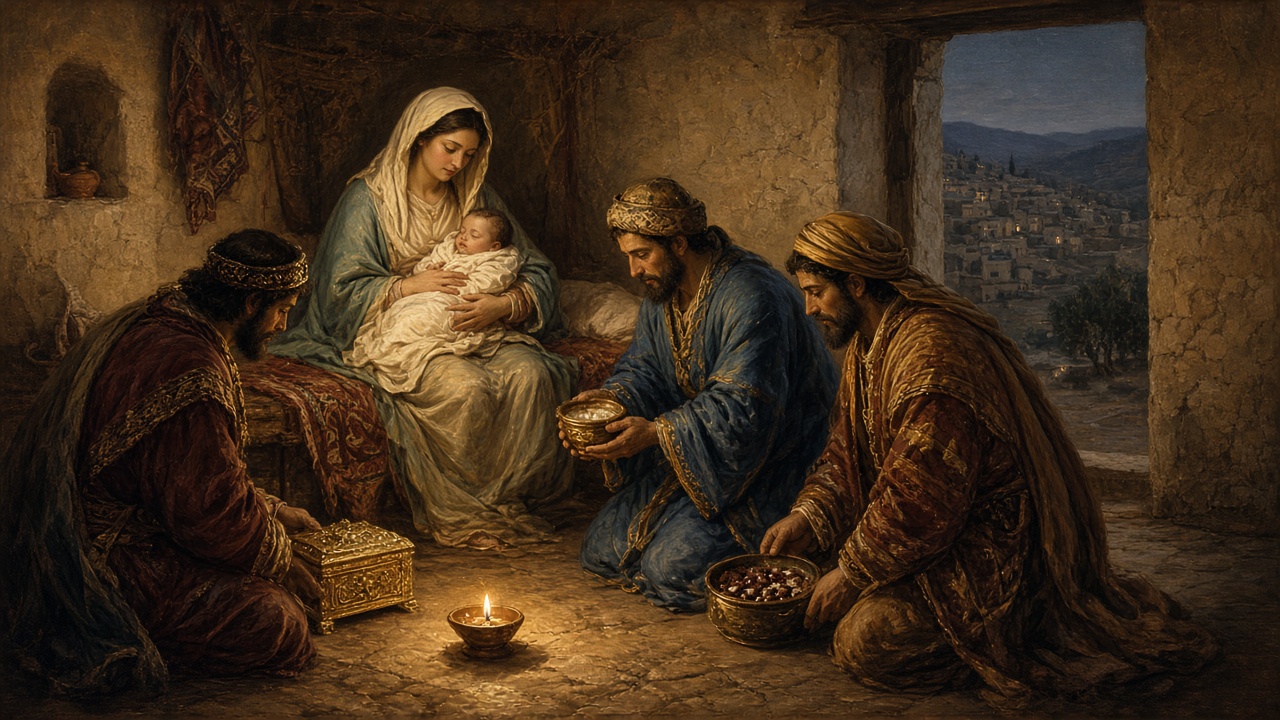
7Then Herod privately summoned the wise men and determined from them when the star had appeared. 8He sent them to Bethlehem and said, “Go and look carefully for the child. When you find him, inform me so that I can go and worship him as well.” 9After listening to the king they left, and once again the star they saw when it rose led them until it stopped above the place where the child was. 10When they saw the star they shouted joyfully. 11As they came into the house and saw the child with Mary his mother, they bowed down and worshiped him. They opened their treasure boxes and gave him gifts of gold, frankincense, and myrrh. 12After being warned in a dream not to return to Herod, they went back by another route to their own country.
The Escape to Egypt
13After they had gone, an angel of the Lord appeared to Joseph in a dream and said, “Get up, take the child and his mother and flee to Egypt, and stay there until I tell you, for Herod is going to look for the child to kill him.” 14Then he got up, took the child and his mother during the night, and went to Egypt. 15He stayed there until Herod died. In this way what was spoken by the Lord through the prophet was fulfilled : “I called my Son out of Egypt.”
16When Herod saw that he had been tricked by the wise men, he became enraged. He sent men to kill all the children in Bethlehem and throughout the surrounding region from the age of two and under, according to the time he had learned from the wise men. 17Then what was spoken by Jeremiah the prophet was fulfilled:
18“ A voice was heard in Ramah,
weeping and loud wailing,
Rachel weeping for her children,
and she did not want to be comforted, because they were gone.”
The Return to Nazareth
19After Herod had died, an angel of the Lord appeared in a dream to Joseph in Egypt 20saying, “Get up, take the child and his mother, and go to the land of Israel, for those who were seeking the child’s life are dead.” 21So he got up and took the child and his mother and returned to the land of Israel. 22But when he heard that Archelaus was reigning over Judea in place of his father Herod, he was afraid to go there. After being warned in a dream, he went to the regions of Galilee. 23He came to a town called Nazareth and lived there. Then what had been spoken by the prophets was fulfilled, that Jesus would be called a Nazarene.
¿Sabías que…?
Magos, Herodes y Nazaret
- El rey Herodes de este capítulo es Herodes el Grande. Su hijo Arquelao, habido con Malthace, una mujer samaritana, heredó la tercera parte del reino: Idumea, Judea y Samaria. Hasta pocos días antes de la muerte de Herodes, otro hijo, Antipas, había sido nombrado sucesor, pero en sus últimos momentos Herodes nombró a Arquelao; por temor a él, José se apartó de Judea y se retiró a Galilea.Fuentes: Archelaus · el propio texto bíblico
- Mateo relaciona la muerte de los niños en Belén con palabras pronunciadas por el profeta Jeremías: una voz en Ramá, Raquel llorando por sus hijos. Raquel, una de las esposas de Jacob, murió al dar a luz a Benjamín y fue sepultada junto al camino de Efrata, es decir, Belén, justo al norte de la ciudad. Su sepulcro es objeto de gran veneración entre los judíos.Fuentes: el propio texto bíblico · Rachel · Bethlehem
- Belén, en la región montañosa de Judá, se llamaba antes Efrata y también era conocida como la ciudad de David; bajo los romanos quedaba en Judea, la más meridional de las tres divisiones de Palestina. José y María fueron en cambio a Nazaret, en Galilea, su hogar, un pueblo que no se menciona en el Antiguo Testamento. En general se supone que el nombre Nazaret proviene del hebreo netser, un renuevo o brote, aunque algunos lo relacionan con una palabra que significa guardar o vigilar.Fuentes: Bethlehem · Judea · Nazareth · el propio texto bíblico
Notas escritas con ayuda de IA a partir de fuentes abiertas (Theographic Bible Metadata, CC BY-SA 4.0; Easton’s Bible Dictionary, dominio público) y revisadas antes de publicarse.
Lugares de este capítulo
- Bethlehem · 31.704, 35.208 · versículos 1, 5, 6, 8, 9, 16
- East · Hoy: region around Amman · 31.955, 35.934 · versículos 1, 2, 9
- Jerusalem · 31.777, 35.234 · versículos 1, 3
- Judea · Hoy: Judea 1 · 31.777, 35.234 · versículos 1, 5, 22
- Egypt · 30.129, 31.308 · versículos 13, 14, 15, 19
- Galilee · 32.760, 35.527 · versículo 22
- Nazareth · 32.702, 35.298 · versículo 23
Solo aparecen lugares identificados con alta confianza (90 % o más según las fuentes académicas reunidas por OpenBible). Mapa de la época: DARE (Digital Atlas of the Roman Empire), CC BY 4.0; mapa actual: © colaboradores de OpenStreetMap; lugares: OpenBible.info (CC BY 4.0).
Créditos y licencia de esta traducción
NET Bible
NET Bible®, New English Translation (NET)
copyright © 1996-2016 Biblical Studies Press, L. L. C.
Please see https://netbible.com/copyright/ for full NET Bible copyright and permissions information. You can also read the NET Bible at http://NETBible.org .
Language: English
Dialect (if applicable): American
Language in English: English
Translation by:
Please see https://netbible.com/copyright/ for full NET Bible copyright and permissions information. You can also read the NET Bible at http://NETBible.org .
The NET Bible (New English Translation) is a completely new translation of the Bible with 58,506 translators’ notes ! It was completed by more than 25 scholars – experts in the original biblical languages – who worked directly from the best currently available Hebrew, Aramaic, and Greek texts. Turn the pages and see the breadth of the translators’ notes, documenting their decisions and choices as they worked.
The translators’ notes make the original languages far more accessible, allowing you to look over the translator’s shoulder at the very process of translation. This level of documentation is a first for a Bible translation, making transparent the textual basis and the rationale for key renderings (including major interpretive options and alternative translations).
This unparalleled level of detail helps connect people to the Bible in the original languages in a way never before possible without years of study of Hebrew, Aramaic, and Greek. It unlocks the riches of the Bible’s truth from entirely new perspectives.
A donation is appreciated. Donate at Bible.org/donations_form so we can continue to provide our material for free for our 16,000+ articles on Bible.org and our world class Bible Study tool at lumina.bible.org .
2026-10-02
Fuente: http://ebible.org/engnet/ · eBible.org