Lamentaciones 4
NET Bible · Toca un versículo para ver sus referencias cruzadas.
א (Alef)
1Alas! Gold has lost its luster;
pure gold loses value.
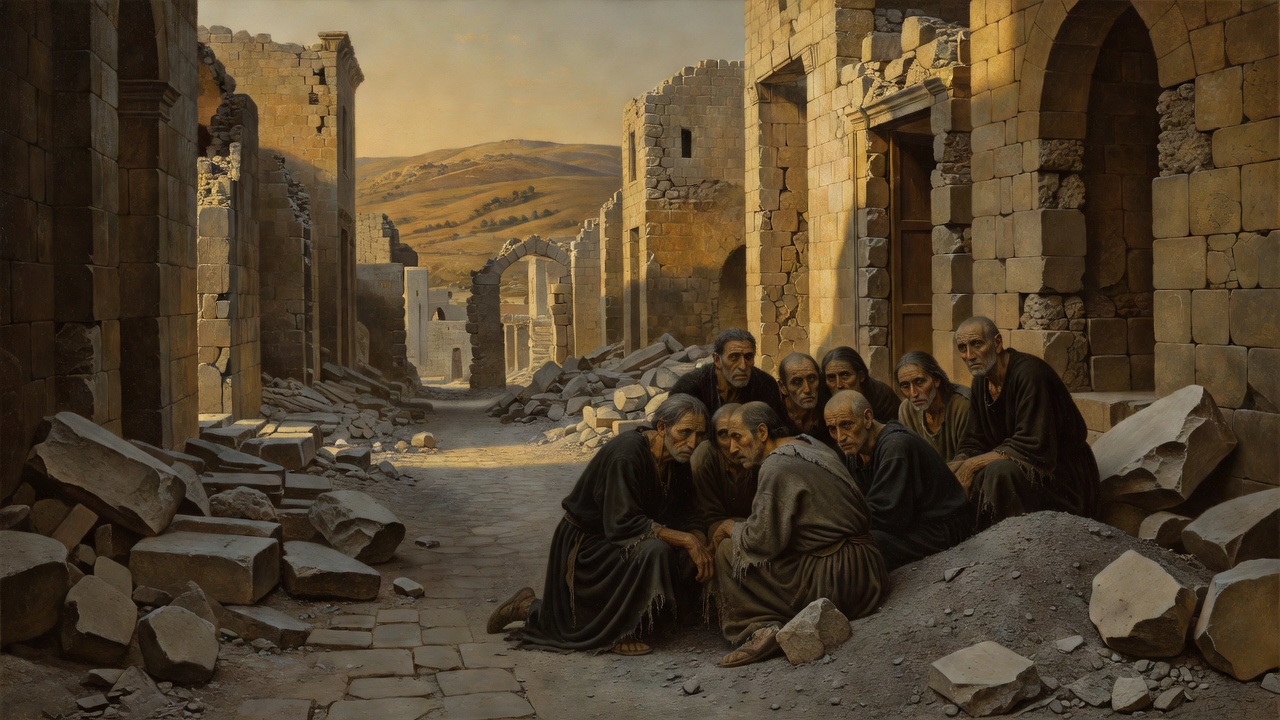
Jewels are scattered
on every street corner.
ב ( Bet)
2The precious sons of Zion
were worth their weight in gold –
Alas! – but now they are treated like broken clay pots,
made by a potter.
ג ( Gimel)
3Even the jackals nurse their young
at their breast,
but my people are cruel,
like ostriches in the desert.
ד ( Dalet)
4The infant’s tongue sticks
to the roof of its mouth due to thirst;
little children beg for bread,
but no one gives them even a morsel.
ה ( He)
5Those who once feasted on delicacies
are now starving to death in the streets.
Those who grew up wearing expensive clothes
are now dying amid garbage.
ו ( Vav)
6The punishment of my people
exceeded that of of Sodom,
which was overthrown in a moment
with no one to help her.
ז ( Zayin)
7Her consecrated ones were brighter than snow,
whiter than milk;
their bodies more ruddy than corals,
their hair like lapis lazuli.
ח ( Khet)
8Now their appearance is darker than soot;
they are not recognized in the streets.
Their skin has shriveled on their bones;
it is dried up, like tree bark.
ט ( Tet)
9Those who died by the sword are better off
than those who die of hunger,
those who waste away,
struck down from lack of food.
י ( Yod)
10The hands of tenderhearted women
cooked their own children,
who became their food,
when my people were destroyed.
כ ( Kaf)
11The Lord fully vented his wrath;
he poured out his fierce anger.
He started a fire in Zion;
it consumed her foundations.
ל ( Lamed)
12Neither the kings of the earth
nor the people of the lands ever thought
that enemy or foe would enter
the gates of Jerusalem.
מ ( Mem)
13But it happened due to the sins of her prophets
and the iniquities of her priests,
who poured out in her midst
the blood of the righteous.
נ ( Nun)
14They wander blindly through the streets,
defiled by the blood they shed,
while no one dares
to touch their garments.
ס ( Samek)
15People cry to them, “Turn away! You are unclean!
Turn away! Turn away! Don’t touch us!”
So they have fled and wander about;
but the nations say, “They may not stay here any longer.”
פ ( Pe)
16The Lord himself has scattered them;
he no longer watches over them.
They did not honor the priests;
they did not show favor to the elders.
The People of Jerusalem Lament:
ע (Ayin)
17Our eyes continually failed us
as we looked in vain for help.
From our watchtowers we watched
for a nation that could not rescue us.
צ ( Tsade)
18Our enemies hunted us down at every step
so that we could not walk about in our streets.
Our end drew near, our days were numbered,
for our end had come!
ק ( Qof)
19Those who pursued us were swifter
than eagles in the sky.
They chased us over the mountains;
they ambushed us in the wilderness.
ר ( Resh)
20Our very life breath – the Lord’s anointed king –
was caught in their traps,
of whom we thought,
“Under his protection we will survive among the nations.”
The Prophet Speaks:
ש (Sin/Shin)
21Rejoice and be glad for now, O people of Edom,
who reside in the land of Uz.
But the cup of judgment will pass to you also;
you will get drunk and take off your clothes.
ת ( Tav)
22O people of Zion, your punishment will come to an end;
he will not prolong your exile.
But, O people of Edom, he will punish your sin
and reveal your offenses!
¿Sabías que…?
La Agonía de la Ciudad Caída
- El poeta considera que el prolongado sufrimiento de Jerusalén fue peor que el destino de Sodoma. Mientras que Sodoma fue destruida en un instante por fuego divino, los habitantes de Jerusalén soportaron el tormento lento y desgarrador del asedio y la hambruna.Fuentes: el propio texto bíblico · Sodom
- Antes de su caída, Jerusalén era considerada en gran medida como una ciudad montañosa impenetrable. El texto señala que los reyes extranjeros y las naciones vecinas nunca creyeron que un enemigo pudiera traspasar sus puertas fortificadas.Fuentes: el propio texto bíblico · Jerusalem
- El capítulo concluye dirigiéndose a Edom, que habitaba en la tierra de Uz, advirtiendo que el juicio pronto la alcanzaría a ella también. La tierra de Uz se menciona únicamente en tres libros bíblicos: Job, Jeremías y Lamentaciones.Fuentes: el propio texto bíblico · Uz · Edom
Notas escritas con ayuda de IA a partir de fuentes abiertas (Theographic Bible Metadata, CC BY-SA 4.0; Easton’s Bible Dictionary, dominio público) y revisadas antes de publicarse.
Lugares de este capítulo
- Zion · Hoy: Jerusalem · 31.777, 35.234 · versículos 2, 11, 22
- Jerusalem · 31.777, 35.234 · versículo 12
- Edom · 30.746, 35.604 · versículos 21, 22
Solo aparecen lugares identificados con alta confianza (90 % o más según las fuentes académicas reunidas por OpenBible). Mapa de la época: DARE (Digital Atlas of the Roman Empire), CC BY 4.0; mapa actual: © colaboradores de OpenStreetMap; lugares: OpenBible.info (CC BY 4.0).
Créditos y licencia de esta traducción
NET Bible
NET Bible®, New English Translation (NET)
copyright © 1996-2016 Biblical Studies Press, L. L. C.
Please see https://netbible.com/copyright/ for full NET Bible copyright and permissions information. You can also read the NET Bible at http://NETBible.org .
Language: English
Dialect (if applicable): American
Language in English: English
Translation by:
Please see https://netbible.com/copyright/ for full NET Bible copyright and permissions information. You can also read the NET Bible at http://NETBible.org .
The NET Bible (New English Translation) is a completely new translation of the Bible with 58,506 translators’ notes ! It was completed by more than 25 scholars – experts in the original biblical languages – who worked directly from the best currently available Hebrew, Aramaic, and Greek texts. Turn the pages and see the breadth of the translators’ notes, documenting their decisions and choices as they worked.
The translators’ notes make the original languages far more accessible, allowing you to look over the translator’s shoulder at the very process of translation. This level of documentation is a first for a Bible translation, making transparent the textual basis and the rationale for key renderings (including major interpretive options and alternative translations).
This unparalleled level of detail helps connect people to the Bible in the original languages in a way never before possible without years of study of Hebrew, Aramaic, and Greek. It unlocks the riches of the Bible’s truth from entirely new perspectives.
A donation is appreciated. Donate at Bible.org/donations_form so we can continue to provide our material for free for our 16,000+ articles on Bible.org and our world class Bible Study tool at lumina.bible.org .
2026-10-02
Fuente: http://ebible.org/engnet/ · eBible.org