Deuteronomio 24
NET Bible · Toca un versículo para ver sus referencias cruzadas.
1If a man marries a woman and she does not please him because he has found something offensive in her, then he may draw up a divorce document, give it to her, and evict her from his house. 2When she has left him she may go and become someone else’s wife. 3If the second husband rejects her and then divorces her, gives her the papers, and evicts her from his house, or if the second husband who married her dies, 4her first husband who divorced her is not permitted to remarry her after she has become ritually impure, for that is offensive to the Lord. You must not bring guilt on the land which the Lord your God is giving you as an inheritance.
5When a man is newly married, he need not go into the army nor be obligated in any way; he must be free to stay at home for a full year and bring joy to the wife he has married.
6One must not take either lower or upper millstones as security on a loan, for that is like taking a life itself as security.
7If a man is found kidnapping a person from among his fellow Israelites, and regards him as mere property and sells him, that kidnapper must die. In this way you will purge evil from among you.
Respect for Human Dignity
8Be careful during an outbreak of leprosy to follow precisely all that the Levitical priests instruct you; as I have commanded them, so you should do. 9Remember what the Lord your God did to Miriam along the way after you left Egypt.
10When you make any kind of loan to your neighbor, you may not go into his house to claim what he is offering as security. 11You must stand outside and the person to whom you are making the loan will bring out to you what he is offering as security. 12If the person is poor you may not use what he gives you as security for a covering. 13You must by all means return to him at sunset the item he gave you as security so that he may sleep in his outer garment and bless you for it; it will be considered a just deed by the Lord your God.
14You must not oppress a lowly and poor servant, whether one from among your fellow Israelites or from the resident foreigners who are living in your land and villages. 15You must pay his wage that very day before the sun sets, for he is poor and his life depends on it. Otherwise he will cry out to the Lord against you, and you will be guilty of sin.
16Fathers must not be put to death for what their children do, nor children for what their fathers do; each must be put to death for his own sin.
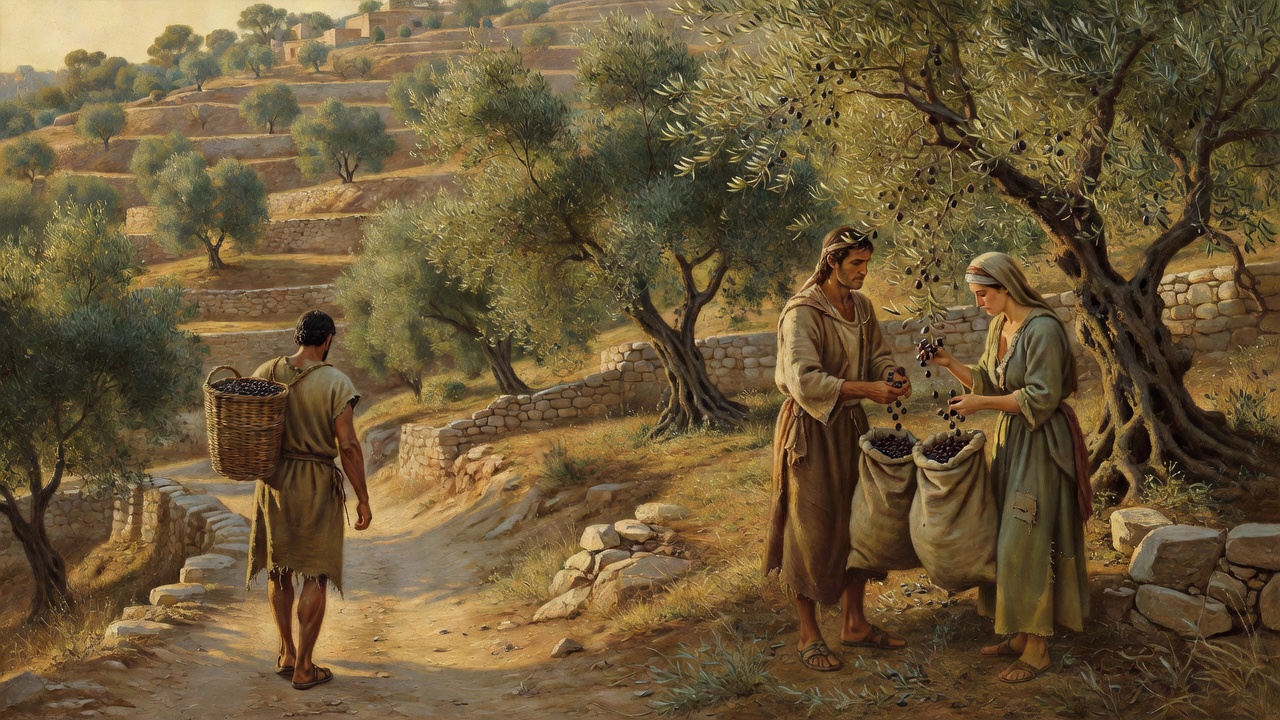
17You must not pervert justice due a resident foreigner or an orphan, or take a widow’s garment as security for a loan. 18Remember that you were slaves in Egypt and that the Lord your God redeemed you from there; therefore I am commanding you to do all this. 19Whenever you reap your harvest in your field and leave some unraked grain there, you must not return to get it; it should go to the resident foreigner, orphan, and widow so that the Lord your God may bless all the work you do. 20When you beat your olive tree you must not repeat the procedure; the remaining olives belong to the resident foreigner, orphan, and widow. 21When you gather the grapes of your vineyard you must not do so a second time; they should go to the resident foreigner, orphan, and widow. 22Remember that you were slaves in the land of Egypt; therefore, I am commanding you to do all this.
¿Sabías que…?
Leyes de Compasión, Justicia y Protección Social
- Las leyes de cosecha de Israel exigían que los propietarios dejaran gavillas olvidadas, aceitunas rezagadas y rebuscos de uvas para los grupos vulnerables: el extranjero residente, el huérfano y la viuda. Este sistema de ayuda social se fundamentaba en el recuerdo de que los propios israelitas habían sido esclavos en Egipto.Fuentes: el propio texto bíblico · Egypt
- Los deudores y jornaleros estaban protegidos por límites legales específicos. Se prohibía a los acreedores entrar en la casa de un deudor para tomar una prenda, retener piedras de molino esenciales para el sustento diario o quedarse con el manto de dormir de un necesitado tras la puesta del sol, y los pagos debían entregarse antes del anochecer.Fuentes: el propio texto bíblico
- Al dar instrucciones sobre enfermedades infecciosas de la piel y las directivas de los sacerdotes levitas, el texto evoca lo ocurrido a Miriam, hermana de Moisés y Aarón, durante la travesía por el desierto tras salir de Egipto.Fuentes: el propio texto bíblico · Miriam · Egypt
Notas escritas con ayuda de IA a partir de fuentes abiertas (Theographic Bible Metadata, CC BY-SA 4.0; Easton’s Bible Dictionary, dominio público) y revisadas antes de publicarse.
Lugares de este capítulo
Solo aparecen lugares identificados con alta confianza (90 % o más según las fuentes académicas reunidas por OpenBible). Mapa de la época: DARE (Digital Atlas of the Roman Empire), CC BY 4.0; mapa actual: © colaboradores de OpenStreetMap; lugares: OpenBible.info (CC BY 4.0).
Créditos y licencia de esta traducción
NET Bible
NET Bible®, New English Translation (NET)
copyright © 1996-2016 Biblical Studies Press, L. L. C.
Please see https://netbible.com/copyright/ for full NET Bible copyright and permissions information. You can also read the NET Bible at http://NETBible.org .
Language: English
Dialect (if applicable): American
Language in English: English
Translation by:
Please see https://netbible.com/copyright/ for full NET Bible copyright and permissions information. You can also read the NET Bible at http://NETBible.org .
The NET Bible (New English Translation) is a completely new translation of the Bible with 58,506 translators’ notes ! It was completed by more than 25 scholars – experts in the original biblical languages – who worked directly from the best currently available Hebrew, Aramaic, and Greek texts. Turn the pages and see the breadth of the translators’ notes, documenting their decisions and choices as they worked.
The translators’ notes make the original languages far more accessible, allowing you to look over the translator’s shoulder at the very process of translation. This level of documentation is a first for a Bible translation, making transparent the textual basis and the rationale for key renderings (including major interpretive options and alternative translations).
This unparalleled level of detail helps connect people to the Bible in the original languages in a way never before possible without years of study of Hebrew, Aramaic, and Greek. It unlocks the riches of the Bible’s truth from entirely new perspectives.
A donation is appreciated. Donate at Bible.org/donations_form so we can continue to provide our material for free for our 16,000+ articles on Bible.org and our world class Bible Study tool at lumina.bible.org .
2026-10-02
Fuente: http://ebible.org/engnet/ · eBible.org