Hechos 20
NET Bible · Toca un versículo para ver sus referencias cruzadas.
1After the disturbance had ended, Paul sent for the disciples, and after encouraging them and saying farewell, he left to go to Macedonia. 2After he had gone through those regions and spoken many words of encouragement to the believers there, he came to Greece, 3where he stayed for three months. Because the Jews had made a plot against him as he was intending to sail for Syria, he decided to return through Macedonia. 4Paul was accompanied by Sopater son of Pyrrhus from Berea, and Timothy, as well as Tychicus and Trophimus from the province of Asia. 5These had gone on ahead and were waiting for us in Troas. 6We sailed away from Philippi after the days of Unleavened Bread, and within five days we came to the others in Troas, where we stayed for seven days. 7On the first day of the week, when we met to break bread, Paul began to speak to the people, and because he intended to leave the next day, he extended his message until midnight. 8(Now there were many lamps in the upstairs room where we were meeting.) 9A young man named Eutychus, who was sitting in the window, was sinking into a deep sleep while Paul continued to speak for a long time. Fast asleep, he fell down from the third story and was picked up dead. 10But Paul went down, threw himself on the young man, put his arms around him, and said, “Do not be distressed, for he is still alive!” 11Then Paul went back upstairs, and after he had broken bread and eaten, he talked with them a long time, until dawn. Then he left. 12They took the boy home alive and were greatly comforted.
The Voyage to Miletus
13We went on ahead to the ship and put out to sea for Assos, intending to take Paul aboard there, for he had arranged it this way. He himself was intending to go there by land. 14When he met us in Assos, we took him aboard and went to Mitylene. 15We set sail from there, and on the following day we arrived off Chios. The next day we approached Samos, and the day after that we arrived at Miletus. 16For Paul had decided to sail past Ephesus if possible, by the day of Pentecost. 17From Miletus he sent a message to Ephesus, telling the elders of the church to come to him.
18When they arrived, he said to them, “You yourselves know how I lived the whole time I was with you, from the first day I set foot in the province of Asia, 19serving the Lord with all humility and with tears, and with the trials that happened to me because of the plots of the Jews. 20You know that I did not hold back from proclaiming to you anything that would be helpful, and from teaching you publicly and from house to house, 21testifying to both Jews and Greeks about repentance toward God and faith in our Lord Jesus. 22And now, compelled by the Spirit, I am going to Jerusalem without knowing what will happen to me there, 23except that the Holy Spirit warns me in town after town that imprisonment and persecutions are waiting for me. 24But I do not consider my life worth anything to myself, so that I may finish my task and the ministry that I received from the Lord Jesus, to testify to the good news of God’s grace.
25“And now I know that none of you among whom I went around proclaiming the kingdom will see me again. 26Therefore I declare to you today that I am innocent of the blood of you all. 27For I did not hold back from announcing to you the whole purpose of God. 28Watch out for yourselves and for all the flock of which the Holy Spirit has made you overseers, to shepherd the church of God that he obtained with the blood of his own Son. 29I know that after I am gone fierce wolves will come in among you, not sparing the flock. 30Even from among your own group men will arise, teaching perversions of the truth to draw the disciples away after them. 31Therefore be alert, remembering that night and day for three years I did not stop warning each one of you with tears. 32And now I entrust you to God and to the message of his grace. This message is able to build you up and give you an inheritance among all those who are sanctified. 33I have desired no one’s silver or gold or clothing. 34You yourselves know that these hands of mine provided for my needs and the needs of those who were with me. 35By all these things, I have shown you that by working in this way we must help the weak, and remember the words of the Lord Jesus that he himself said, ‘It is more blessed to give than to receive.’”
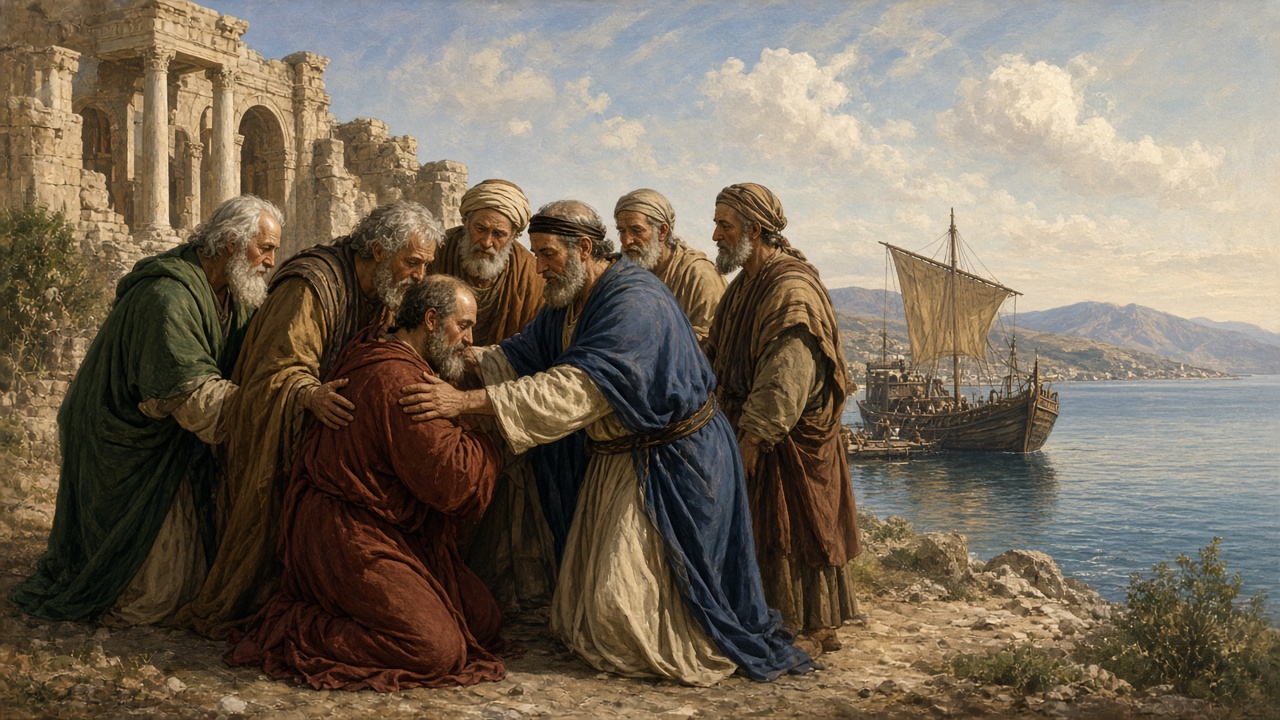
36When he had said these things, he knelt down with them all and prayed. 37They all began to weep loudly, and hugged Paul and kissed him, 38especially saddened by what he had said, that they were not going to see him again. Then they accompanied him to the ship.
¿Sabías que…?
Despedida camino a Jerusalén
- Al salir de Troas, Pablo envió a sus compañeros por delante en el barco y caminó hasta Assos por el camino romano. Assos era un puerto de la Asia proconsular, en Misia, en la costa norte del golfo de Adramitio; el trayecto a pie era de unas 20 millas, el de mar de unas 30, y la isla de Lesbos quedaba a unas 7 millas de la costa.Fuentes: el propio texto bíblico · Assos
- Pablo pasó de largo frente a Éfeso para no demorarse en la provincia de Asia —la provincia romana del oeste de Asia Menor, cuya capital era Éfeso—, porque esperaba, si era posible, llegar a Jerusalén para el día de Pentecostés. Se detuvo en Mileto, un puerto y la antigua capital de Jonia, a unas 36 millas al sur de Éfeso, y mandó llamar a los ancianos de la iglesia de Éfeso.Fuentes: el propio texto bíblico · Asia · Miletus
- Siete hombres viajaban con él: Sópater de Berea, Aristarco y Segundo de Tesalónica, Gayo de Derbe, Timoteo, y Tíquico y Trófimo de Asia. Aristarco, de Tesalónica, más tarde compartió el encarcelamiento de Pablo en Roma, y Trófimo, efesio, lo acompañó en esta parte del viaje y estuvo con él en Jerusalén.Fuentes: el propio texto bíblico · Aristarchus · Trophimus
Notas escritas con ayuda de IA a partir de fuentes abiertas (Theographic Bible Metadata, CC BY-SA 4.0; Easton’s Bible Dictionary, dominio público) y revisadas antes de publicarse.
Lugares de este capítulo
- Macedonia · 41.600, 22.540 · versículos 1, 3, 6
- Greece · 37.972, 23.727 · versículo 2
- Syria · Hoy: Syria 2 · 33.511, 36.306 · versículo 3
- Asia · 38.400, 28.300 · versículos 4, 16, 18
- Berea · Hoy: Veria · 40.518, 22.200 · versículo 4
- Thessalonica · Hoy: Thessaloniki · 40.638, 22.946 · versículo 4
- Troas · Hoy: Alexandria Troas · 39.752, 26.159 · versículos 5, 6
- Philippi · 41.012, 24.285 · versículo 6
- Assos · 39.491, 26.337 · versículos 13, 14
- Mitylene · Hoy: ancient theater at Mitylene · 39.110, 26.547 · versículo 14
- Chios · 38.373, 26.137 · versículo 15
- Miletus · 37.531, 27.276 · versículos 15, 17
- Samos · 37.750, 26.833 · versículo 15
- Trogyllium · Hoy: Cape Mycale · 37.659, 27.003 · versículo 15
- Ephesus · 37.939, 27.341 · versículos 16, 17
- Jerusalem · 31.777, 35.234 · versículos 16, 22
Solo aparecen lugares identificados con alta confianza (90 % o más según las fuentes académicas reunidas por OpenBible). Mapa de la época: DARE (Digital Atlas of the Roman Empire), CC BY 4.0; mapa actual: © colaboradores de OpenStreetMap; lugares: OpenBible.info (CC BY 4.0).
Créditos y licencia de esta traducción
NET Bible
NET Bible®, New English Translation (NET)
copyright © 1996-2016 Biblical Studies Press, L. L. C.
Please see https://netbible.com/copyright/ for full NET Bible copyright and permissions information. You can also read the NET Bible at http://NETBible.org .
Language: English
Dialect (if applicable): American
Language in English: English
Translation by:
Please see https://netbible.com/copyright/ for full NET Bible copyright and permissions information. You can also read the NET Bible at http://NETBible.org .
The NET Bible (New English Translation) is a completely new translation of the Bible with 58,506 translators’ notes ! It was completed by more than 25 scholars – experts in the original biblical languages – who worked directly from the best currently available Hebrew, Aramaic, and Greek texts. Turn the pages and see the breadth of the translators’ notes, documenting their decisions and choices as they worked.
The translators’ notes make the original languages far more accessible, allowing you to look over the translator’s shoulder at the very process of translation. This level of documentation is a first for a Bible translation, making transparent the textual basis and the rationale for key renderings (including major interpretive options and alternative translations).
This unparalleled level of detail helps connect people to the Bible in the original languages in a way never before possible without years of study of Hebrew, Aramaic, and Greek. It unlocks the riches of the Bible’s truth from entirely new perspectives.
A donation is appreciated. Donate at Bible.org/donations_form so we can continue to provide our material for free for our 16,000+ articles on Bible.org and our world class Bible Study tool at lumina.bible.org .
2026-10-02
Fuente: http://ebible.org/engnet/ · eBible.org