1 Reyes 22
NET Bible · Toca un versículo para ver sus referencias cruzadas.
1There was no war between Syria and Israel for three years. 2In the third year King Jehoshaphat of Judah came down to visit the king of Israel. 3The king of Israel said to his servants, “Surely you recognize that Ramoth Gilead belongs to us, though we are hesitant to reclaim it from the king of Syria.” 4Then he said to Jehoshaphat, “Will you go with me to attack Ramoth Gilead?” Jehoshaphat replied to the king of Israel, “I will support you; my army and horses are at your disposal.” 5Then Jehoshaphat added, “First seek an oracle from the Lord.” 6So the king of Israel assembled about four hundred prophets and asked them, “Should I attack Ramoth Gilead or not?” They said, “Attack! The sovereign one will hand it over to the king.” 7But Jehoshaphat asked, “Is there not a prophet of the Lord still here, that we may ask him?” 8The king of Israel answered Jehoshaphat, “There is still one man through whom we can seek the Lord’s will. But I despise him because he does not prophesy prosperity for me, but disaster. His name is Micaiah son of Imlah. Jehoshaphat said, “The king should not say such things.” 9The king of Israel summoned an official and said, “Quickly bring Micaiah son of Imlah.”
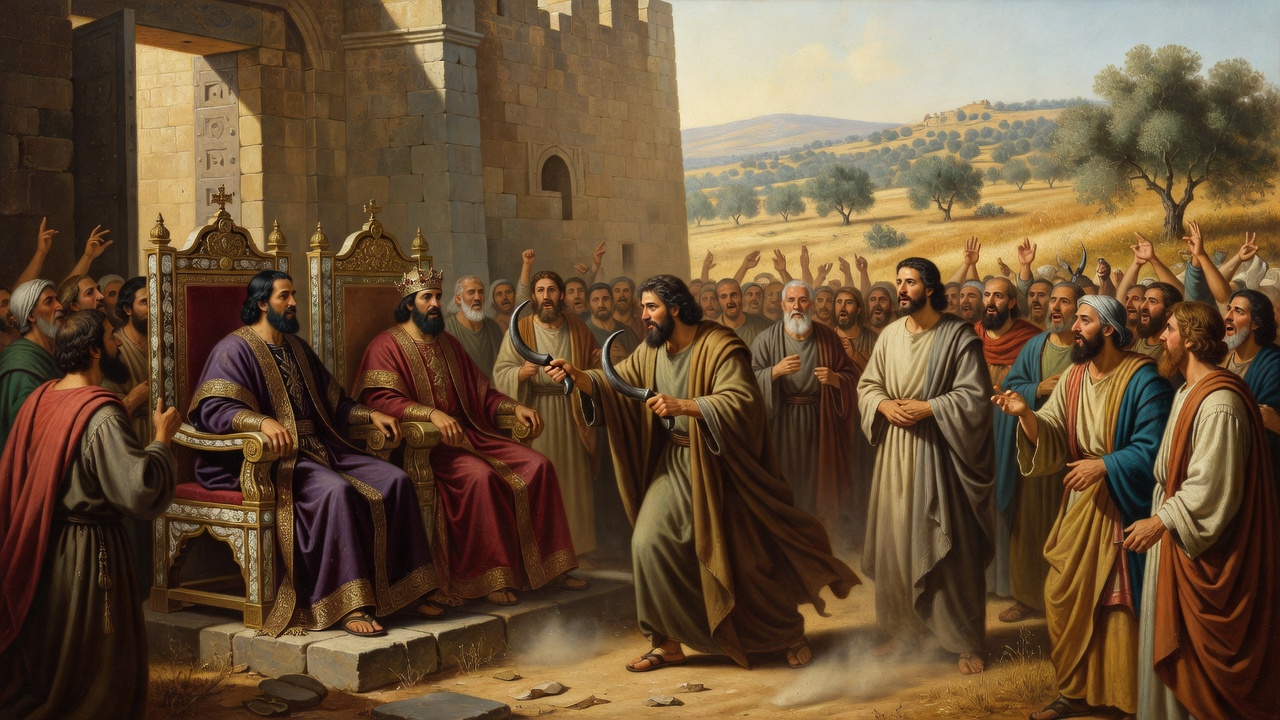
10Now the king of Israel and King Jehoshaphat of Judah were sitting on their respective thrones, dressed in their robes, at the threshing floor at the entrance of the gate of Samaria. All the prophets were prophesying before them. 11Zedekiah son of Kenaanah made iron horns and said, “This is what the Lord says, ‘With these you will gore Syria until they are destroyed.’” 12All the prophets were prophesying the same, saying, “Attack Ramoth Gilead! You will succeed; the Lord will hand it over to the king.” 13Now the messenger who went to summon Micaiah said to him, “Look, the prophets are in complete agreement that the king will succeed. Your words must agree with theirs; you must predict success.” 14But Micaiah said, “As certainly as the Lord lives, I will say what the Lord tells me to say.”
15When he came before the king, the king asked him, “Micaiah, should we attack Ramoth Gilead or not?” He answered him, “Attack! You will succeed; the Lord will hand it over to the king.” 16The king said to him, “How many times must I make you solemnly promise in the name of the Lord to tell me only the truth?” 17Micaiah said, “I saw all Israel scattered on the mountains like sheep that have no shepherd. Then the Lord said, ‘They have no master. They should go home in peace.’” 18The king of Israel said to Jehoshaphat, “Didn’t I tell you he does not prophesy prosperity for me, but disaster?” 19Micaiah said, “That being the case, hear the word of the Lord. I saw the Lord sitting on his throne, with all the heavenly assembly standing on his right and on his left. 20The Lord said, ‘Who will deceive Ahab, so he will attack Ramoth Gilead and die there?’ One said this and another that. 21Then a spirit stepped forward and stood before the Lord. He said, ‘I will deceive him.’ The Lord asked him, ‘How?’ 22He replied, ‘I will go out and be a lying spirit in the mouths of all his prophets.’ The Lord said, ‘Deceive and overpower him. Go out and do as you have proposed.’ 23So now, look, the Lord has placed a lying spirit in the mouths of all these prophets of yours; but the Lord has decreed disaster for you.” 24Zedekiah son of Kenaanah approached, hit Micaiah on the jaw, and said, “Which way did the Lord’s spirit go when he went from me to speak to you?” 25Micaiah replied, “Look, you will see in the day when you go into an inner room to hide.” 26Then the king of Israel said, “Take Micaiah and return him to Amon the city official and Joash the king’s son. 27Say, ‘This is what the king says, “Put this man in prison. Give him only a little bread and water until I safely return.”’” 28Micaiah said, “If you really do safely return, then the Lord has not spoken through me.” Then he added, “Take note, all you people.”
29The king of Israel and King Jehoshaphat of Judah attacked Ramoth Gilead. 30The king of Israel said to Jehoshaphat, “I will disguise myself and then enter into the battle; but you wear your royal robes.” So the king of Israel disguised himself and then entered into the battle. 31Now the king of Syria had ordered his thirty-two chariot commanders, “Do not fight common soldiers or high-ranking officers; fight only the king of Israel.” 32When the chariot commanders saw Jehoshaphat, they said, “He must be the king of Israel.” So they turned and attacked him, but Jehoshaphat cried out. 33When the chariot commanders realized he was not the king of Israel, they turned away from him. 34Now an archer shot an arrow at random, and it struck the king of Israel between the plates of his armor. The king ordered his charioteer, “Turn around and take me from the battle line, because I’m wounded.” 35While the battle raged throughout the day, the king stood propped up in his chariot opposite the Syrians. He died in the evening; the blood from the wound ran down into the bottom of the chariot. 36As the sun was setting, a cry went through the camp, “Each one should return to his city and to his homeland.” 37So the king died and was taken to Samaria, where they buried him. 38They washed off the chariot at the pool of Samaria (this was where the prostitutes bathed); dogs licked his blood, just as the Lord had said would happen.
39The rest of the events of Ahab’s reign, including a record of his accomplishments and how he built a luxurious palace and various cities, are recorded in the scroll called the Annals of the Kings of Israel. 40Ahab passed away. His son Ahaziah replaced him as king.
Jehoshaphat’s Reign over Judah
41In the fourth year of King Ahab’s reign over Israel, Asa’s son Jehoshaphat became king over Judah. 42Jehoshaphat was thirty-five years old when he became king and he reigned for twenty-five years in Jerusalem. His mother was Azubah, the daughter of Shilhi. 43He followed in his father Asa’s footsteps and was careful to do what the Lord approved. However, the high places were not eliminated; the people continued to offer sacrifices and burn incense on the high places. 44Jehoshaphat was also at peace with the king of Israel.
45The rest of the events of Jehoshaphat’s reign, including his successes and military exploits, are recorded in the scroll called the Annals of the Kings of Judah. 46He removed from the land any male cultic prostitutes who had managed to survive the reign of his father Asa. 47There was no king in Edom at this time; a governor ruled. 48Jehoshaphat built a fleet of large merchant ships to travel to Ophir for gold, but they never made the voyage because they were shipwrecked in Ezion Geber. 49Then Ahaziah son of Ahab said to Jehoshaphat, “Let my sailors join yours in the fleet,” but Jehoshaphat refused.
50Jehoshaphat passed away and was buried with his ancestors in the city of his ancestor David. His son Jehoram replaced him as king.
Ahaziah’s Reign over Israel
51In the seventeenth year of King Jehoshaphat’s reign over Judah, Ahab’s son Ahaziah became king over Israel in Samaria. He ruled for two years over Israel. 52He did evil in the sight of the Lord and followed in the footsteps of his father and mother; like Jeroboam son of Nebat, he encouraged Israel to sin. 53He worshiped and bowed down to Baal, angering the Lord God of Israel just as his father had done.
¿Sabías que…?
Profecía y la Batalla en Ramot de Galaad
- Cuando el rey Acab reunió a unos cuatrocientos profetas que predijeron unánimemente la victoria en Ramot de Galaad, el rey Josafat pidió consultar a otro profeta del SEÑOR. Micaías, hijo de Imla, fue traído de la prisión y reveló una visión celestial que explicaba cómo un espíritu de mentira había llenado la boca de los profetas de Acab.Fuentes: Micaiah · el propio texto bíblico
- Ramot de Galaad era una ciudad de refugio al este del Jordán que Acab intentó recuperar del rey de Aram. Aunque Acab entró en la batalla disfrazado de soldado común para protegerse, fue herido de muerte cuando un arquero enemigo disparó una flecha al azar entre las junturas de su armadura.Fuentes: Ramoth-gilead · Ahab · el propio texto bíblico
- La alianza de Josafat con Acab marcó un cambio importante que involucró a Judá en los conflictos militares del reino del norte. Más adelante en su reinado, Josafat construyó una flota de barcos mercantes en Ezión-guéber para buscar oro, pero las naves naufragaron antes de zarpar, y él rechazó una expedición marítima conjunta propuesta por Ocozías, hijo de Acab.Fuentes: Jehoshaphat · Ahaziah · el propio texto bíblico
Notas escritas con ayuda de IA a partir de fuentes abiertas (Theographic Bible Metadata, CC BY-SA 4.0; Easton’s Bible Dictionary, dominio público) y revisadas antes de publicarse.
Lugares de este capítulo
- Syria · Hoy: Aram · 33.511, 36.306 · versículos 1, 3, 11, 31, 35
- Samaria · 32.276, 35.195 · versículos 10, 37, 38, 51
- Jerusalem · 31.777, 35.234 · versículo 42
- Edom · 30.746, 35.604 · versículo 47
- City of David · 31.774, 35.236 · versículo 50
Solo aparecen lugares identificados con alta confianza (90 % o más según las fuentes académicas reunidas por OpenBible). Mapa de la época: DARE (Digital Atlas of the Roman Empire), CC BY 4.0; mapa actual: © colaboradores de OpenStreetMap; lugares: OpenBible.info (CC BY 4.0).
Créditos y licencia de esta traducción
NET Bible
NET Bible®, New English Translation (NET)
copyright © 1996-2016 Biblical Studies Press, L. L. C.
Please see https://netbible.com/copyright/ for full NET Bible copyright and permissions information. You can also read the NET Bible at http://NETBible.org .
Language: English
Dialect (if applicable): American
Language in English: English
Translation by:
Please see https://netbible.com/copyright/ for full NET Bible copyright and permissions information. You can also read the NET Bible at http://NETBible.org .
The NET Bible (New English Translation) is a completely new translation of the Bible with 58,506 translators’ notes ! It was completed by more than 25 scholars – experts in the original biblical languages – who worked directly from the best currently available Hebrew, Aramaic, and Greek texts. Turn the pages and see the breadth of the translators’ notes, documenting their decisions and choices as they worked.
The translators’ notes make the original languages far more accessible, allowing you to look over the translator’s shoulder at the very process of translation. This level of documentation is a first for a Bible translation, making transparent the textual basis and the rationale for key renderings (including major interpretive options and alternative translations).
This unparalleled level of detail helps connect people to the Bible in the original languages in a way never before possible without years of study of Hebrew, Aramaic, and Greek. It unlocks the riches of the Bible’s truth from entirely new perspectives.
A donation is appreciated. Donate at Bible.org/donations_form so we can continue to provide our material for free for our 16,000+ articles on Bible.org and our world class Bible Study tool at lumina.bible.org .
2026-10-02
Fuente: http://ebible.org/engnet/ · eBible.org