Salmos 74
Updated Brenton English Septuagint · Toca un versículo para ver sus referencias cruzadas.
Why Have You Rejected Us Forever?
1For the end, Destroy not, a Psalm of a Song for Asaph.
2We will give thanks to thee, O God,
We will give thanks, and call upon thy name:
I will declare all thy wonderful works.
3When I shall take a set time, I will judge righteously.
4The earth is dissolved, and all that dwell in it:
I have strengthened its pillars. Pause.
5I said unto the transgressors, Do not transgress;
And to the sinners, Lift not up the horn.
6Lift not up your horn on high;
Speak not unrighteousness against God.
7For good comes neither from the east, nor from the west,
Nor from the desert mountains.
8For God is the judge;
He puts down one, and raises up another.
9For there is a cup in the hand of the Lord,
Full of unmingled wine;
And he has turned it from side to side,
But its dregs have not been wholly poured out;
All the sinners of the earth shall drink them.
10But I will exult forever:
I will sing praises to the God of Jacob.
11And I will break all the horns of sinners;
But the horns of the righteous one shall be exalted.
¿Sabías que…?
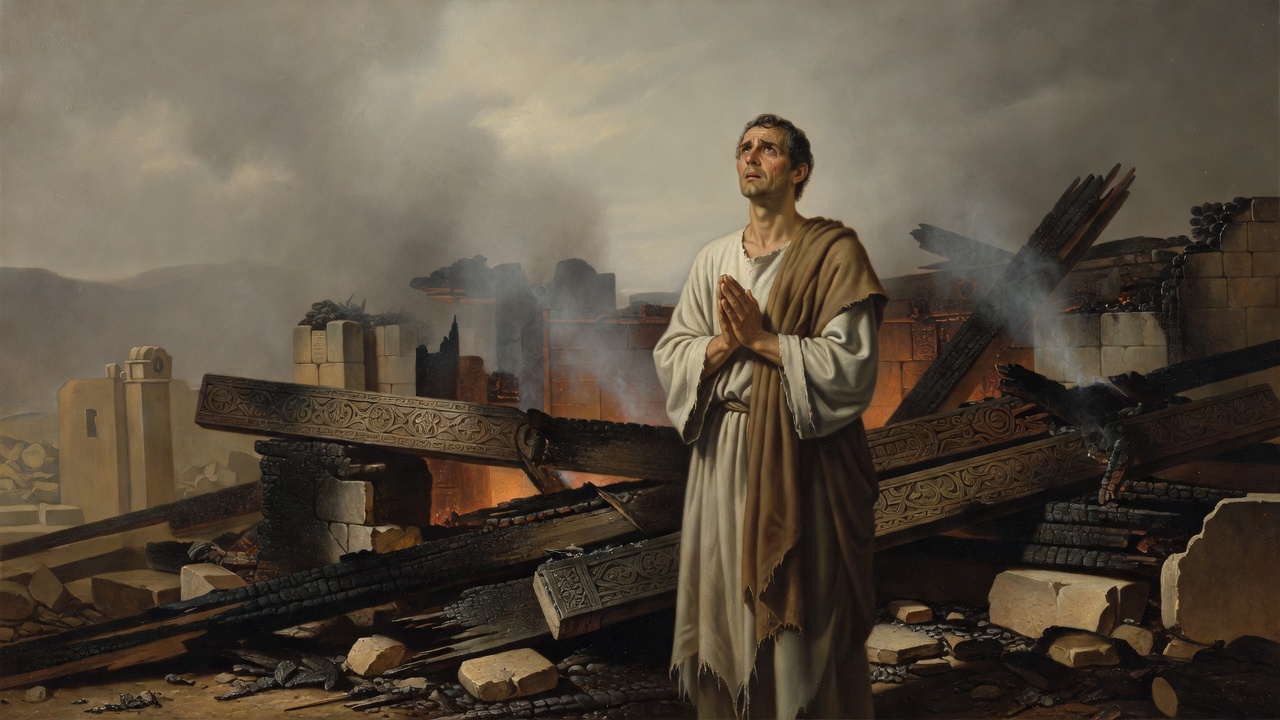
Lamento por el santuario destruido
- Los Salmos 73 al 83 se atribuyen a Asaf, un músico levita y director del coro de David. Puesto que el Salmo 74 lamenta el incendio y la destrucción total del santuario, muchos eruditos lo asocian con los posteriores "hijos de Asaf", un gremio de poetas y cantores que continuaron su tradición.Fuentes: Asaph (Levite) · el propio texto bíblico
- El salmo apela a Dios para que recuerde el monte Sion, una prominente colina de Jerusalén donde David estableció su ciudadela y donde se alzaba el santuario como morada del nombre divino.Fuentes: Mount Zion · el propio texto bíblico
- La destrucción del santuario se describe de manera gráfica con la metáfora de leñadores talando un bosque, con invasores destrozando las tallas de madera con hachas y picos antes de quemar por completo el lugar sagrado.Fuentes: el propio texto bíblico
Notas escritas con ayuda de IA a partir de fuentes abiertas (Theographic Bible Metadata, CC BY-SA 4.0; Easton’s Bible Dictionary, dominio público) y revisadas antes de publicarse.
Lugares de este capítulo
- Mount Zion · 31.772, 35.229 · versículo 2
Solo aparecen lugares identificados con alta confianza (90 % o más según las fuentes académicas reunidas por OpenBible). Mapa de la época: DARE (Digital Atlas of the Roman Empire), CC BY 4.0; mapa actual: © colaboradores de OpenStreetMap; lugares: OpenBible.info (CC BY 4.0).
Créditos y licencia de esta traducción
Updated Brenton English Septuagint
Spelling and formatting update of the Brenton English Septuagint with Apocrypha
Public Domain
Language: English
Dialect: Mixed
Translation by: Sir Lancelot C. L. Brenton
Contributor: Adam Boyd
Original work was by Sir Lancelot C. L. Brenton in 1851.
CC0 Public Domain dedication on language updates by Adam Boyd in 2020.
2026-02-18
Títulos de sección adaptados de la Berean Standard Bible (dominio público); no forman parte del texto bíblico de esta traducción.
Fuente: http://ebible.org/englxxup/ · eBible.org