Salmos 148
Updated Brenton English Septuagint · Toca un versículo para ver sus referencias cruzadas.
Praise the LORD from the Heavens
1Alleluia, a Psalm of Haggai and Zechariah.
Praise ye the Lord from the heavens:
Praise him in the highest.
2Praise ye him, all his angels:
Praise ye him, all his hosts.
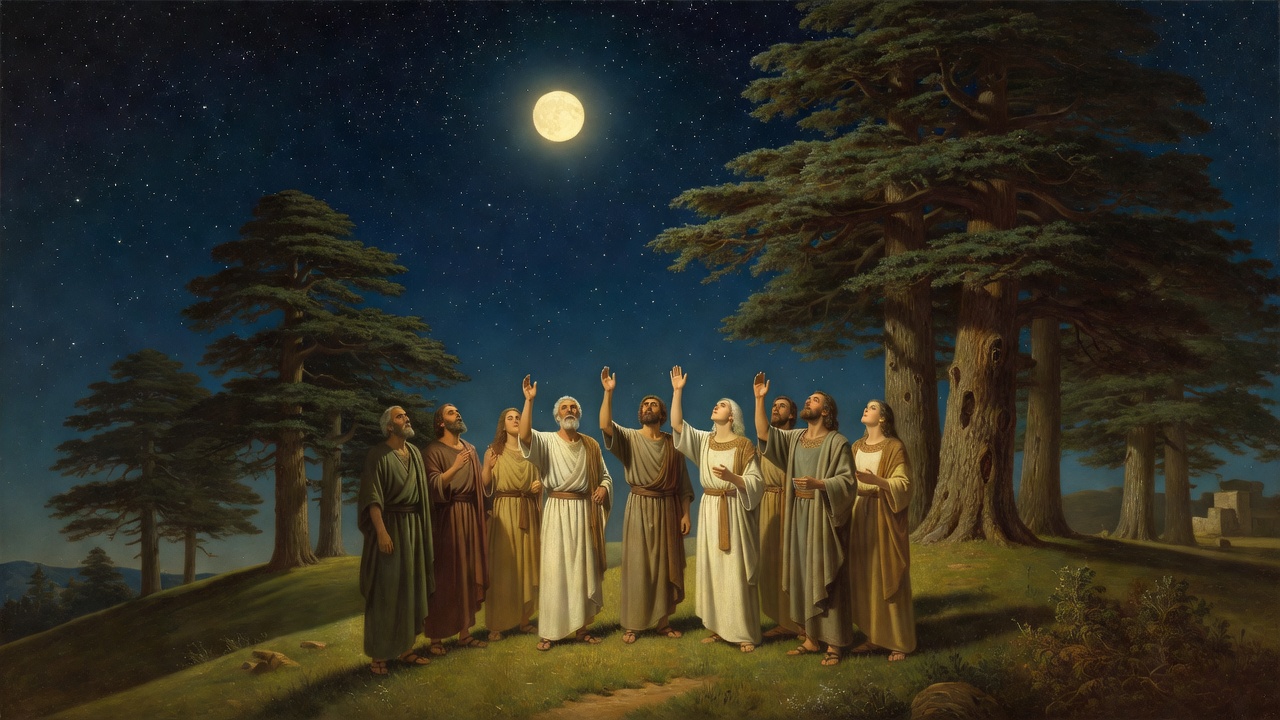
3Praise him, sun and moon:
Praise him, all ye stars and light.
4Praise him, ye heavens of heavens,
And the water that is above the heavens.
5Let them praise the name of the Lord:
For he spoke, and they were made;
He commanded, and they were created.
6He has established them forever, even forever and ever:
He has made an ordinance, and it shall not pass away.
7Praise the Lord from the earth,
Ye serpents, and all deeps.
8Fire, hail, snow, ice, stormy wind;
The things that perform his word.
9Mountains, and all hills;
Fruitful trees, and all cedars:
10Wild beasts, and all cattle;
Reptiles, and winged birds:
11Kings of the earth, and all peoples;
Princes, and all judges of the earth:
12Young men and virgins,
Old men with youths:
13Let them praise the name of the Lord:
For his name only is exalted;
His praise is above the earth and heaven,
14And he shall exalt the horn of his people,
There is a hymn for all his saints,
Even of the children of Israel, a people who draw near to him.
¿Sabías que…?
Alabanza universal del cielo y de la tierra
- El Salmo 148 está estructurado como un inventario cósmico integral que convoca a cada nivel de la creación a alabar a Dios. Comienza en las alturas celestiales con ángeles, huestes celestes, el sol, la luna, las estrellas y las aguas superiores, antes de descender a la tierra.Fuentes: el propio texto bíblico
- La sección terrenal abarca fenómenos meteorológicos, relieves, árboles, animales salvajes y domésticos, así como todos los sectores de la sociedad humana, desde reyes y gobernantes hasta jóvenes, doncellas y ancianos.Fuentes: el propio texto bíblico
- El himno concluye su amplio recorrido enfocándose en el pueblo del pacto, señalando que Dios ha levantado el poder de Sus fieles y describiendo a Israel como un pueblo cercano a Él.Fuentes: el propio texto bíblico · Jacob (Israel)
Notas escritas con ayuda de IA a partir de fuentes abiertas (Theographic Bible Metadata, CC BY-SA 4.0; Easton’s Bible Dictionary, dominio público) y revisadas antes de publicarse.
Créditos y licencia de esta traducción
Updated Brenton English Septuagint
Spelling and formatting update of the Brenton English Septuagint with Apocrypha
Public Domain
Language: English
Dialect: Mixed
Translation by: Sir Lancelot C. L. Brenton
Contributor: Adam Boyd
Original work was by Sir Lancelot C. L. Brenton in 1851.
CC0 Public Domain dedication on language updates by Adam Boyd in 2020.
2026-02-18
Títulos de sección adaptados de la Berean Standard Bible (dominio público); no forman parte del texto bíblico de esta traducción.
Fuente: http://ebible.org/englxxup/ · eBible.org