Jeremías 47
Updated Brenton English Septuagint · Toca un versículo para ver sus referencias cruzadas.
Judgment on the Philistines
1The word that came from the Lord to Jeremiah, after that Nebuzaradan the captain of the guard had let him go out of Ramah, when he had taken him in manacles in the midst of the captivity of Judah, even those who were carried to Babylon.
2And the chief captain of the guard took him, and said to him, The Lord thy God has pronounced all these evils upon this place: 3and the Lord has done it; because ye sinned against him, and hearkened not to his voice. 4Behold, I have loosed thee from the manacles that were upon thy hands. If it seem good to thee to go with me to Babylon, then will I set mine eyes upon thee. 5But if not, depart; return to Gedaliah the son of Ahikam, the son of Shaphan, whom the king of Babylon has appointed governor in the land of Judah, and dwell with him in the midst of the people in the land of Judah: to whatsoever places it seems good in thine eyes to go, do thou even go. And the captain of the guard made him presents, and let him go. 6And he came to Gedaliah to Mizpah, and dwelt in the midst of his people that was left in the land.
7And all the leaders of the host that was in the country, they and their men, heard that the king of Babylon had appointed Gedaliah governor in the land, and they committed to him the men and their wives, whom Nebuchadnezzar had not removed to Babylon. 8And there came to Gedaliah to Mizpah Ishmael the son of Nethaniah, and Johanan son of Kareah, and Seraiah the son of Tanhumeth, and the sons of Ephai the Netophathite, and Jezaniah son of the Maacathite, they and their men.
9And Gedaliah swore to them and to their men, saying, Be not afraid before the children of the Chaldeans: dwell in the land, and serve the king of Babylon, and it shall be better for you. 10And, behold, I dwell in your presence at Mizpah, to stand before the Chaldeans who shall come against you: and do ye gather grapes, and fruits, and oil, and put them into your vessels, and dwell in the cities which ye have obtained possession of.
11And all the Jews that were in Moab, and among the children of Ammon, and those that were in Edom, and those that were in all the rest of the country, heard that the king of Babylon had granted a remnant to Judah, and that he had appointed over them Gedaliah the son of Ahikam. 12And they came to Gedaliah into the land of Judah, to Mizpah, and gathered grapes, and very much summer fruit, and oil.
13And Johanan the son of Kareah, and all the leaders of the host, who were in the fields, came to Gedaliah to Mizpah, 14and said to him, Dost thou indeed know that King Baalis son of Ammon has sent Ishmael to thee to slay thee? But Gedaliah believed them not. 15And Johanan said to Gedaliah secretly in Mizpah, I will go now and smite Ishmael, and let no man know it; lest he slay thee, and all the Jews that are gathered to thee be dispersed, and the remnant of Judah perish. 16But Gedaliah said to Johanan, Do not the thing, for thou speakest lies concerning Ishmael.
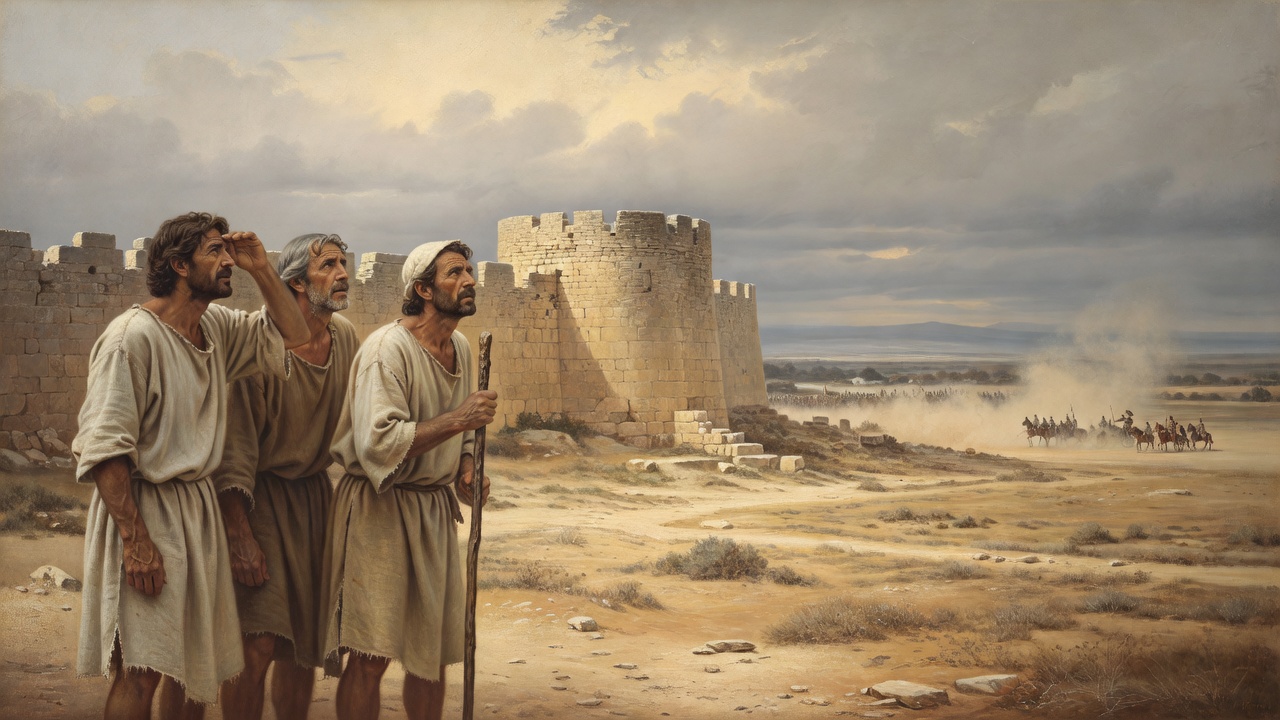
¿Sabías que…?
Juicio sobre los Filisteos
- Jeremías se refiere a los filisteos como el remanente de las costas de Caftor. Las tradiciones bíblicas identifican a Caftor como la tierra de origen de los filisteos, un lugar que muchos eruditos asocian con Creta o con zonas de la costa del Mediterráneo oriental.Fuentes: el propio texto bíblico · Caphtor
- El capítulo dirige sus advertencias contra Gaza y Ascalón, dos de las cinco ciudades filisteas destacadas a lo largo de la costa mediterránea. Ambas eran antiguos centros conocidos por su posición estratégica y rutas comerciales que conectaban Egipto con las regiones vecinas.Fuentes: el propio texto bíblico · Gaza · Ashkelon
- La profecía señala que la destrucción inminente cortaría a todos los aliados restantes de Tiro y Sidón. Estos dos importantes puertos fenicios al norte eran centros marítimos cruciales cuyos intereses estaban estrechamente ligados a la región costera.Fuentes: el propio texto bíblico · Tyre · Sidon
Notas escritas con ayuda de IA a partir de fuentes abiertas (Theographic Bible Metadata, CC BY-SA 4.0; Easton’s Bible Dictionary, dominio público) y revisadas antes de publicarse.
Lugares de este capítulo
- Gaza · Hoy: Tell Harube · 31.504, 34.464 · versículos 1, 5
- Sidon · Hoy: Sandikli archaeological site in Sidon · 33.561, 35.372 · versículo 4
- Tyre · 33.271, 35.196 · versículo 4
- Ashkelon · Hoy: Tel Ashkelon · 31.664, 34.546 · versículos 5, 7
- Great Sea · Hoy: Mediterranean Sea · 31.805, 34.170 · versículo 5
- Philistia · 31.664, 34.546 · versículo 5
Solo aparecen lugares identificados con alta confianza (90 % o más según las fuentes académicas reunidas por OpenBible). Mapa de la época: DARE (Digital Atlas of the Roman Empire), CC BY 4.0; mapa actual: © colaboradores de OpenStreetMap; lugares: OpenBible.info (CC BY 4.0).
Créditos y licencia de esta traducción
Updated Brenton English Septuagint
Spelling and formatting update of the Brenton English Septuagint with Apocrypha
Public Domain
Language: English
Dialect: Mixed
Translation by: Sir Lancelot C. L. Brenton
Contributor: Adam Boyd
Original work was by Sir Lancelot C. L. Brenton in 1851.
CC0 Public Domain dedication on language updates by Adam Boyd in 2020.
2026-02-18
Títulos de sección adaptados de la Berean Standard Bible (dominio público); no forman parte del texto bíblico de esta traducción.
Fuente: http://ebible.org/englxxup/ · eBible.org