Isaías 37
Updated Brenton English Septuagint · Toca un versículo para ver sus referencias cruzadas.
Isaiah’s Message of Deliverance
1And it came to pass, when King Hezekiah heard it, that he rent his clothes, and put on sackcloth, and went up to the house of the Lord.
2And he sent Eliakim the steward, and Shebna the scribe, and the elders of the priests clothed with sackcloth, to Isaiah the son of Amoz, the prophet. And they said to him, Thus says Hezekiah, 3Today is a day of affliction, and reproach, and rebuke, and anger: for the pangs are come upon the travailing woman, but she has not strength to bring forth. 4May the Lord thy God hear the words of Rabshakeh, which the king of the Assyrians has sent, to reproach the living God, even to reproach with the words which the Lord thy God has heard: therefore thou shalt pray to thy Lord for these that are left.
5So the servants of King Hezekiah came to Isaiah. 6And Isaiah said to them, Thus shall ye say to your master, Thus saith the Lord, Be not thou afraid at the words which thou hast heard, wherewith the ambassadors of the king of the Assyrians have reproached me. 7Behold, I will send a blast upon him, and he shall hear a report, and return to his own country, and he shall fall by the sword in his own land.
Sennacherib’s Blasphemous Letter
8So Rabshakeh returned, and found the king of the Assyrians besieging Libnah: for he had heard that he had departed from Lachish. 9And Tirhakah king of the Ethiopians went forth to attack him. And when he heard it, he turned aside, and sent messengers to Hezekiah, saying, 10Thus shall ye say to Hezekiah king of Judea, Let not thy God, in whom thou trustest, deceive thee, saying, Jerusalem shall not be delivered into the hand of the king of the Assyrians.
11Hast thou not heard what the kings of the Assyrians have done, how they have destroyed the whole earth? and shalt thou be delivered? 12Have the gods of the nations which my fathers destroyed delivered them, both Gozan, and Haran, and Rezeph, which are in the land of Theemath? 13Where are the kings of Hamath? and where is the king of Arpad? and where is the king of the city of Sepharvaim, and of Anagugana?
Hezekiah’s Prayer
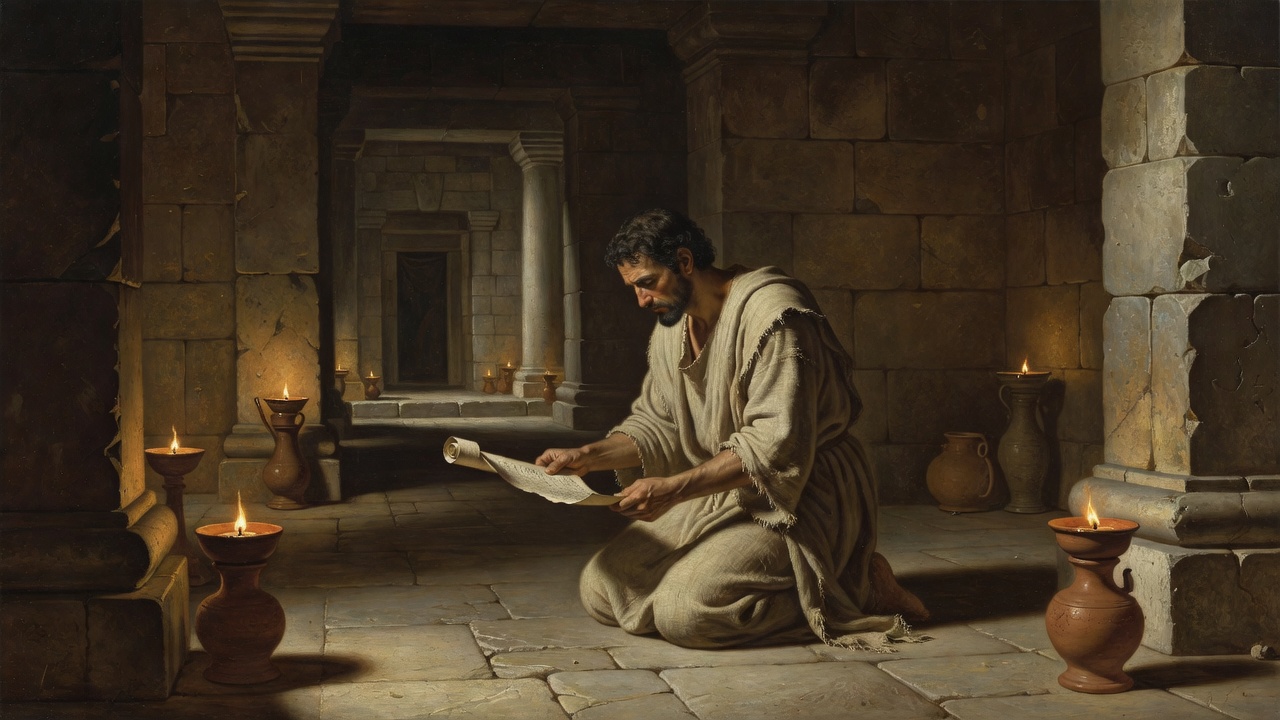
14And Hezekiah received the letter from the messengers, and read it, and went up to the house of the Lord, and opened it before the Lord. 15And Hezekiah prayed to the Lord, saying,
16O Lord of hosts, God of Israel, who sittest upon the cherubs, thou alone art the God of every kingdom of the world: thou hast made heaven and earth. 17Incline thine ear, O Lord, hearken, O Lord; open thine eyes, O Lord, look, O Lord: and behold the words of Sennacherib, which he has sent to reproach the living God. 18For of a truth, Lord, the kings of the Assyrians have laid waste the whole world, and the countries thereof, 19and have cast their idols into the fire: for they were no gods, but the work of men’s hands, wood and stone; and they have cast them away. 20But now, O Lord our God, deliver us from his hands, that every kingdom of the earth may know that thou art God alone.
Sennacherib’s Fall Prophesied
21And Isaiah the son of Amoz was sent to Hezekiah, and said to him, Thus saith the Lord, the God of Israel, I have heard thy prayer to me concerning Sennacherib king of the Assyrians. 22This is the word which God has spoken concerning him; The virgin daughter of Zion has despised thee, and mocked thee; the daughter of Jerusalem has shaken her head at thee. 23Whom hast thou reproached and provoked? and against whom hast thou lifted up thy voice? and hast thou not lifted up thine eyes on high against the Holy One of Israel? 24For thou hast reproached the Lord by messengers; for thou hast said, With the multitude of chariots have I ascended to the height of mountains, and to the sides of Lebanon; and I have cropped the height of his cedars and the beauty of his cypresses; and I entered into the height of the forest region: 25and I have made a bridge, and dried up the waters, and every pool of water.
26Hast thou not heard of these things which I did of old? I appointed them from ancient times; but now have I manifested my purpose of desolating nations in their strongholds, and them that dwell in strong cities. 27I weakened their hands, and they withered; and they became as dry grass on the housetops, and as grass. 28But now I know thy rest, and thy going out, and thy coming in. 29And thy wrath wherewith thou hast been enraged, and thy rancor has come up to me; therefore I will put a hook in thy nose, and a bit in thy lips, and will turn thee back by the way by which thou camest.
30And this shall be a sign to thee, Eat this year what thou hast sown; and the second year that which is left: and the third year sow, and reap, and plant vineyards, and eat the fruit of them. 31And they that are left in Judea shall take root downward, and bear fruit upward: 32for out of Jerusalem there shall be a remnant, and the saved ones out of Mount Zion: the zeal of the Lord of hosts shall perform this. 33Therefore thus saith the Lord concerning the king of the Assyrians, He shall not enter into this city, nor cast a weapon against it, nor bring a shield against it, nor make a rampart round it. 34But by the way by which he came, by it shall he return, and shall not enter into this city: thus saith the Lord. 35I will protect this city to save it for my own sake, and for my servant David’s sake.
Jerusalem Delivered from the Assyrians
36And the angel of the Lord went forth, and slew out of the camp of the Assyrians a hundred and eighty-five thousand: and they arose in the morning and found all these bodies dead. 37And Sennacherib king of the Assyrians turned and departed, and dwelt in Nineveh. 38And while he was worshiping Nisroch his country’s god in the house, Adrammelech and Sharezer his sons smote him with swords; and they escaped into Armenia: and Esarhaddon his son reigned in his stead.
¿Sabías que…?
La oración de Ezequías y la liberación de Jerusalén
- Cuando el rey Ezequías recibió la carta amenazante del rey asirio Senaquerib, subió al templo en Jerusalén y extendió el documento ante Dios en oración. En su plegaria señaló que los dioses de las naciones conquistadas habían caído por ser solo obras humanas de madera y piedra, a diferencia del Dios vivo.Fuentes: el propio texto bíblico · Hezekiah
- El relato menciona a Tirhaca, rey de Cus, quien marchó para combatir a Senaquerib. En aquel periodo, Cus y Egipto se encontraban unificados bajo gobernantes etíopes, lo que constituía una fuerza militar en el sur que se oponía a la expansión asiria.Fuentes: Tirhakah · Cush · el propio texto bíblico
- Tras el desastre que diezmó a su ejército frente a Jerusalén, Senaquerib se retiró a su capital en Nínive. Mientras adoraba en el templo de su dios Nisroc, sus propios hijos, Adramelec y Sarezer, lo asesinaron.Fuentes: el propio texto bíblico · Sennacherib · Adrammelech
Notas escritas con ayuda de IA a partir de fuentes abiertas (Theographic Bible Metadata, CC BY-SA 4.0; Easton’s Bible Dictionary, dominio público) y revisadas antes de publicarse.
Lugares de este capítulo
- Assyria · 36.359, 43.153 · versículos 4, 6, 8, 10, 11, 18, 21, 33, 37, 38
- Jerusalem · 31.777, 35.234 · versículos 8, 9, 10, 22, 32, 33
- Lachish · Hoy: Tell ed Duweir · 31.565, 34.849 · versículo 8
- Cush · Hoy: Cush 1 · 16.935, 33.751 · versículo 9
- Eden · Hoy: Beth-eden · 36.701, 38.087 · versículo 12
- Haran · Hoy: Harran · 36.864, 39.033 · versículo 12
- Hamath · Hoy: Hama · 35.136, 36.750 · versículo 13
- Zion · Hoy: Jerusalem · 31.777, 35.234 · versículo 22
- Lebanon · 33.540, 35.584 · versículo 24
- Mount Carmel · 32.672, 35.023 · versículo 24
- Egypt · 30.129, 31.308 · versículo 25
- Mount Zion · 31.772, 35.229 · versículo 32
- Nineveh · 36.359, 43.153 · versículo 37
- Ararat · Hoy: Urartu · 39.703, 44.300 · versículo 38
Solo aparecen lugares identificados con alta confianza (90 % o más según las fuentes académicas reunidas por OpenBible). Mapa de la época: DARE (Digital Atlas of the Roman Empire), CC BY 4.0; mapa actual: © colaboradores de OpenStreetMap; lugares: OpenBible.info (CC BY 4.0).
Créditos y licencia de esta traducción
Updated Brenton English Septuagint
Spelling and formatting update of the Brenton English Septuagint with Apocrypha
Public Domain
Language: English
Dialect: Mixed
Translation by: Sir Lancelot C. L. Brenton
Contributor: Adam Boyd
Original work was by Sir Lancelot C. L. Brenton in 1851.
CC0 Public Domain dedication on language updates by Adam Boyd in 2020.
2026-02-18
Títulos de sección adaptados de la Berean Standard Bible (dominio público); no forman parte del texto bíblico de esta traducción.
Fuente: http://ebible.org/englxxup/ · eBible.org