Isaías 15
Updated Brenton English Septuagint · Toca un versículo para ver sus referencias cruzadas.
The Burden against Moab
1The word against the land of Moab.
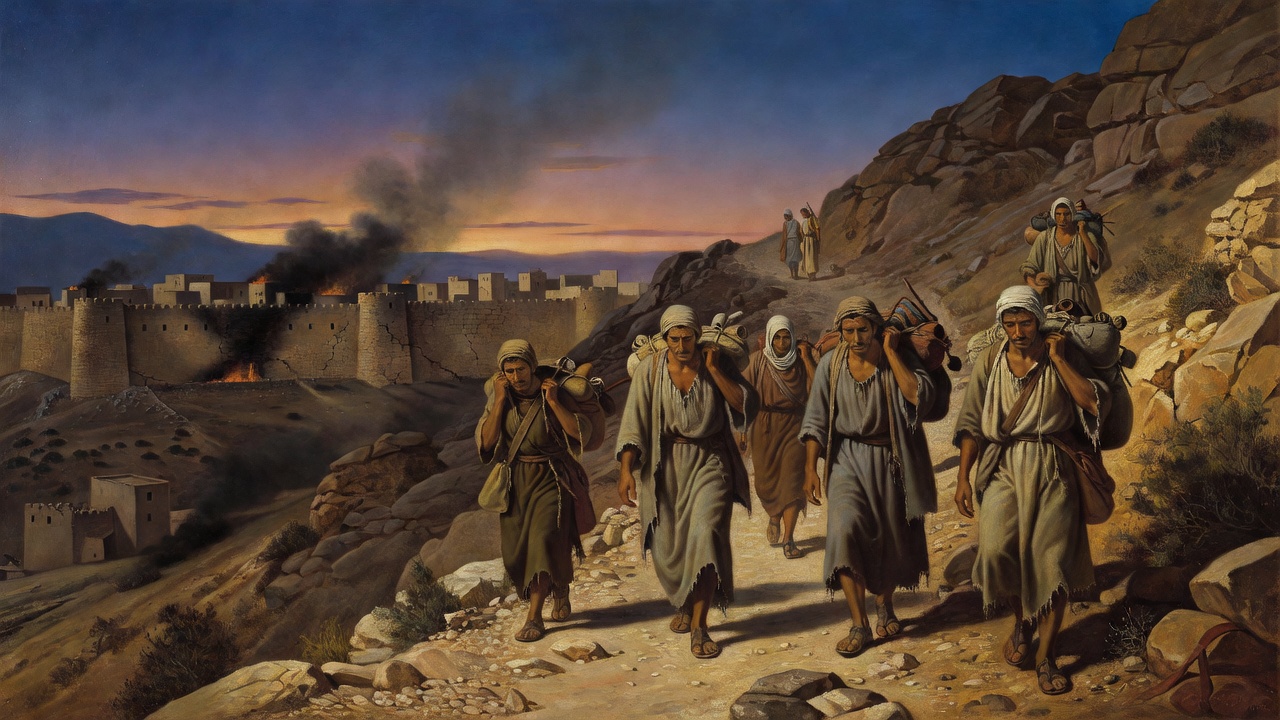
By night the land of Moab shall be destroyed; for by night the wall of the land of Moab shall be destroyed. 2Grieve for yourselves; for even Dibon, where your altar is, shall be destroyed: thither shall ye go up to weep, over Nebo of the land of Moab: howl ye: baldness shall be on every head, and all arms shall be wounded. 3Gird yourselves with sackcloth in her streets: and lament upon her roofs, and in her streets, and in her ways; howl all of you with weeping. 4For Heshbon and Elealeh have cried: their voice was heard to Jahaz: therefore the loins of the region of Moab cry aloud; her soul shall know. 5The heart of the region of Moab cries within her to Zoar; for it is as a heifer of three years old: and on the ascent of Eglath they shall go up to thee weeping by the way of Horonaim: she cries, Destruction, and trembling. 6The water of Nimrim shall be desolate, and the grass thereof shall fail: for there shall be no green grass. 7Shall Moab even thus be delivered? for I will bring the Arabians upon the valley, and they shall take it. 8For the cry has reached the border of the region of Moab, even of Eglaim; and her howling has gone as far as the well of Elim. 9And the water of Dimon shall be filled with blood: for I will bring Arabians upon Dimon, and I will take away the seed of Moab, and Ariel, and the remnant of Adama.
¿Sabías que…?
La Profecía sobre Moab
- Moab era una región ubicada al este del Mar Muerto y del río Jordán, que incluía antiguos asentamientos como Ar, Quir y Medeba. En este capítulo, el profeta lamenta la repentina destrucción nocturna y el llanto que recorre las ciudades y los lugares altos moabitas.Fuentes: Moab · Medeba · el propio texto bíblico
- El texto retrata rituales tradicionales de duelo practicados en la región en tiempos de calamidad. Ante la devastación, los habitantes de Moab se rapan la cabeza, se cortan la barba y se visten de cilicio mientras lloran en las plazas y sobre las azoteas.Fuentes: el propio texto bíblico
- La ciudad de Dibón, situada al norte del río Arnón y al este del Mar Muerto, también recibe el nombre de Dimón en Isaías 15:9. El oráculo ilustra la gravedad de la invasión al describir las aguas de Dimón llenas de sangre mientras los fugitivos huyen.Fuentes: Dibon · el propio texto bíblico
Notas escritas con ayuda de IA a partir de fuentes abiertas (Theographic Bible Metadata, CC BY-SA 4.0; Easton’s Bible Dictionary, dominio público) y revisadas antes de publicarse.
Lugares de este capítulo
- Moab · Hoy: Moab 1 · 31.181, 35.701 · versículos 1, 2, 4, 5, 8, 9
- Dibon · Hoy: Tall Dhiban · 31.502, 35.777 · versículo 2
- Medeba · Hoy: Madaba · 31.716, 35.795 · versículo 2
Solo aparecen lugares identificados con alta confianza (90 % o más según las fuentes académicas reunidas por OpenBible). Mapa de la época: DARE (Digital Atlas of the Roman Empire), CC BY 4.0; mapa actual: © colaboradores de OpenStreetMap; lugares: OpenBible.info (CC BY 4.0).
Créditos y licencia de esta traducción
Updated Brenton English Septuagint
Spelling and formatting update of the Brenton English Septuagint with Apocrypha
Public Domain
Language: English
Dialect: Mixed
Translation by: Sir Lancelot C. L. Brenton
Contributor: Adam Boyd
Original work was by Sir Lancelot C. L. Brenton in 1851.
CC0 Public Domain dedication on language updates by Adam Boyd in 2020.
2026-02-18
Títulos de sección adaptados de la Berean Standard Bible (dominio público); no forman parte del texto bíblico de esta traducción.
Fuente: http://ebible.org/englxxup/ · eBible.org