Génesis 8
Updated Brenton English Septuagint · Toca un versículo para ver sus referencias cruzadas.
The Ark Rests on Ararat
1And God remembered Noah, and all the wild beasts, and all the cattle, and all the birds, and all the reptiles that creep, as many as were with him in the ark, and God brought a wind upon the earth, and the water stayed. 2And the fountains of the deep were closed up, and the floodgates of heaven, and the rain from heaven was withheld. 3And the water subsided, and went off the earth, and after a hundred and fifty days the water was diminished, and the ark rested in the seventh month, on the twenty-seventh day of the month, on the mountains of Ararat. 4And the water continued to decrease until the tenth month. 5And in the tenth month, on the first day of the month, the heads of the mountains were seen.
Noah Sends a Raven and a Dove
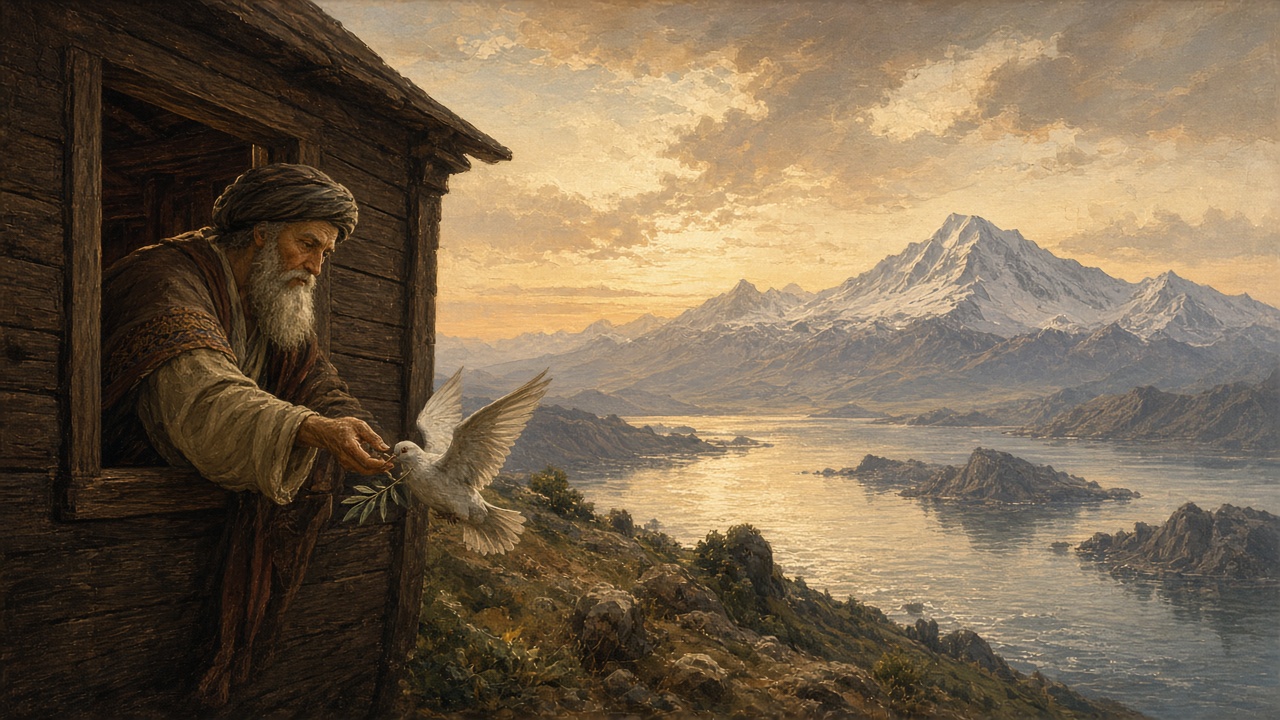
6And it came to pass after forty days Noah opened the window of the ark which he had made. 7And he sent forth a raven; and it went forth and returned not until the water was dried from off the earth. 8And he sent a dove after it to see if the water had ceased from off the earth. 9And the dove not having found rest for her feet, returned to him into the ark, because the water was on all the face of the earth, and he stretched out his hand and took her, and brought her to himself into the ark. 10And having waited yet seven other days, he again sent forth the dove from the ark. 11And the dove returned to him in the evening, and had a leaf of olive, a sprig in her mouth; and Noah knew that the water had ceased from off the earth. 12And having waited yet seven other days, he again sent forth the dove, and she did not return to him again anymore.
Exiting the Ark
13And it came to pass in the six hundred and first year of the life of Noah, in the first month, on the first day of the month, the water subsided from off the earth, and Noah opened the covering of the ark which he had made, and he saw that the water had subsided from the face of the earth. 14And in the second month the earth was dried, on the twenty-seventh day of the month.
15And the Lord God spoke to Noah, saying, 16Come out from the ark, thou and thy wife and thy sons, and thy sons’ wives with thee. 17And all the wild beasts as many as are with thee, and all flesh both of birds and beasts, and every reptile moving upon the earth, bring forth with thee: and increase ye and multiply upon the earth. 18And Noah came forth, and his wife and his sons, and his sons’ wives with him. 19And all the wild beasts and all the cattle and every bird, and every reptile creeping upon the earth after their kind, came forth out of the ark.
Noah Builds an Altar
20And Noah built an altar to the Lord, and took of all clean beasts, and of all clean birds, and offered a whole burnt offering upon the altar. 21And the Lord God smelled a smell of sweetness, and the Lord God having considered, said, I will not anymore curse the earth, because of the works of men, because the imagination of man is intently bent upon evil things from his youth, I will not therefore anymore smite all living flesh as I have done. 22All the days of the earth, seed and harvest, cold and heat, summer and spring, shall not cease by day or night.
¿Sabías que…?
Las aguas retroceden
- El arca se detuvo sobre los montes de Ararat, nombre que significa “tierra sagrada” o “tierra alta” y designa un país en cuyas montañas el arca reposó después del diluvio. El Easton's Bible Dictionary (1897) sugiere que esos montes eran, probablemente, la cordillera kurda del sur de Armenia, aunque el nombre también se aplica comúnmente a un pico alto y casi inaccesible que se alza desde la llanura del Araxes. En 2 Reyes 19:37 e Isaías 37:38, la Authorized Version traduce el nombre como “Armenia” y la Revised Version como “tierra de Ararat”, mientras que Jeremías 51:27 lo usa para la Armenia central o meridional.Fuentes: Ararat · el propio texto bíblico
- El nombre hebreo de Noé significa “descanso”, y en este capítulo la propia arca llega a reposar mientras bajan las aguas. Era hijo de Lamec y nieto de Matusalén, y padre de Sem, Cam y Jafet. El Easton's Bible Dictionary lo describe como el vínculo entre el mundo antiguo y el nuevo, y como un segundo gran progenitor de la familia humana.Fuentes: Noah · el propio texto bíblico
- Unas notas cronológicas sitúan el Gran Diluvio en 2347 a. C., con una duración de un año; el descenso de las aguas en 2346 a. C., a lo largo de 220 días; y la salida del arca en 2346 a. C., en un solo día. En el propio capítulo, las aguas ya han bajado después de 150 días y el arca reposa el día diecisiete del mes séptimo; el día primero del mes primero del año seiscientos uno de Noé las aguas se han secado, y para el día veintisiete del mes segundo la tierra está completamente seca.Fuentes: The Great Flood · The flood subsides · Leaving the Ark · el propio texto bíblico
Notas escritas con ayuda de IA a partir de fuentes abiertas (Theographic Bible Metadata, CC BY-SA 4.0; Easton’s Bible Dictionary, dominio público) y revisadas antes de publicarse.
Lugares de este capítulo
- Ararat · Hoy: Urartu · 39.703, 44.300 · versículo 4
Solo aparecen lugares identificados con alta confianza (90 % o más según las fuentes académicas reunidas por OpenBible). Mapa de la época: DARE (Digital Atlas of the Roman Empire), CC BY 4.0; mapa actual: © colaboradores de OpenStreetMap; lugares: OpenBible.info (CC BY 4.0).
Créditos y licencia de esta traducción
Updated Brenton English Septuagint
Spelling and formatting update of the Brenton English Septuagint with Apocrypha
Public Domain
Language: English
Dialect: Mixed
Translation by: Sir Lancelot C. L. Brenton
Contributor: Adam Boyd
Original work was by Sir Lancelot C. L. Brenton in 1851.
CC0 Public Domain dedication on language updates by Adam Boyd in 2020.
2026-02-18
Títulos de sección adaptados de la Berean Standard Bible (dominio público); no forman parte del texto bíblico de esta traducción.
Fuente: http://ebible.org/englxxup/ · eBible.org