Ezequiel 17
Updated Brenton English Septuagint · Toca un versículo para ver sus referencias cruzadas.
The Parable of Two Eagles and a Vine
1And the word of the Lord came to me, saying, 2Son of man, relate a tale, and speak a parable to the house of Israel: 3and thou shalt say, Thus saith the Lord;
A great eagle with large wings, spreading them out very far, with many claws, which has the design of entering into Lebanon—and he took the choice branches of the cedar: 4he cropped off the ends of the tender twigs, and brought them into the land of Canaan; he laid them up in a walled city. 5And he took of the seed of the land, and sowed it in a field planted by much water; he set it in a conspicuous place. 6And it sprang up, and became a weak and little vine, so that the branches thereof appeared upon it, and its roots were under it: and it became a vine, and put forth shoots, and sent forth its tendrils.
7And there was another great eagle, with great wings and many claws: and, behold, this vine bent itself round toward him, and her roots were turned toward him, and she sent forth her branches toward him, that he might water her together with the growth of her plantation. 8She thrives in a fair field by much water, to produce shoots and bear fruit, that she might become a great vine.
9Therefore say, Thus saith the Lord; Shall it prosper? shall not the roots of her tender stem and her fruit be blighted? yea, all her early shoots shall be dried up, and that not by a mighty arm, nor by many people, to tear her up from her roots. 10And, behold, it thrives: shall it prosper? shall it not wither as soon as the east wind touches it? it shall be withered together with the growth of its shoots.
The Parable Explained
11Moreover the word of the Lord came to me, saying, 12Son of man, say now to the provoking house, Know ye not what these things were? say to them, Whenever the king of Babylon shall come against Jerusalem, then he shall take her king and her princes, and shall take them home to Babylon. 13And he shall take of the seed royal, and shall make a covenant with him, and shall bind him with an oath: and he shall take the princes of the land: 14that it may become a weak kingdom, so as never to lift itself up, that he may keep his covenant, and establish it. 15And if he shall revolt from him, to send his messengers into Egypt, that they may give him horses and much people; shall he prosper? shall he that acts as an adversary be preserved? and shall he that transgresses the covenant be preserved?
16As I live, saith the Lord, verily in the same place where the king is that made him king, who dishonored my oath, and who broke my covenant, shall he die with him in the midst of Babylon. 17And Pharaoh shall make war upon him not with a large force or great multitude, in throwing up a mound, and in building of forts, to cut off souls. 18Whereas he has profaned the oath so as to break the covenant, when, behold, I engaged his hand, and he has done all these things to him, he shall not escape.
19Therefore say, Thus saith the Lord; As I live, surely mine oath which he has profaned, and my covenant which he has transgressed, I will even recompense it upon his head. 20And I will spread a net upon him, and he shall be caught in its snare. 21In every battle of his they shall fall by the sword, and I will scatter his remnant to every wind: and ye shall know that I the Lord have spoken it.
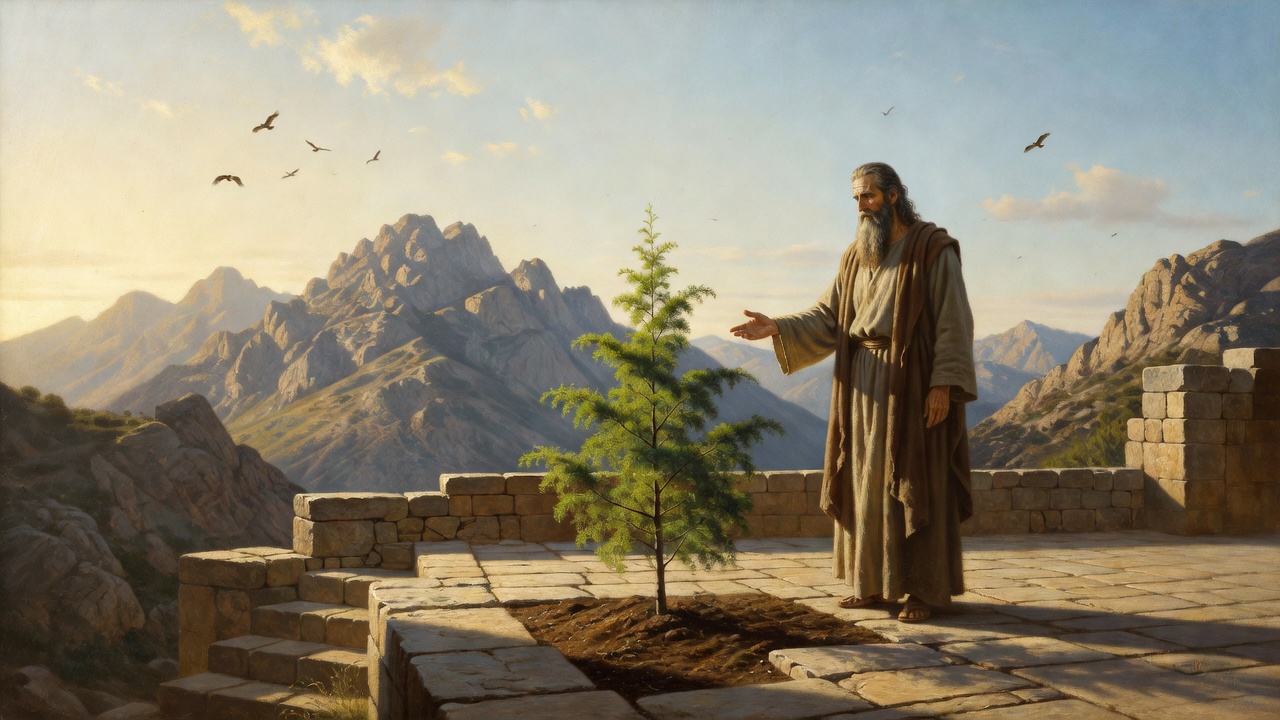
22For thus saith the Lord; I will even take of the choice branches of the cedar from the top thereof, I will crop off their hearts, and I will plant it on a high mountain: 23and I will hang it on a lofty mountain of Israel: yea, I will plant it, and it shall put forth shoots, and shall bear fruit, and it shall be a great cedar: and every bird shall rest beneath it, even every fowl shall rest under its shadow: its branches shall be restored. 24And all the trees of the field shall know that I am the Lord that bring low the high tree, and exalt the low tree, and wither the green tree, and cause the dry tree to flourish: I the Lord have spoken, and will do it.
¿Sabías que…?
La parábola de las águilas y el cedro
- Ezequiel presenta una alegoría política donde la primera gran águila representa al rey de Babilonia, quien deportó a la realeza de Jerusalén e impuso a un rey vasallo mediante un pacto solemne. La segunda águila representa a Egipto y a su faraón, a quienes el monarca de Judá recurrió en busca de caballería y tropas, quebrantando su lealtad jurada.Fuentes: el propio texto bíblico · Babylon · Egypt · Pharaoh
- En el mensaje profético, romper un juramento de vasallaje contraído ante Babilonia no se consideraba solo una rebelión diplomática, sino una traición espiritual contra Dios, quien reclamaba dicho juramento como su propio pacto.Fuentes: el propio texto bíblico
- El capítulo concluye revirtiendo las intrigas políticas humanas: Dios mismo promete tomar un retoño tierno de la copa del cedro y plantarlo en las cumbres montañosas de Israel, donde crecerá como un cedro majestuoso que brindará refugio a aves de toda clase.Fuentes: el propio texto bíblico
Notas escritas con ayuda de IA a partir de fuentes abiertas (Theographic Bible Metadata, CC BY-SA 4.0; Easton’s Bible Dictionary, dominio público) y revisadas antes de publicarse.
Lugares de este capítulo
- Lebanon · 33.540, 35.584 · versículo 3
- Canaan · 32.767, 35.333 · versículo 4
- Babylon · 32.543, 44.422 · versículos 12, 14, 15, 16, 17, 20
- Jerusalem · 31.777, 35.234 · versículos 12, 17
- Egypt · 30.129, 31.308 · versículo 15
Solo aparecen lugares identificados con alta confianza (90 % o más según las fuentes académicas reunidas por OpenBible). Mapa de la época: DARE (Digital Atlas of the Roman Empire), CC BY 4.0; mapa actual: © colaboradores de OpenStreetMap; lugares: OpenBible.info (CC BY 4.0).
Créditos y licencia de esta traducción
Updated Brenton English Septuagint
Spelling and formatting update of the Brenton English Septuagint with Apocrypha
Public Domain
Language: English
Dialect: Mixed
Translation by: Sir Lancelot C. L. Brenton
Contributor: Adam Boyd
Original work was by Sir Lancelot C. L. Brenton in 1851.
CC0 Public Domain dedication on language updates by Adam Boyd in 2020.
2026-02-18
Títulos de sección adaptados de la Berean Standard Bible (dominio público); no forman parte del texto bíblico de esta traducción.
Fuente: http://ebible.org/englxxup/ · eBible.org