Éxodo 24
Updated Brenton English Septuagint · Toca un versículo para ver sus referencias cruzadas.
The Covenant Sealed
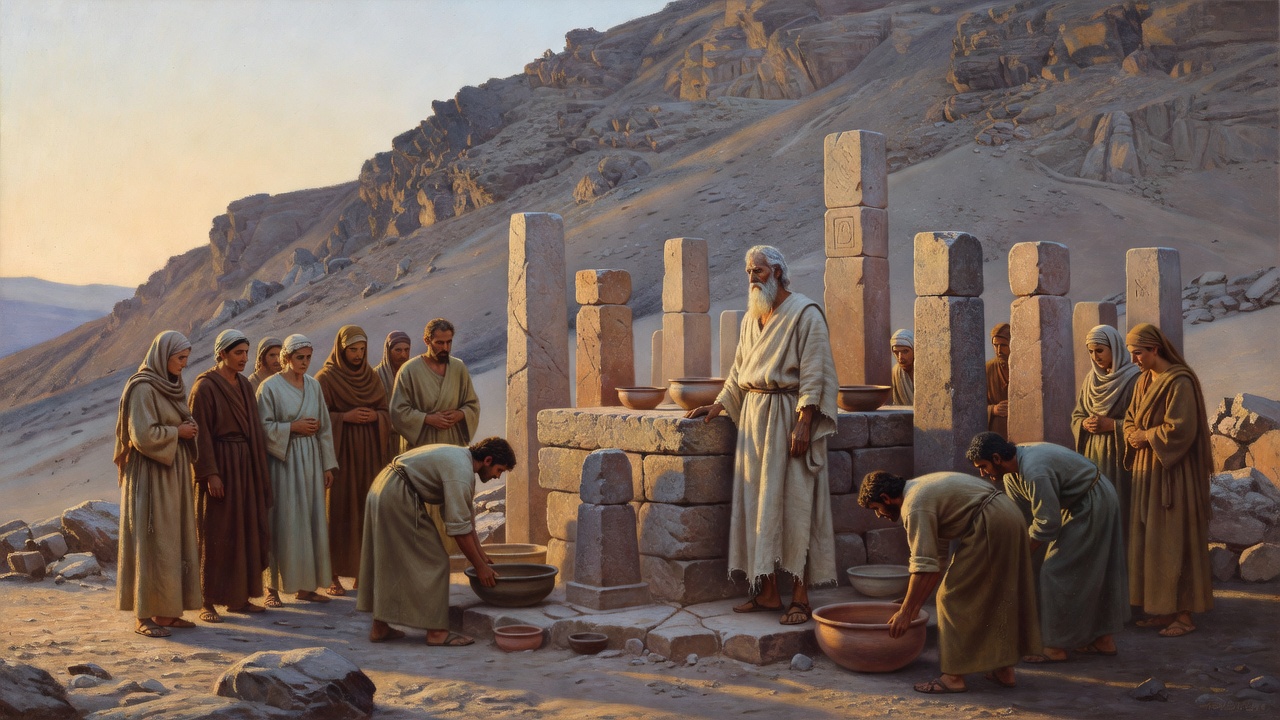
1And to Moses he said, Go up to the Lord, thou and Aaron and Nadab and Abihu, and seventy of the elders of Israel: and they shall worship the Lord from a distance. 2And Moses alone shall draw nigh to God; and they shall not draw nigh, and the people shall not come up with them. 3And Moses went in and related to the people all the words of God and the ordinances; and all the people answered with one voice, saying, All the words which the Lord has spoken, we will do and be obedient. 4And Moses wrote all the words of the Lord; and Moses rose up early in the morning, and built an altar under the mountain, and set up twelve stones for the twelve tribes of Israel. 5And he sent forth the young men of the children of Israel, and they offered whole burnt offerings, and they sacrificed young calves as a peace offering to God. 6And Moses took half the blood and poured it into bowls, and half the blood he poured out upon the altar. 7And he took the book of the covenant and read it in the ears of the people, and they said, All things whatsoever the Lord has spoken we will do and hearken therein. 8And Moses took the blood and sprinkled it upon the people, and said, Behold the blood of the covenant, which the Lord has made with you concerning all these words.
9And Moses went up, and Aaron, and Nadab and Abihu, and seventy of the elders of Israel. 10And they saw the place where the God of Israel stood; and under his feet was as it were a work of sapphire slabs, and as it were the appearance of the firmament of heaven in its purity. 11And of the chosen ones of Israel there was not even one missing, and they appeared in the place of God, and did eat and drink.
Moses on the Mountain
12And the Lord said to Moses, Come up to me into the mountain, and be there; and I will give thee the tables of stone, the law and the commandments, which I have written to give them laws. 13And Moses rose up and Joshua his attendant, and they went up into the mount of God. 14And to the elders they said, Rest there till we return to you; and behold, Aaron and Hur are with you: if any man have a cause to be tried, let them go to them. 15And Moses and Joshua went up to the mountain, and the cloud covered the mountain. 16And the glory of God came down upon the Mount Sinai, and the cloud covered it six days; and the Lord called Moses on the seventh day out of the midst of the cloud. 17And the appearance of the glory of the Lord was as burning fire on the top of the mountain, before the children of Israel. 18And Moses went into the midst of the cloud, and went up to the mountain, and was there in the mountain forty days and forty nights.
¿Sabías que…?
El pacto en el monte Sinaí
- El Diccionario Bíblico de Easton (1897) dice que el monte Sinaí, llamado también Horeb, era la región montañosa a la que los hebreos llegaron en el tercer mes después del Éxodo, donde permanecieron acampados cerca de un año. Señala que los últimos veintidós capítulos de Éxodo, todo Levítico y Números 1–11 recogen lo ocurrido durante esa estancia.Fuentes: Mount Sinai
- El SEÑOR dice a Moisés que suba con Aarón, Nadab y Abiú y setenta ancianos de Israel, pero solo Moisés debe acercarse; los demás adoran a distancia, y el pueblo no sube. Nadab era el hijo mayor de Aarón, y Abiú el segundo; el Diccionario Bíblico de Easton (1897) señala que los dos hermanos acompañaron a su padre y a los ancianos solo parte del camino montaña arriba.Fuentes: el propio texto bíblico · Aaron · Nadab · Abihu
- Moisés sube entonces más arriba con Josué, su ayudante, y deja a Aarón y a Hur con los ancianos, para que quien tuviera una disputa pudiera acudir a ellos. El Diccionario Bíblico de Easton (1897) llama a Josué siervo de Moisés, que lo acompañó parte del camino en el Sinaí, e identifica a Hur, esposo de Miriam, como el hombre asociado con Aarón al frente del pueblo mientras Moisés estaba ausente en el monte.Fuentes: el propio texto bíblico · Joshua · Hur
Notas escritas con ayuda de IA a partir de fuentes abiertas (Theographic Bible Metadata, CC BY-SA 4.0; Easton’s Bible Dictionary, dominio público) y revisadas antes de publicarse.
Créditos y licencia de esta traducción
Updated Brenton English Septuagint
Spelling and formatting update of the Brenton English Septuagint with Apocrypha
Public Domain
Language: English
Dialect: Mixed
Translation by: Sir Lancelot C. L. Brenton
Contributor: Adam Boyd
Original work was by Sir Lancelot C. L. Brenton in 1851.
CC0 Public Domain dedication on language updates by Adam Boyd in 2020.
2026-02-18
Títulos de sección adaptados de la Berean Standard Bible (dominio público); no forman parte del texto bíblico de esta traducción.
Fuente: http://ebible.org/englxxup/ · eBible.org