Deuteronomio 19
Updated Brenton English Septuagint · Toca un versículo para ver sus referencias cruzadas.
Cities of Refuge
1And when the Lord thy God shall have destroyed the nations, which God gives thee, even the land, and ye shall inherit them, and dwell in their cities, and in their houses, 2thou shalt separate for thyself three cities in the midst of thy land, which the Lord thy God gives thee. 3Take a survey of thy way, and thou shalt divide the coasts of thy land, which the Lord thy God apportions to thee, into three parts, and there shall be there a refuge for every manslayer.
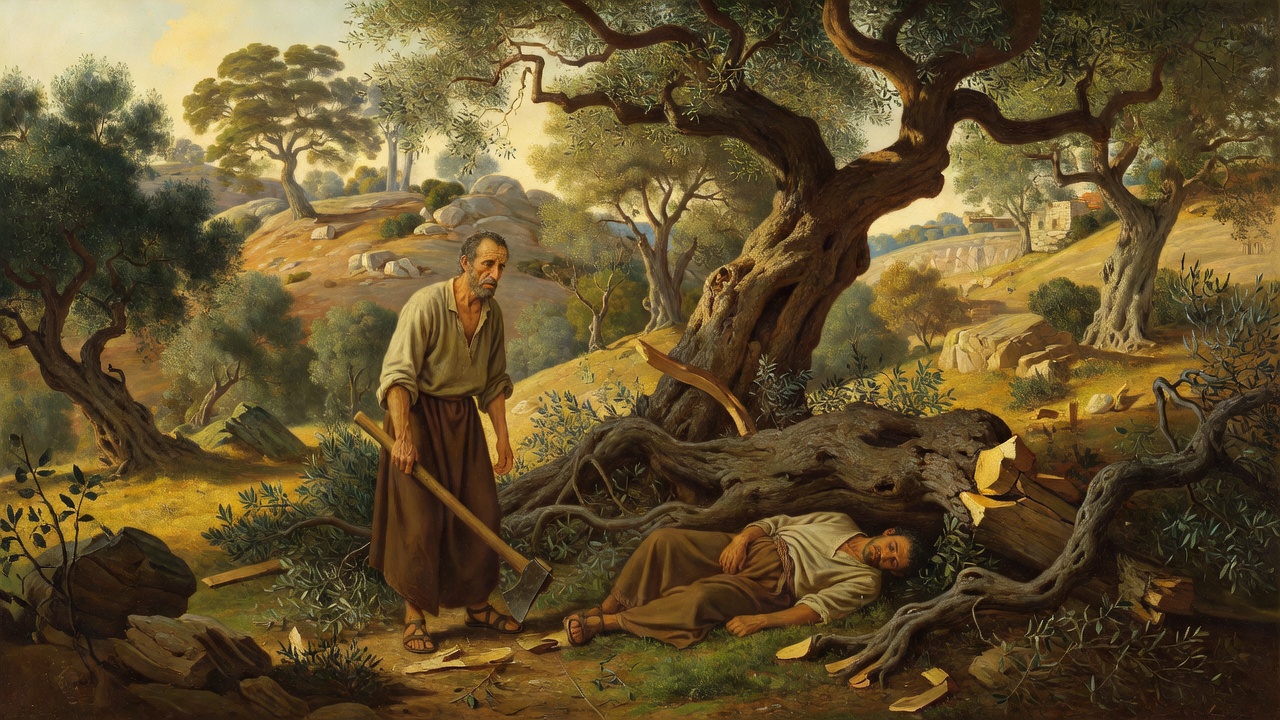
4And this shall be the ordinance of the manslayer, who shall flee thither, and shall live, whosoever shall have smitten his neighbor ignorantly, whereas he hated him not in times past. 5And whosoever shall enter with his neighbor into the thicket, to gather wood, if the hand of him that cuts wood with the axe should be violently shaken, and the axe head falling off from the handle should light on his neighbor, and he should die, he shall flee to one of these cities, and live. 6Lest the avenger of blood pursue after the slayer, because his heart is hot, and overtake him, if the way be too long, and slay him, though there is to this man no sentence of death, because he hated him not in time past. 7Therefore I charge thee, saying, Thou shalt separate for thyself three cities.
8And if the Lord shall enlarge thy borders, as he swore to thy fathers, and the Lord shall give to thee all the land which he said he would give to thy fathers; 9if thou shalt hearken to do all these commands, which I charge thee this day, to love the Lord thy God, to walk in all his ways continually; thou shalt add for thyself yet three cities to these three. 10So innocent blood shall not be spilt in the land, which the Lord thy God gives thee to inherit, and there shall not be in thee one guilty of blood.
11But if there should be in thee a man hating his neighbor, and he should lay wait for him, and rise up against him, and smite him, that he die, and he should flee to one of these cities, 12then shall the elders of his city send, and take him thence, and they shall deliver him into the hands of the avengers of blood, and he shall die. 13Thine eye shall not spare him; so shalt thou purge innocent blood from Israel, and it shall be well with thee.
14Thou shalt not move the landmarks of thy neighbor, which thy fathers set in the inheritance, in which thou hast obtained a share in the land, which the Lord thy God gives thee to inherit.
The Testimony of Two or Three Witnesses
15One witness shall not stand to testify against a man for any iniquity, or for any fault, or for any sin which he may commit; by the mouth of two witnesses, or by the mouth of three witnesses, shall every word be established. 16And if an unjust witness rise up against a man, alleging iniquity against him; 17then shall the two men between whom the controversy is, stand before the Lord, and before the priests, and before the judges, who may be in those days. 18And the judges shall make diligent inquiry, and, behold, if an unjust witness has borne unjust testimony; and has stood up against his brother; 19then shall ye do to him as he wickedly devised to do against his brother, and thou shalt remove the evil from yourselves. 20And the rest shall hear and fear, and do no more according to this evil thing in the midst of you. 21Thine eye shall not spare him: thou shalt exact life for life, eye for eye, tooth for tooth, hand for hand, foot for foot.
¿Sabías que…?
Ciudades de refugio, linderos y justicia imparcial
- La ley ordenaba a Israel apartar tres ciudades de refugio y construir caminos de acceso a través de tres regiones de la tierra. Estas ciudades permitían que alguien que matara a su prójimo por accidente, como cuando la hoja de un hacha se desprende del mango, huyera a salvo del vengador de la sangre.Fuentes: el propio texto bíblico
- Estaba estrictamente prohibido mover los linderos antiguos colocados por los antepasados. Estas marcas delimitaban las tierras heredadas por cada familia, y moverlas equivalía a apoderarse injustamente de la propiedad del prójimo.Fuentes: el propio texto bíblico
- Para evitar acusaciones falsas, un solo testigo no bastaba para condenar a nadie por un delito; se requería el testimonio de dos o tres testigos. Si los sacerdotes y jueces comprobaban que un testigo había mentido con malicia, se le imponía exactamente el mismo castigo que él pretendía para el acusado.Fuentes: el propio texto bíblico
Notas escritas con ayuda de IA a partir de fuentes abiertas (Theographic Bible Metadata, CC BY-SA 4.0; Easton’s Bible Dictionary, dominio público) y revisadas antes de publicarse.
Créditos y licencia de esta traducción
Updated Brenton English Septuagint
Spelling and formatting update of the Brenton English Septuagint with Apocrypha
Public Domain
Language: English
Dialect: Mixed
Translation by: Sir Lancelot C. L. Brenton
Contributor: Adam Boyd
Original work was by Sir Lancelot C. L. Brenton in 1851.
CC0 Public Domain dedication on language updates by Adam Boyd in 2020.
2026-02-18
Títulos de sección adaptados de la Berean Standard Bible (dominio público); no forman parte del texto bíblico de esta traducción.
Fuente: http://ebible.org/englxxup/ · eBible.org