Lucas 16
Literal Standard Version · Toca un versículo para ver sus referencias cruzadas.
The Parable of the Shrewd Manager
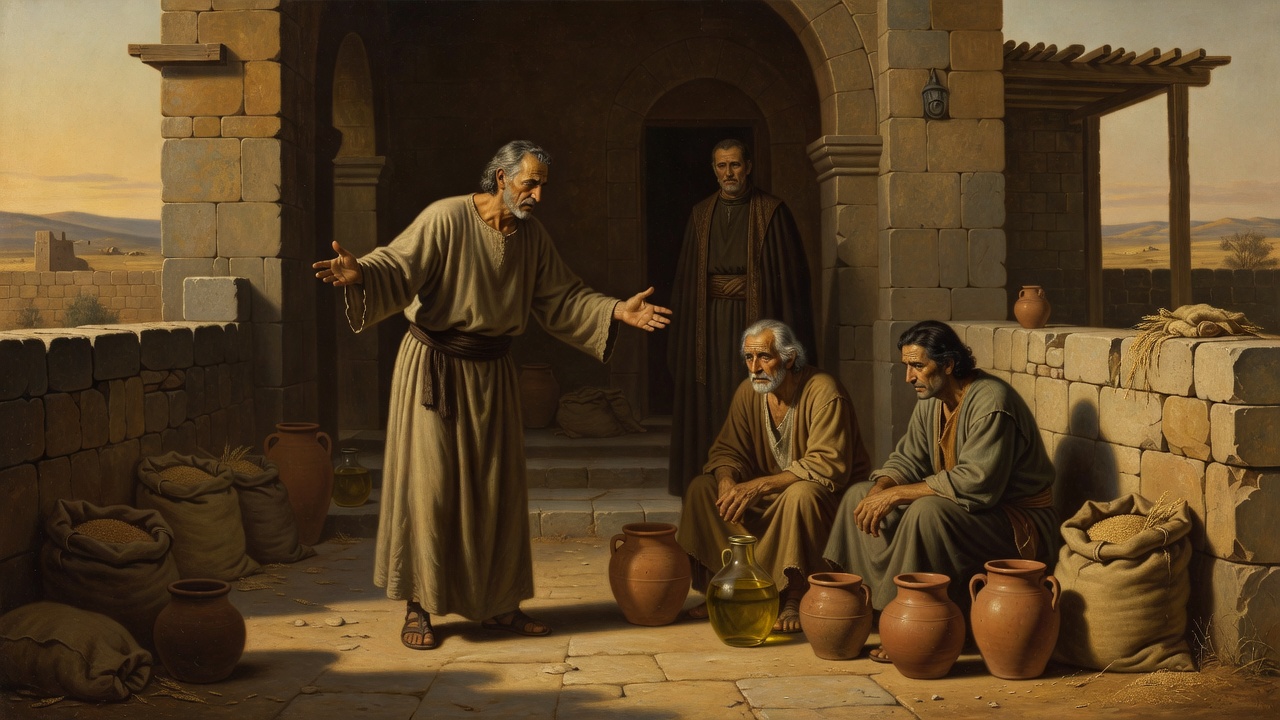
1And He also said to His disciples, “A certain man was rich, who had a steward, and he was accused to him as scattering his goods; 2and having called him, he said to him, What [is] this I hear about you? Render the account of your stewardship, for you may not be steward any longer. 3And the steward said in himself, What will I do, because my lord takes away the stewardship from me? I am not able to dig, I am ashamed to beg— 4I have known what I will do, that, when I may be removed from the stewardship, they may receive me to their houses. 5And having called near each one of his lord’s debtors, he said to the first, How much do you owe to my lord? 6And he said, One hundred baths of oil; and he said to him, Take your bill, and having sat down write fifty. 7Afterward to another he said, And you, how much do you owe? And he said, One hundred cors of wheat; and he says to him, Take your bill, and write eighty. 8And the lord commended the unrighteous steward that he did prudently, because the sons of this age are more prudent than the sons of the light in respect to their generation. 9And I say to you, make to yourselves friends out of the wealth of unrighteousness, that when you may fail, they may receive you into the continuous dwelling places. 10He who is faithful in the least, [is] also faithful in much; and he who in the least [is] unrighteous, is also unrighteous in much; 11if, then, in the unrighteous wealth you did not become faithful—who will entrust to you the true? 12And if in the other’s you did not become faithful—who will give to you your own? 13No servant is able to serve two lords, for either he will hate the one, and he will love the other; or one he will hold to, and of the other he will be heedless; you are not able to serve God and wealth.”
The Law and the Prophets
14And also the Pharisees, being lovers of money, were hearing all these things, and were deriding Him, 15and He said to them, “You are those declaring yourselves righteous before men, but God knows your hearts; because that which is high among men [is] abomination before God; 16the Law and the Prophets [are] until John; since then the good news of the Kingdom of God is proclaimed, and everyone presses into it; 17and it is easier for the heaven and the earth to pass away, than one tittle to fall of the Law. 18Everyone who is sending his wife away, and marrying another, commits adultery; and everyone who is marrying her sent away from a husband commits adultery.
The Rich Man and Lazarus
19And—a certain man was rich, and was clothed in purple and fine linen, making merry sumptuously every day, 20and there was a certain poor man, by name Lazarus, who was laid at his porch, full of sores, 21and desiring to be filled from the crumbs that are falling from the table of the rich man; indeed, also the dogs, coming, were licking his sores. 22And it came to pass, that the poor man died, and that he was carried away by the messengers into the bosom of Abraham—and the rich man also died, and was buried; 23and having lifted up his eyes in Hades, being in torments, he sees Abraham far off, and Lazarus in his bosom, 24and having cried, he said, Father Abraham, deal kindly with me, and send Lazarus, that he may dip the tip of his finger in water, and may cool my tongue, because I am distressed in this flame. 25And Abraham said, Child, remember that you received your good things in your life, and Lazarus in like manner the evil things, and now he is comforted, and you are distressed; 26and besides all these things, between us and you a great chasm is fixed, so that they who are willing to go over from here to you are not able, nor do they pass through from there to us. 27And he said, I ask, then, father, that you may send him to the house of my father, 28for I have five brothers, so that he may thoroughly testify to them, that they also may not come to this place of torment. 29Abraham says to him, They have Moses and the prophets, let them hear them; 30and he said, No, father Abraham, but if anyone from the dead may go to them, they will convert. 31And he said to him, If they do not hear Moses and the prophets, neither will they be persuaded if one may rise out of the dead.”
¿Sabías que…?
Riqueza, dos amos y Lázaro
- En las palabras de Jesús sobre el rico y Lázaro, el rico clama: 'Padre Abraham', y Abraham responde: 'Hijo'. El Diccionario Bíblico de Easton (1897) explica el nombre Abraham como 'Padre de una multitud' y lo describe como heredero de las promesas.Fuentes: el propio texto bíblico · Abraham
- Hablando a los fariseos, que se burlaban de él, Jesús dice que la Ley y los Profetas fueron proclamados hasta Juan, y que desde entonces se predica el evangelio del reino de Dios. El Diccionario Bíblico de Easton (1897) llama a Juan el Bautista 'precursor de nuestro Señor', afirma que su misión fue objeto de profecía, entre ellas Isaías 40:3 y Malaquías 3:1, y declara que su nacimiento ocurrió seis meses antes del de Jesús.Fuentes: el propio texto bíblico · John the Baptist
- A un administrador acusado de desperdiciar los bienes de su señor se le ordena rendir cuentas y dejar el puesto. Hace que los deudores reescriban sus cuentas, reduciendo cien medidas de aceite de oliva a cincuenta y cien medidas de trigo a ochenta, y el señor elogia al administrador deshonesto porque había actuado con astucia. Jesús dice entonces que ningún siervo puede servir a dos amos, y que nadie puede servir al mismo tiempo a Dios y al dinero.Fuentes: el propio texto bíblico
Notas escritas con ayuda de IA a partir de fuentes abiertas (Theographic Bible Metadata, CC BY-SA 4.0; Easton’s Bible Dictionary, dominio público) y revisadas antes de publicarse.
Créditos y licencia de esta traducción
Literal Standard Version
The Holy Bible in English, Literal Standard Version
copyright © 2020 Covenant Press
Language: English
Dialect: American
Contributor: Covenant Press
The Literal Standard Version of the Holy Bible is a registered copyright of Covanet Press and the Covenant Christian Coalition (© 2020). Covenant Press is soliciting partnerships with Bible publishers that are interested in the LSV project. For queries about partnering with us, please email the translation team at [email protected]. To learn more, visit lsvbible.com. The purpose behind the LSV is to provide readers with a modern, easy-to-read, literal, and accurate translation of the Bible that is free to read, distribute, and translate from. We pray that God will use the LSV to illuminate the hearts and minds of multitudes with the good news that His Son Jesus Christ came in the flesh, died for our sins as a substitutionary sacrifice, rose bodily from the dead, and is coming back again.
This translation is made available to you under the terms of the
Creative Commons Attribution Share-Alike license 4.0.
You have permission to share and redistribute this Bible translation in any format and to make reasonable revisions and adaptations of this translation, provided that:
You include the above copyright and source information.
If you make any changes to the text, you must indicate that you did so in a way that makes it clear that the original licensor is not necessarily endorsing your changes.
If you redistribute this text, you must distribute your contributions under the same license as the original.
Pictures included with Scriptures and other documents on this site are licensed just for use with those Scriptures and documents.
For other uses, please contact the respective copyright owners.
Note that in addition to the rules above, revising and adapting God's Word involves a great responsibility to be true to God's Word. See Revelation 22:18-19.
2026-10-02
Títulos de sección adaptados de la Berean Standard Bible (dominio público); no forman parte del texto bíblico de esta traducción.
Fuente: http://eBible.org/englsv/ · eBible.org