Isaías 62
Isaac Leeser Tanakh · Toca un versículo para ver sus referencias cruzadas.
Zion’s Salvation and New Name
1For the sake of Zion will I not be silent, and for the sake of Jerusalem will I not be quiet; until its righteousness go forth as the brightness [of light], and its salvation as a burning torch. 2And nations shall see thy righteousness, and all kings thy glory; and men shall call thee by a new name, which the mouth of the Lord shall pronounce. 3And thou shalt be a crown of ornament in the hand of the Lord, and a royal diadem in the hand of thy God. 4Thou shalt not be termed any more “Forsaken,” and thy land shall not be termed any more “Desolate;” for thou shalt be called “My delight in her” [[Chephzi-bah]], and thy land “Espoused” [[Be'ulah]]; for the Lord will have delight in thee, and thy land shall be espoused. 5For as a young man espouseth a virgin, so shall thy sons espouse thee; and as the bridegroom is glad over the bride, so will be glad over thee thy God. 6Over thy walls, O Jerusalem, have I appointed watchmen, all the day and all the night, continually, shall they not be silent: ye that make mention of the Lord, take ye no rest. 7And give him no rest, until he have established, and until he have set up Jerusalem as a praise on the earth. 8Sworn hath the Lord by his right hand, and by the arm of his strength, I will not give thy corn any more as food for thy enemies, and the sons of the stranger shall not drink thy young wine for which thou hast labored; 9But they who gather it shall eat it, and praise the Lord; and they who bring it together shall drink it in the courts of my sanctuary. 10Pass, pass through the gates, make clear the way of the people, cast up, cast up the highway, remove away the stones, lift up a banner over the nations. 11Behold, the Lord hath caused to be heard unto the ends of the earth, “Say ye to the daughter of Zion, Behold, thy salvation cometh; behold his reward is with him, and his recompense before him.” 12And they shall call them, The holy people, The redeemed of the Lord; and thou shalt be called, Sought for, [[Derusha,]] The city never forsaken.
¿Sabías que…?
La restauración y el nuevo nombre de Jerusalén
- En este capítulo, se promete a Jerusalén y a Sión nuevos nombres simbólicos que reflejan un cambio profundo en su condición. En lugar de ser llamada Desamparada o Desolada, la ciudad y su tierra reciben nombres como Hefziba (mi deleite en ella) y Beula (desposada), retratando la restauración con la imagen de una alegre boda.Fuentes: el propio texto bíblico · Jerusalem · Zion
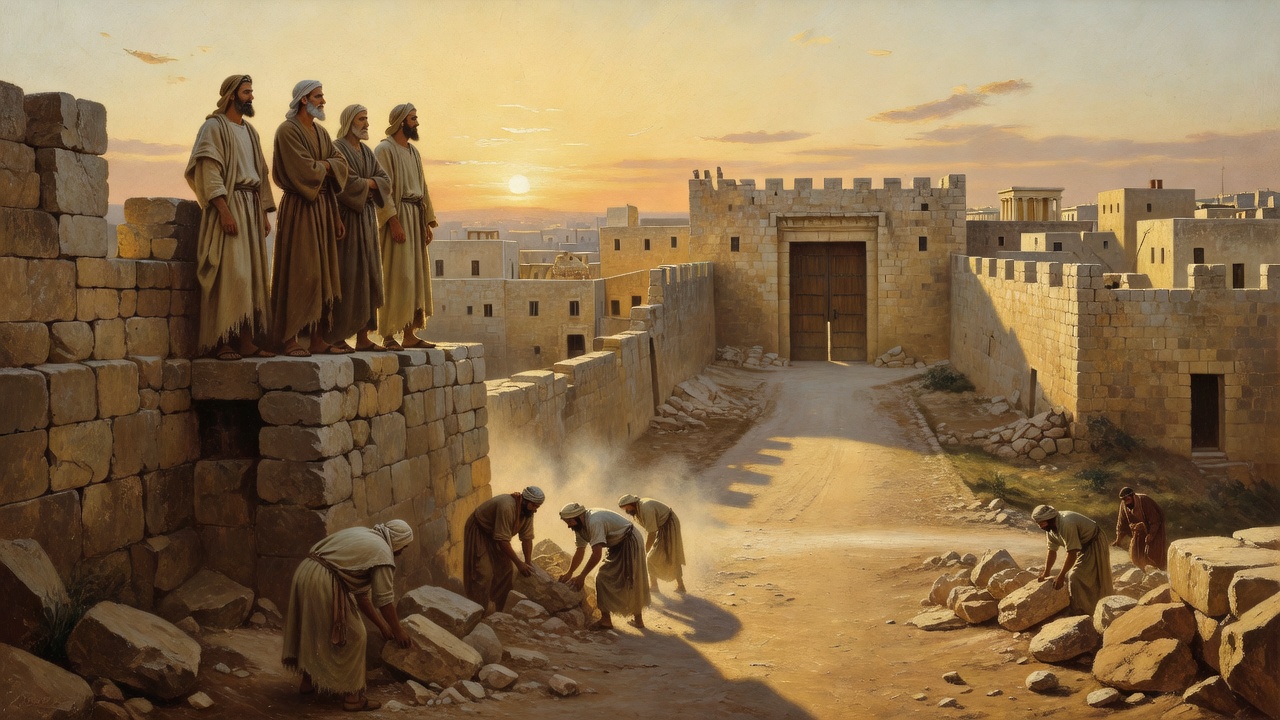
- El poema describe a guardias apostados continuamente sobre los muros de piedra de Jerusalén, vigilando día y noche. Su función trasciende la simple vigilancia militar, ya que se les encomienda clamar sin descanso para que el SEÑOR establezca a la ciudad montañosa y la convierta en motivo de alabanza en toda la tierra.Fuentes: el propio texto bíblico · Jerusalem
- La orden de pasar por las puertas, retirar las piedras y construir una calzada elevada utiliza la imagen antigua de preparar una vía procesional para dar la bienvenida al pueblo que regresa y proclamar la salvación ante las naciones.Fuentes: el propio texto bíblico
Notas escritas con ayuda de IA a partir de fuentes abiertas (Theographic Bible Metadata, CC BY-SA 4.0; Easton’s Bible Dictionary, dominio público) y revisadas antes de publicarse.
Lugares de este capítulo
- Jerusalem · 31.777, 35.234 · versículos 1, 5, 6, 7, 8, 12
- Zion · Hoy: Jerusalem · 31.777, 35.234 · versículos 1, 11
Solo aparecen lugares identificados con alta confianza (90 % o más según las fuentes académicas reunidas por OpenBible). Mapa de la época: DARE (Digital Atlas of the Roman Empire), CC BY 4.0; mapa actual: © colaboradores de OpenStreetMap; lugares: OpenBible.info (CC BY 4.0).
Créditos y licencia de esta traducción
Isaac Leeser Tanakh
The Isaac Leeser Tanakh (Jewish Bible)
Public Domain
Language: English
Dialect: archaic British
Translation by: Isaac Leeser
2020-10-14
Títulos de sección adaptados de la Berean Standard Bible (dominio público); no forman parte del texto bíblico de esta traducción.
Fuente: http://ebible.org/englee/ · eBible.org