Génesis 46
Isaac Leeser Tanakh · Toca un versículo para ver sus referencias cruzadas.
Jacob’s Journey to Egypt
1And Israel commenced his journey with all that he had, and came to Beer-sheba, and offered sacrifices unto the God of his father Isaac. 2And God spoke unto Israel in the visions of the night, and said, Jacob, Jacob. And he said, Here am I. 3And he said, I am God, the God of thy father; fear not to go down into Egypt; for a great nation will I make of thee there: 4I will go down with thee into Egypt; and I will also surely bring thee up again; and Joseph shall put his hand upon thy eyes. 5And Jacob rose up from Beer-sheba: and the sons of Israel carried Jacob their father, and their little ones, and their wives, in the wagons which Pharaoh had sent to carry him. 6And they took their cattle and their goods, which they had gotten in the land of Canaan, and came into Egypt; Jacob, and all his seed with him:
Those Who Went to Egypt
7His sons, and his son's sons with him, his daughters, and his sons' daughters, and all his seed he brought with him into Egypt.
The Children of Leah
8And these are the names of the children of Israel, that came into Egypt, Jacob and his sons: the first-born of Jacob, Reuben. 9And the sons of Reuben: Chanoch, and Pallu, and Chezron, and Carmi. 10And the sons of Simeon: Yemuel, and Yamin, and Ohad, and Yachin, and Zochar, and Shaul the son of the Canaanitish woman. 11And the sons of Levi: Gershon, Kehath, and Merari. 12And the sons of Judah: 'Er, and Onan, and Shelah, and Perez, and Zerach; but 'Er and Onan died in the land of Canaan, and the sons of Perez were Chezron and Chamul. 13And the sons of Issachar: Tola, and Puvah, and Yob, and Shimron. 14And the sons of Zebulun: Sered, and Elon, and Yachleel. 15These are the sons of Leah, whom she bore unto Jacob in Padan-aram, with Dinah his daughter: all the souls of his sons and his daughters were thirty and three.
The Children of Zilpah
16And the sons of Gad: Ziphyon, and Chaggi, Shuni, and Ezbon, 'Eri, and Arodi, and Areli. 17And the sons of Asher: Yimnah, and Yishvah, and Yishvi, and Beriah, and Serach their sister; and the sons of Beriah: Cheber, and Malkiel. 18These are the sons of Zilpah, whom Laban gave to Leah his daughter, and she bore these unto Jacob, sixteen souls.
The Children of Rachel
19The sons of Rachel, Jacob's wife: Joseph and Benjamin. 20And there were born unto Joseph in the land of Egypt Menasseh and Ephraim, whom Assenath the daughter of Poti-phera', the priest of On, bore unto him. 21And the sons of Benjamin: Bela', and Becher, and Ashbel, Gera, and Naaman, Echi, and Rosh, Muppim and Chuppim, and Ard. 22These are the sons of Rachel, that were born to Jacob: in all fourteen souls.
The Children of Bilhah
23And the son of Dan: Chushim. 24And the sons of Naphtali: Yachzeel, and Guni, and Yezer, and Shillem. 25These are the sons of Bilhah, whom Laban gave unto Rachel his daughter, and she bore these unto Jacob, in all seven souls. 26All the souls that came with Jacob into Egypt, that came out of his loins, besides the wives of Jacob's sons, were in all sixty and six souls. 27And the sons of Joseph, who were born him in Egypt, were two souls; all the souls of the house of Jacob, that came into Egypt, were seventy.
Jacob Arrives in Egypt
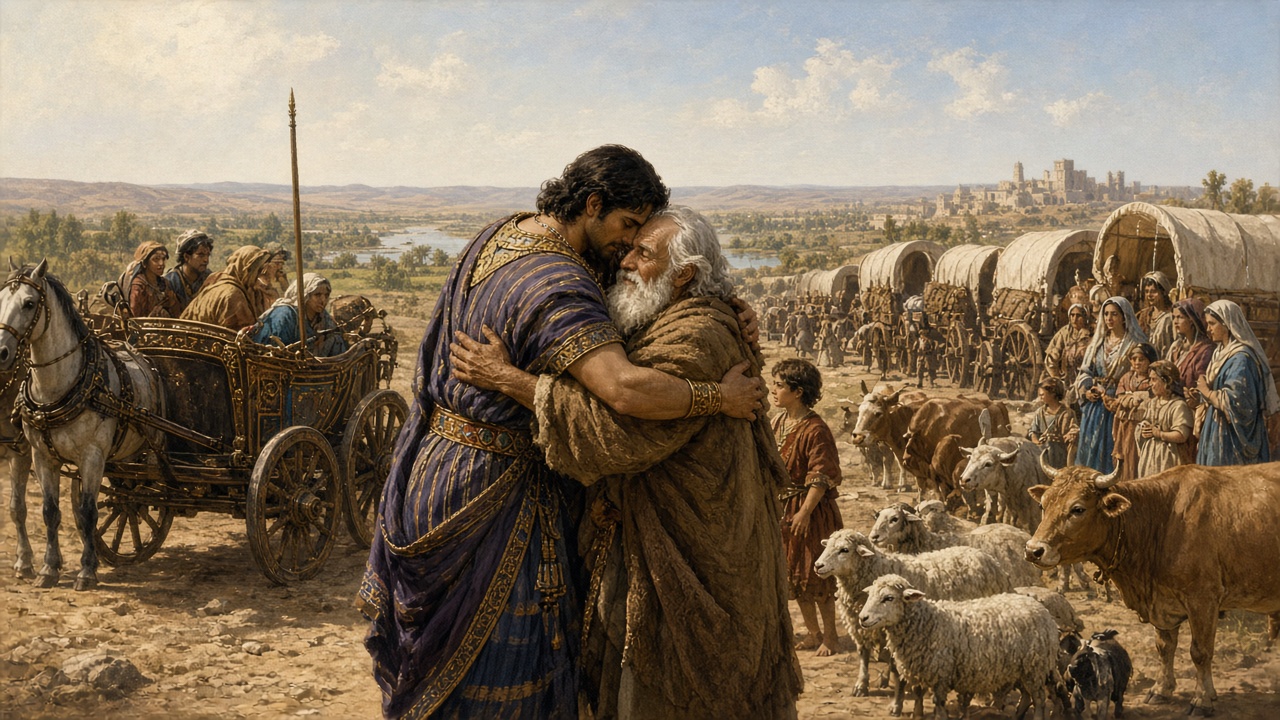
28And Judah he sent before him unto Joseph, to direct him beforehand unto Goshen; and they came into the land of Goshen. 29And Joseph made ready his chariot, and went up to meet Israel his father, to Goshen; and when he obtained sight of him, he fell on his neck, and wept on his neck a good while. 30And Israel said unto Joseph, Let me die now, since I have seen thy face, that thou art yet alive. 31And Joseph said unto his brothers, and unto his father's house, I will go up, and tell Pharaoh, and say unto him, My brothers and my father's house, who were in the land of Canaan, are come unto me; 32And the men are shepherds, for they have been owners of cattle; and their flocks, and their herds, and all that they have, they have brought along. 33And it shall come to pass, if Pharaoh should have you called, and say, What is your occupation? 34That ye shall say, Owners of cattle have thy servants been from our youth even until now, both we, as also our fathers; in order that ye may dwell in the land of Goshen; for every shepherd is an abomination unto the Egyptians.
¿Sabías que…?
Israel desciende a Egipto
- Cuando Israel partió hacia Egipto con todo lo que tenía, se detuvo en Beerseba y ofreció sacrificios al Dios de su padre Isaac. Beerseba, que significa pozo del juramento o pozo de los siete, fue un pozo que Abraham cavó y nombró tras un pacto con Abimelec; cuando Isaac lo reabrió, le dio el mismo nombre. Era un lugar favorito de residencia de ambos patriarcas, y allí, aquella noche, Dios habló a Jacob en una visión y le dijo que no temiera bajar a Egipto, porque allí lo haría una gran nación.Fuentes: el propio texto bíblico · Beersheba
- Jacob envió a Judá por delante hacia José para que le indicara el camino a Gosén, un distrito egipcio al este del Nilo, al parecer cerca de la residencia real, donde la familia permaneció hasta el Éxodo. El Easton's Bible Dictionary (1897) la llama lo mejor de la tierra, hoy un desierto, y también tierra de Ramesés. José dijo a sus hermanos que afirmaran haber criado ganado desde su juventud, para poder establecerse allí, porque los pastores eran detestables para los egipcios; ese diccionario sugiere que el faraón fue probablemente Apopi, el último rey de los hicsos, que acogió a estos pastores asiáticos, mientras los egipcios nativos los aborrecían, aunque algunos argumentan que José llegó más tarde, bajo Tutmosis III, después de la expulsión de los hicsos.Fuentes: el propio texto bíblico · Goshen · Pharaoh (of Joseph)
- El capítulo cuenta sesenta y seis descendientes directos de Jacob que llegaron a Egipto, sin incluir a las esposas de sus hijos, y setenta al incluir a los dos hijos de José ya nacidos en Egipto. Los hijos de Lea y su hija Dina aparecen en esa lista, aunque el Easton's Bible Dictionary (1897) dice que la propia Lea ya había muerto en Canaán antes del viaje y fue sepultada en la cueva de Macpela; Raquel había muerto antes, al dar a luz a Benjamín, y fue sepultada en el camino a Efrata, es decir, Belén. Manasés y Efraín nacieron a José en Egipto de Asenat, hija de Potifera, sacerdote de On, un centro del culto al sol que la Septuaginta y la Vulgata llaman Heliópolis.Fuentes: el propio texto bíblico · Leah · Rachel · On
Notas escritas con ayuda de IA a partir de fuentes abiertas (Theographic Bible Metadata, CC BY-SA 4.0; Easton’s Bible Dictionary, dominio público) y revisadas antes de publicarse.
Lugares de este capítulo
- Egypt · 30.129, 31.308 · versículos 1, 3, 4, 5, 6, 7, 8, 20, 26, 27
- Canaan · 32.767, 35.333 · versículos 6, 12, 31
- Heliopolis · Hoy: Ain Shams · 30.129, 31.308 · versículo 20
- Goshen · Hoy: Goshen 1 · 30.799, 31.834 · versículos 28, 29, 34
Solo aparecen lugares identificados con alta confianza (90 % o más según las fuentes académicas reunidas por OpenBible). Mapa de la época: DARE (Digital Atlas of the Roman Empire), CC BY 4.0; mapa actual: © colaboradores de OpenStreetMap; lugares: OpenBible.info (CC BY 4.0).
Créditos y licencia de esta traducción
Isaac Leeser Tanakh
The Isaac Leeser Tanakh (Jewish Bible)
Public Domain
Language: English
Dialect: archaic British
Translation by: Isaac Leeser
2020-10-14
Títulos de sección adaptados de la Berean Standard Bible (dominio público); no forman parte del texto bíblico de esta traducción.
Fuente: http://ebible.org/englee/ · eBible.org