Génesis 28
Isaac Leeser Tanakh · Toca un versículo para ver sus referencias cruzadas.
Jacob’s Departure
1And Isaac called Jacob, and blessed him, and charged him, and said unto him, Thou shalt not take a wife from the daughters of Canaan. 2Arise, go to Padan-aram, to the house of Bethuel thy mother's father; and take thyself from there a wife of the daughters of Laban thy mother's brother. 3And God, the Almighty, bless thee, and make thee fruitful, and multiply thee, that thou mayest become a multitude of people; 4And may he give thee the blessing of Abraham, to thee, and to thy seed with thee; that thou mayest inherit the land of thy sojourn, which God gave unto Abraham. 5And Isaac sent away Jacob, and he went to Padan-aram, unto Laban, the son of Bethuel the Syrian, the brother of Rebekah, the mother of Jacob and Esau.
Esau Marries Mahalath
6And when Esau saw that Isaac had blessed Jacob, and sent him away to Padan-aram, to take himself from there a wife; and in blessing him had given him a charge, saying, Thou shalt not take a wife of the daughters of Canaan; 7And that Jacob had obeyed his father and his mother, and was gone to Padan-aram: 8Then saw Esau that the daughters of Canaan were evil in the eyes of Isaac his father; 9And Esau went unto Ishmael, and took Machalath the daughter of Ishmael, Abraham's son, the sister of Nebayoth in addition to his wives, to himself as wife.
Jacob’s Ladder
10And Jacob went out from Beer-sheba, and went toward Charan. 11And he lighted upon a certain place, and tarried there all night, because the sun was set; and he took one of the stones of the place, and put it for his pillow, and laid himself down in that place. 12And he dreamed, and behold a ladder was set up on the earth, and the top of it reached to heaven; and behold, angels of God were ascending and descending on it. 13And, behold, the Lord stood above it, and said, I am the Lord, the God of Abraham thy father, and the God of Isaac: the land whereon thou liest, to thee will I give it, and to thy seed; 14And thy seed shall be as the dust of the earth, and thou shalt spread abroad to the west, and to the east, and to the north and to the south; and in thee and thy seed shall all the families of the earth be blessed. 15And, behold, I am with thee, and will keep thee whithersoever thou goest, and will bring thee again into this land; for I will not leave thee, until I have done what I have spoken to thee of. 16And Jacob awakened out of his sleep, and he said, Surely the Lord is present in this place; and I knew it not. 17And he was afraid, and said, How fearful is this place! this is none other but the house of God, and this is the gate of heaven.
The Stone of Bethel
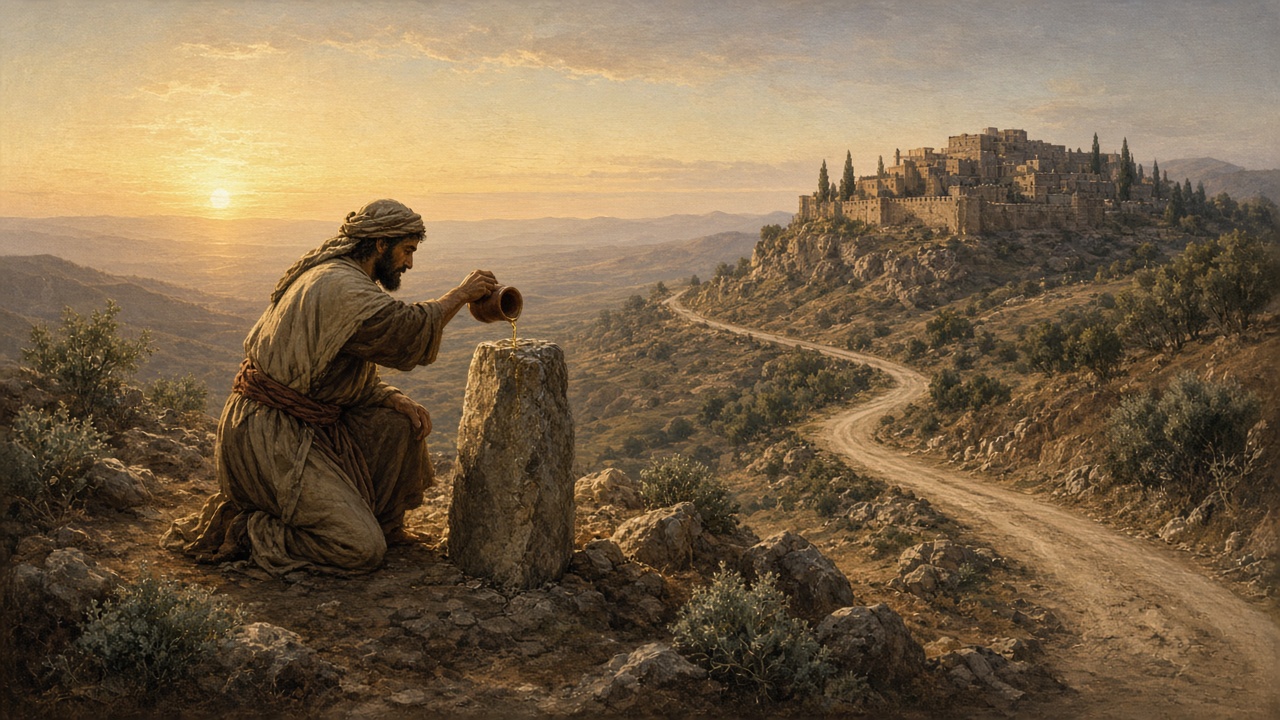
18And Jacob rose up early in the morning, and took the stone that he had put for his pillow, and set it up for a pillar, and poured oil upon the top of it. 19And he called the name of that place Beth-el; but Luz was the name of that city in former times. 20And Jacob made a vow, saying, If God will be with me, and will keep me on this way which I am going, and will give me bread to eat, and raiment to put on, 21And I come again in peace to my father's house: then shall the Lord be my God; 22And this stone, which I have set for a pillar, shall be God's house; and of all that thou wilt give me I will surely give the tenth unto thee.
¿Sabías que…?
El viaje de Jacob y el sueño en Betel
- Isaac envió a Jacob desde Beerseba a Padan-aram para que tomara esposa entre las hijas de Labán, hermano de su madre Rebeca, y no entre las mujeres cananeas. Padan-aram, llamada la llanura de Aram, se considera comúnmente el distrito mesopotámico alrededor de Harán, donde vivía Labán; Harán, también llamada la ciudad de Nacor, fue donde Abraham permaneció después de salir de Ur hasta que murió su padre Taré.Fuentes: el propio texto bíblico · Paddan-aram · Haran · Laban
- El lugar donde Jacob soñó, levantó como columna la piedra que había puesto bajo su cabeza y derramó aceite sobre ella era la ciudad real cananea de Luz; él la renombró Betel. El Easton's Bible Dictionary (1897) sitúa Betel en la Palestina central, a unas diez millas al norte de Jerusalén, y señala que el nombre se dio al principio, al parecer, a un santuario en las cercanías de Luz, y no se dio a la ciudad misma hasta después de que la tribu de Efraín la conquistara.Fuentes: el propio texto bíblico · Luz · Bethel (of Palestine)
- Cuando Esaú supo que Isaac había bendecido a Jacob y le había ordenado no casarse con una mujer cananea, fue a Ismael y se casó con Mahalat, hermana de Nebaiot e hija de Ismael, hijo de Abraham, además de las esposas que ya tenía. El Easton's Bible Dictionary (1897) también la llama Basemat y señala que las tres esposas de Esaú reciben nombres distintos en la genealogía edomita de Génesis 36 de los que se dan en el relato de Génesis 26 y 28.Fuentes: el propio texto bíblico · Bashemath
Notas escritas con ayuda de IA a partir de fuentes abiertas (Theographic Bible Metadata, CC BY-SA 4.0; Easton’s Bible Dictionary, dominio público) y revisadas antes de publicarse.
Lugares de este capítulo
- Canaan · 32.767, 35.333 · versículos 1, 6, 8
- Haran · Hoy: Harran · 36.864, 39.033 · versículo 10
- Luz · Hoy: Beitin · 31.923, 35.241 · versículo 19
Solo aparecen lugares identificados con alta confianza (90 % o más según las fuentes académicas reunidas por OpenBible). Mapa de la época: DARE (Digital Atlas of the Roman Empire), CC BY 4.0; mapa actual: © colaboradores de OpenStreetMap; lugares: OpenBible.info (CC BY 4.0).
Créditos y licencia de esta traducción
Isaac Leeser Tanakh
The Isaac Leeser Tanakh (Jewish Bible)
Public Domain
Language: English
Dialect: archaic British
Translation by: Isaac Leeser
2020-10-14
Títulos de sección adaptados de la Berean Standard Bible (dominio público); no forman parte del texto bíblico de esta traducción.
Fuente: http://ebible.org/englee/ · eBible.org