Génesis 11
Isaac Leeser Tanakh · Toca un versículo para ver sus referencias cruzadas.
The Tower of Babel
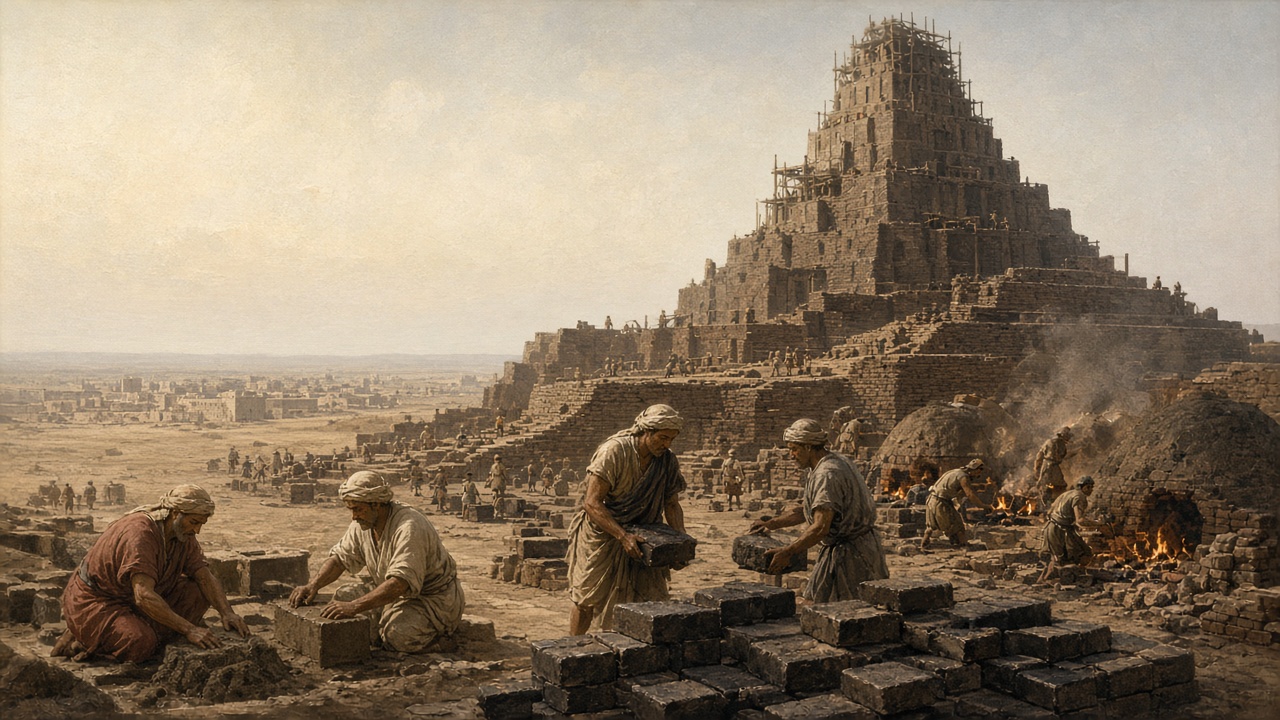
1And the whole earth was of one language, and of one kind of words. 2And it came to pass, as they journeyed toward the east, that they found a plain in the land of Shinar, and they dwelt there. 3And they said to one another, Go to, let us make bricks, and burn them thoroughly. And thus the brick served them for stone, and slime served them for mortar. 4And they said, Go to, let us build ourselves a city, and a tower, the top of which may reach unto heaven; and let us make ourselves a name, lest we be scattered abroad upon the face of the whole earth. 5And the Lord came down to see the city and the tower, which the children of man were building. 6And the Lord said, Behold, it is one people, and they have all one language, and this is the first thing they undertake to do; and now shall they not be restrained in all which they have imagined to do? 7Go to, let us go down, and confound there their language, that they may not understand one another's speech. 8So the Lord scattered them abroad from there over the face of all the earth; and they left off to build the city. 9Therefore is the name of it called Babel, because the Lord did there confound the language of all the earth; and from there did the Lord scatter them abroad over the face of all the earth.
Genealogy from Shem to Abram
10These are the generations of Shem: Shem, when a hundred years old, begat Arpachshad, two years after the flood. 11And Shem lived after he had begotten Arpachshad five hundred years; and begat sons and daughters. 12And Arpachshad lived five and thirty years, and begat Shelach. 13And Arpachshad lived after he had begotten Shelach four hundred and three years; and begat sons and daughters. 14And Shelach lived thirty years, and begat Eber. 15And Shelach lived after he had begotten Eber four hundred and three years; and begat sons and daughters. 16And Eber lived four and thirty years, and begat Peleg. 17And Eber lived after he had begotten Peleg four hundred and thirty years; and begat sons and daughters. 18And Peleg lived thirty years, and begat Reu. 19And Peleg lived after he had begotten Reu two hundred and nine years; and begat sons and daughters. 20And Reu lived two and thirty years, and begat Serug. 21And Reu lived after he had begotten Serug two hundred and seven years; and begat sons and daughters. 22And Serug lived thirty years, and begat Nachor. 23And Serug lived after he had begotten Nachor two hundred years; and begat sons and daughters. 24And Nachor lived nine and twenty years, and begat Terach. 25And Nachor lived after he had begotten Terach a hundred and nineteen years; and begat sons and daughters. 26And Terach lived seventy years, and begat Abram, Nachor, and Haran.
Terah’s Descendants
27Now these are the generations of Terach: Terach begat Abram, Nachor, and Haran; and Haran begat Lot. 28And Haran died before his father Terach in the land of his nativity, in Ur of the Chaldees. 29And Abram and Nachor took themselves wives; the name of Abram's wife was Sarai; and the name of Nachor's wife was Milcah, the daughter of Haran, the father of Milcah, and the father of Yiscah. 30But Sarai was barren; she had no child. 31And Terach took Abram his son, and Lot, the son of Haran, his son's son, and Sarai his daughter-in-law, the wife of his son Abram; and they went forth with them from Ur of the Chaldees, to go into the land of Canaan; and they came unto Charan, and dwelt there. 32And the days of Terach were two hundred and five years; and Terach died in Charan.
¿Sabías que…?
Babel y el camino desde Ur
- En este capítulo, unos viajeros se establecen en una llanura de Sinar y construyen con ladrillo cocido y asfalto, en lugar de piedra y mezcla. Un diccionario considera Sinar, probablemente, como Babilonia o el sur de Mesopotamia, que se extiende casi hasta el golfo Pérsico, dice que allí se construyó la torre de Babel y describe a los primeros habitantes de la tierra como gente que hacía ladrillos y edificaba ciudades.Fuentes: el propio texto bíblico · Shinar
- La ciudad inconclusa recibe el nombre de Babel porque, según el relato, allí el Señor confundió la lengua de todo el mundo y dispersó a la gente. Un diccionario explica el nombre como 'confusión' y sugiere que la torre se pensó, probablemente, como un punto de reunión en la extensa llanura de Sinar, tras una migración desde las tierras altas de Armenia, para que los constructores no se dispersaran.Fuentes: el propio texto bíblico · Babel
- El capítulo termina con Taré saliendo de Ur de los caldeos hacia Canaán, con Abram, Sarai y su nieto Lot, y estableciéndose luego en Harán, donde muere a los 205 años; su hijo Harán ya había muerto en Ur. Un diccionario llama a Ur lugar de nacimiento de ese hijo, la ciudad más grande de Sinar o de la Caldea del norte, y un centro de comercio y poder político, y sitúa Harán, hoy Harran y llamada Charrán en el Antiguo Testamento griego y en Hechos, junto al Belik, afluente del Éufrates en la Alta Mesopotamia, donde Abram permaneció hasta la muerte de Taré.Fuentes: el propio texto bíblico · Terah · Ur of the Chaldees · Haran
Notas escritas con ayuda de IA a partir de fuentes abiertas (Theographic Bible Metadata, CC BY-SA 4.0; Easton’s Bible Dictionary, dominio público) y revisadas antes de publicarse.
Lugares de este capítulo
- Shinar · Hoy: Babylonia · 32.543, 44.422 · versículo 2
- Chaldea · 30.962, 46.104 · versículos 28, 31
- Canaan · 32.767, 35.333 · versículo 31
- Haran · Hoy: Harran · 36.864, 39.033 · versículos 31, 32
Solo aparecen lugares identificados con alta confianza (90 % o más según las fuentes académicas reunidas por OpenBible). Mapa de la época: DARE (Digital Atlas of the Roman Empire), CC BY 4.0; mapa actual: © colaboradores de OpenStreetMap; lugares: OpenBible.info (CC BY 4.0).
Créditos y licencia de esta traducción
Isaac Leeser Tanakh
The Isaac Leeser Tanakh (Jewish Bible)
Public Domain
Language: English
Dialect: archaic British
Translation by: Isaac Leeser
2020-10-14
Títulos de sección adaptados de la Berean Standard Bible (dominio público); no forman parte del texto bíblico de esta traducción.
Fuente: http://ebible.org/englee/ · eBible.org